April 11

What was advertised in a colonial American newspaper 250 years ago today?

South-Carolina Gazette and Country Journal (April 11, 1775).

“The Sign of the NEGRO BOY.”

The April 11, 1775, edition of the South-Carolina Gazette and Country Journal carried seventeen advertisements about enslaved people.  Several offered enslaved people for sale.  Jacob Valk, a broker who regularly advertised, noted that “NEGROES of different Qualifications” were “daily for SALE” at his office.  Valentine Lynn sought to sell “Seven healthy, stout NEGROES,” including “a good boatman,” a “handy” domestic servant, and five “field slaves.”  Robert Goudey announced that he “will dispose of, by private contract,” nearly three dozen enslaved people, “among whom are carpenters, coopers, wagon drivers, plough men, and house” maids.  Prospective purchasers could presumably examine those enslaved people, just as they could examine any of the eleven Black men and women “Brought to the Workhouse” and imprisoned there until their enslavers claimed them.

Other advertisements certainly enlisted readers in examining Black bodies closely to determine if they matched the descriptions of enslaved people who liberated themselves by running away from their enslavers.  William Stitt, for instance, asked readers to take note of any Black women they encountered who might be Lydia, “about 40 years of age, of a yellowish complexion.”  William Roberts described Tena, who “had on when she went away, a blue negro cloth gown, and osnaburgs apron.”

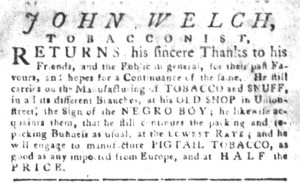
Yet these were not the only instances of Black bodies on display in Charleston.  In a notice asking others to settle accounts before he left the city for a while, John Welch, a tobacconist, advised his “Friends and Customers” that associates would conduct business “as usual” at his “SHOP in Union-street, the Sign of the NEGRO BOY.”  He may have chosen that emblem to represent the laborers who cultivated the tobacco he sold.  By the time Welch ran his advertisement in the spring of 1775 the sign that marked his shop was a familiar sight to those who traversed the streets of Charleston.  He referenced it in an advertisement the previous summer, so it had been in place for the better part of a year and probably longer, especially considering that he also referred to that location as his “old SHOP.”  Welch’s commercial enterprise appropriated the labor the enslaved men and women who raised the tobacco he sold, but that was not the extent of his use of Black bodies in earning his livelihood.  He also deployed an image of a Black boy as the emblem of his business and the device that confirmed customers arrived at the right location to purchase tobacco and snuff.
July 12

What was advertised in a colonial American newspaper 250 years ago today?

South-Carolina Gazette and Country Journal (July 13, 1774).

“The Sign of the NEGRO BOY.”

When John Welch, a tobacconist, advertised in the July 12, 1774, edition of the South-Carolina Gazette and Country Journal, he invited “his Friends, and the Public in general” to “his OLD SHOP in Union-street, the Sign of the NEGRO BOY.”  That emblem linked the commodity that Welch’s customers consumed to the enslaved men, women, and children who played such a significant role in producing it.  While Welch emphasized his role in the final stage of “the Manufacturing of TOBACCO and SNUFF, in all its different Branches” to make those items available on the market, the “Sign of the NEGRO BOY” merely hinted at the enslaved labor that raised tobacco on plantations.

South-Carolina Gazette and Country Journal (July 12, 1774).

Welch’s sign was one more instance of putting Black bodies on display in the colonies during the era of the American Revolution.  At auctions and as they went about their daily lives, the bodies of enslaved people were scrutinized by colonizers.  Advertisements that provided descriptions of enslaved people who liberated themselves by running away from their enslavers and offered rewards for their capture and return encouraged even more careful observation of Black bodies.  Other advertisements announcing enslaved people for sale incorporated images of Black bodies.  Those woodcuts, stock images supplied by printers, were nondescript and interchangeable, further dehumanizing the people they represented in a system that treated them as commodities.  An image of a Black man accompanied an advertisement about “A CARGO OF ONE HUNDRED & TWENTY PRIME NEGROES … directly from SIERRA-LEON, a Rice Country, on the Windward Coast of AFRICA” in the same column as Welch’s advertisement.

Variations of the “Sign of the NEGRO BOY” marked the locations of shops in other towns.  In March 1766, August Deley advertised tobacco “At the Sign of the Black Boy … in Hartford” in the Connecticut Courant.  Jonathan Russell peddled a “NEW and FRESH Assortment of English and India GOODS … at the Sign of the BLACK-BOY” in Providence in May 1767.  In December 1768, he gave a different description, “the Sign of the Black Boy and Butt.”  Perhaps he had a new sign that incorporated a large barrel along with the boy, though he may have added a detail that he did not mention in his previous advertisement.  Several months later, Samuel Young promoted an “Assortment of European, East and West-India GOODS” in stock at his store at “the Sign of the Black Boy” in Providence.  Four years after that, he continued business “At the Sign of the Black Boy” in May 1773.  Jonathan Williams gave his location as “the Black Boy and Butt in Cornhill” in the Massachusetts Gazette and Boston Weekly News-Letter in September 1770 and in the Boston Evening-Post in April 1771.  Advertisers in northern colonies as well as southern ones deployed images of Black bodies in marking their locations.

Colonizers appropriated the labor of enslaved men, women, and children in producing commodities for market throughout the Atlantic world and beyond, but that was not the extent of the appropriation that took place.  They also appropriated images of Black bodies to market goods, to sell Black people they treated as commodities, and to encourage surveillance of Black people to determine whether they were fugitives for freedom who liberated themselves from their enslavers.