April 11

What was advertised in a colonial American newspaper 250 years ago today?

South-Carolina Gazette and Country Journal (April 11, 1775).

“The Sign of the NEGRO BOY.”

The April 11, 1775, edition of the South-Carolina Gazette and Country Journal carried seventeen advertisements about enslaved people.  Several offered enslaved people for sale.  Jacob Valk, a broker who regularly advertised, noted that “NEGROES of different Qualifications” were “daily for SALE” at his office.  Valentine Lynn sought to sell “Seven healthy, stout NEGROES,” including “a good boatman,” a “handy” domestic servant, and five “field slaves.”  Robert Goudey announced that he “will dispose of, by private contract,” nearly three dozen enslaved people, “among whom are carpenters, coopers, wagon drivers, plough men, and house” maids.  Prospective purchasers could presumably examine those enslaved people, just as they could examine any of the eleven Black men and women “Brought to the Workhouse” and imprisoned there until their enslavers claimed them.

Other advertisements certainly enlisted readers in examining Black bodies closely to determine if they matched the descriptions of enslaved people who liberated themselves by running away from their enslavers.  William Stitt, for instance, asked readers to take note of any Black women they encountered who might be Lydia, “about 40 years of age, of a yellowish complexion.”  William Roberts described Tena, who “had on when she went away, a blue negro cloth gown, and osnaburgs apron.”

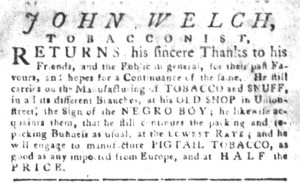
Yet these were not the only instances of Black bodies on display in Charleston.  In a notice asking others to settle accounts before he left the city for a while, John Welch, a tobacconist, advised his “Friends and Customers” that associates would conduct business “as usual” at his “SHOP in Union-street, the Sign of the NEGRO BOY.”  He may have chosen that emblem to represent the laborers who cultivated the tobacco he sold.  By the time Welch ran his advertisement in the spring of 1775 the sign that marked his shop was a familiar sight to those who traversed the streets of Charleston.  He referenced it in an advertisement the previous summer, so it had been in place for the better part of a year and probably longer, especially considering that he also referred to that location as his “old SHOP.”  Welch’s commercial enterprise appropriated the labor the enslaved men and women who raised the tobacco he sold, but that was not the extent of his use of Black bodies in earning his livelihood.  He also deployed an image of a Black boy as the emblem of his business and the device that confirmed customers arrived at the right location to purchase tobacco and snuff.
July 12

What was advertised in a colonial American newspaper 250 years ago today?

South-Carolina Gazette and Country Journal (July 13, 1774).

“The Sign of the NEGRO BOY.”

When John Welch, a tobacconist, advertised in the July 12, 1774, edition of the South-Carolina Gazette and Country Journal, he invited “his Friends, and the Public in general” to “his OLD SHOP in Union-street, the Sign of the NEGRO BOY.”  That emblem linked the commodity that Welch’s customers consumed to the enslaved men, women, and children who played such a significant role in producing it.  While Welch emphasized his role in the final stage of “the Manufacturing of TOBACCO and SNUFF, in all its different Branches” to make those items available on the market, the “Sign of the NEGRO BOY” merely hinted at the enslaved labor that raised tobacco on plantations.

South-Carolina Gazette and Country Journal (July 12, 1774).

Welch’s sign was one more instance of putting Black bodies on display in the colonies during the era of the American Revolution.  At auctions and as they went about their daily lives, the bodies of enslaved people were scrutinized by colonizers.  Advertisements that provided descriptions of enslaved people who liberated themselves by running away from their enslavers and offered rewards for their capture and return encouraged even more careful observation of Black bodies.  Other advertisements announcing enslaved people for sale incorporated images of Black bodies.  Those woodcuts, stock images supplied by printers, were nondescript and interchangeable, further dehumanizing the people they represented in a system that treated them as commodities.  An image of a Black man accompanied an advertisement about “A CARGO OF ONE HUNDRED & TWENTY PRIME NEGROES … directly from SIERRA-LEON, a Rice Country, on the Windward Coast of AFRICA” in the same column as Welch’s advertisement.

Variations of the “Sign of the NEGRO BOY” marked the locations of shops in other towns.  In March 1766, August Deley advertised tobacco “At the Sign of the Black Boy … in Hartford” in the Connecticut Courant.  Jonathan Russell peddled a “NEW and FRESH Assortment of English and India GOODS … at the Sign of the BLACK-BOY” in Providence in May 1767.  In December 1768, he gave a different description, “the Sign of the Black Boy and Butt.”  Perhaps he had a new sign that incorporated a large barrel along with the boy, though he may have added a detail that he did not mention in his previous advertisement.  Several months later, Samuel Young promoted an “Assortment of European, East and West-India GOODS” in stock at his store at “the Sign of the Black Boy” in Providence.  Four years after that, he continued business “At the Sign of the Black Boy” in May 1773.  Jonathan Williams gave his location as “the Black Boy and Butt in Cornhill” in the Massachusetts Gazette and Boston Weekly News-Letter in September 1770 and in the Boston Evening-Post in April 1771.  Advertisers in northern colonies as well as southern ones deployed images of Black bodies in marking their locations.

Colonizers appropriated the labor of enslaved men, women, and children in producing commodities for market throughout the Atlantic world and beyond, but that was not the extent of the appropriation that took place.  They also appropriated images of Black bodies to market goods, to sell Black people they treated as commodities, and to encourage surveillance of Black people to determine whether they were fugitives for freedom who liberated themselves from their enslavers.

April 1

What was advertised in a colonial American newspaper 250 years ago today?

Boston Evening-Post (April 1, 1771).

“At the Black Boy and Butt.”

Two advertisements in the April 1, 1771, edition of the Boston Evening-Post featured Black bodies on display, either as part of a device that marked the location of a shop or in the description of an enslaved man who liberated himself by fleeing from his enslaver.  In each instance, an advertiser laid claim to a Black body for his own purposes and benefit.

Jonathan Williams sold “Good Madeira,” other imported wines, and cider at his shop “in Cornhill.”  To help customers identify his business, Williams marked the location with a sign, “the Black Boy and Butt,” that depicted a Black child and a large cask.  Like other purveyors of goods and services who included shop signs in their advertisements, Williams presented an image intended to represent his business, a precursor to the modern logo.  In this instance, that image commodified not only wine through the depiction of the cask but also Black men, women, and children through the depiction of the “Black Boy.”  Both wine and enslaved Black people arrived in Boston and elsewhere in the colonies via networks of trade that crisscrossed the Atlantic.  Colonial consumers very well knew that commerce depended in large part on enslaved labor and the transatlantic slave trade.  In placing a Black boy and a cask on display, Williams’s shop sign encapsulated that relationship.

Massachusetts Gazette and Boston Post-Boy (April 1, 1771).

Elsewhere among the advertisements in that issue, Hugh McLean of Milton provided a description of “a Negro Man, named Peleg Abby” and offered a reward to “Whoever will apprehend said Runaway.”  According to McLean, Abby was “about 26 Years of Age” and “about Five Feet Six Inches high.”  To help readers recognize the fugitive who sought his freedom so they could return him to bondage, McLean also documented the clothes Abby wore when he departed and other clothes he took with him.  McLean placed the same advertisement in the Massachusetts Gazette and Boston Post-Boy, but that version also included a generic woodcut of a Black man on the run.  The image helped draw attention to that advertisement at the same time that McLean asked readers to take careful note of the age, height, and clothing of all Black men they encountered in order to discern if any of them might be the enslaved man he sought to recover.

Black people were a common sight in Boston and its hinterlands in the colonial period on the eve of the American Revolution.  Descriptions of Black bodies, sometimes accompanied by nondescript woodcuts, were also subjects of interest in the public prints, frequently appearing in newspaper advertisements published in the bustling port city.  Their presence testified to the extent that both culture and commerce, even in New England, were enmeshed the transatlantic slave trade and the perpetuation of slavery in the colonies.

December 29

What was advertised in a colonial American newspaper 250 years ago today?

Dec 29 - 12:29:1769 New-London Gazette
New-London Gazette (December 29, 1769).

“A negro Man named TOM … has a scar on one of his wrists.”


The final issue of the New-London Gazette published in 1769 included several advertisements that encouraged surveillance of Black men, women, and children. The last column consisted almost entirely of advertisements concerning enslaved people who escaped from those who held them in bondage. Those enslaved people seized their own liberty at the same time that colonists complained about their supposed enslavement to Britain as a result of various measures enacted by Parliament, including duties levied on certain imported goods by the Townshend Acts.

The advertisements in the New-London Gazette encouraged readers to begin the new year by carefully observing Black people they encountered, assessing whether they matched the descriptions published in the newspaper. Each offered a reward as an incentive for participating in an eighteenth-century version of racial profiling, but only if that participation resulted in the capture and recovery of enslaved people who “Ran-away from their Master.”

Theophilus Hopkins advised colonists that Joseph Cuffe “speaks good English [and] very well understands playing on a violin.” Two other characteristics may have made him even easier to identify: he “has lost both his great toes” and he “went off in company with a small indian squaw.” Hopkins reported that Cuffe had been spotted with the Indian woman in the eastern part of Connecticut in the time since making his escape. In so doing, he encouraged colonists not only to observe individual Black people but also to take note of the company they kept.

Samuel Chapman similarly emphasized looking for specific configurations of people, in this instance a family that consisted of Newport, “a Negro Man Servant … of a light swarthy Complexion,” his wife, Sarah, and six children ranging in age from two to fifteen. The three eldest were boys – Rufus, Israel, and Gershon – followed by two girls – Rhena and Chloe – and then another boy – Amos. Like Cuffe, Newport could also be recognized by a unique physical attribute: he “has lost the Top of one or two of his Fingers on one Hand, by the firing of a Pistol.” Observers may have detected that more readily than Cuffe’s missing toes, but in each instance they were encouraged to engage in careful scrutiny of Black bodies.

Isaac Tanner of South Kingston, Rhode Island, was so eager to recapture “a negro Man named TOM” that he offered “SIX DOLLARS reward” in an advertisement in the New-London Gazette, apparently suspecting that Tom made his way to Connecticut. Tanner noted that the fugitive “often calls himself TOM CARD,” suggesting that he asserted agency in shaping his identity before making his escape. Tanner described the clothes that Card wore when he departed, but also stated that he “has a scar on one of his wrists.” Once again, an advertiser invited readers of the New-London Gazette to carefully examine Black bodies to identify or eliminate the Black people they encountered as suspected runaways.

This concentration of advertisements about enslaved men, women, and children who escaped on the final page of the New-London Gazette testifies to the widespread surveillance of Black bodies in the colonies on the eve of the American Revolution. This was not a feature of southern colonies alone. Instead, from Georgia to New England, enslavers mobilized the press for purposes of surveillance of Black people in service of recapturing those who escaped.

May 9

What was advertised in a colonial American newspaper 250 years ago today?

May 9 - 5:9:1767 Providence Gazette
Providence Gazette (May 9, 1767).

“Assortment of English and India GOODS, at his Shop at the Sign of the BLACK-BOY.”

Jonathan Russell ran a shop “at the Sign of the BLACK-BOY; on the West Side of the Great-Bridge, in PROVIDENCE.” As I compiled today’s entries for the Slavery Adverts 250 Project I debated whether Russell’s advertisement should be included. Two other notices in the same issue of the Providence Gazette explicitly sold slaves, “A Negro Woman, who understands all sorts of houshold Work” and “A Likely, healthy Negro Boy … fit for either Town of Country,” but Russell’s advertisement did not promote the sale of slaves.

The Slavery Adverts 250 Project casts a wide net when it comes to including notices that mention slaves. Most of the advertisements fall into three main categories: slaves for sale, runaway slaves, and captured slaves. Enslaved men, women, and children, however sometimes found themselves the subjects of other sorts of advertising. Rather than sell slaves, some masters preferred to hire them out. Others mentioned the role slaves played in commercial ventures, such as Lewis Johnson’s help wanted notice seeking “AN OVERSEER who understands the BUSINESS of STAVEMAKING, to take charge of a few negroes employed in that way” in the Georgia Gazette (May 6, 1767). Some provided evidence of the presence of enslaved people in everyday life in the colonies, such as Robert Murray’s notice in the South-Carolina and American General Gazette (May 8, 1767) offering to return a “PLAIN gold RING” upon the owner “paying for this advertisement, and giving something to the negro who found it.”

Russell’s advertisement for “his Shop at the Sign of the BLACK-BOY,” however, does not refer to an actual person or to any humans treated as commodities that he attempted to sell. Yet “the Sign of the BLACK-BOY” drew meaning from the context of transatlantic commerce that included the slave trade and the production of “indigo, rum, melasses, sugar, rice,” and other goods produced by enslaved men, women, and children and transported to Russell’s and other shops throughout the Atlantic world. Slaves lived and toiled in Providence. Many merchants from the city and other ports in Rhode Island made their livings, at least in part, by participating in the slave trade. In his own fashion, Jonathan Russell also exploited black bodies for his own benefit when he adopted “the sign of the BLACK-BOY” as the device to mark his location and identify his commercial enterprises. Accordingly, I have included his advertisement in the Slavery Adverts 250 Project.

March 4

GUEST CURATOR: Samuel Birney

Who was the subject of an advertisement in a colonial American newspaper 250 years ago today?

mar-4-341767-georgia-gazette
Georgia Gazette (March 4, 1767).

“Five Pounds Sterling Reward. RUN AWAY … NEGROE MAN, named DAVID.”

This advertisement for a runaway slave named David provides a brief description of his appearance, including special features like the holes in his ears and the blanket, hat, and pair of “cheque trowsers, and an old cheque shirt” he took when he escaped. Slaves’ appearance was crucial to advertisements seeking their capture because clothing was one of the most important means of identifying people in the colonial and Revolutionary periods. Runaway slaves attempted to disguise themselves through altering or changing their clothes when possible.

Charmaine A. Nelson recently discussed the use of clothing in runaway slave advertisements. The amount of control slaves had over their appearance varied, and while David may not have had much choice in the clothes he possessed he still could have attempted to change his appearance after escaping his master. Nelson draws attention to David Waldstreicher’s arguments regarding the importance of describing slaves’ appearance and clothing in runaway advertisements, along with “trades or skills, linguistic ability or usage, and ethnic or racial identity.” Nelson also focuses on the case of a runaway woman named Cash, whose description included clothes she owned and that she presumably produced.

It’s depressing to realize that at a time when ideas of liberty and democracy were taking root in the American consciousness, people were also callously trampling on other humans’ attempts to gain freedom and prosperity.

For more information see “Cash’s Bundle: Fugitive Slave Advertisements, Clothing, and Self-Care” at The Junto.

**********

ADDITIONAL COMMENTARY: Carl Robert Keyes

Thomas Lee’s notice offering a reward for David included all four of the most common types of descriptions in runaway advertisements identified by David Waldstreicher.[1] Sam has already investigated the clothing David took with him. Lee also implicitly remarked on David’s trade or skills when he mentioned that the enslaved man fled “from the subscriber’s brick-yard.” He explicitly incorporated linguistic ability (“can speak no English”) and ethnic identity (“of the Gambia country”). This notice was one of nineteen runaway advertisements printed in newspapers throughout the colonies during the week of February 26 through March 4, 1767. Most deployed some or all of these common means of describing runaways.

From the clothes that David wore to his height to the “large hole in each year,” Lee provided means for identifying the fugitive slave according to his physical features, but doing so required surveillance by readers of the Georgia Gazette. In order for runaway advertisements to be effective, colonists needed to scrutinize black bodies – carefully, actively, and constantly. Using text rather than images, runaway advertisements put the bodies of Africans and African Americans on display in the pages of newspapers, but this effect was not limited to print. Such advertisements demanded that readers take special notice of any and all black people they encountered, especially any not previously familiar to them. Such advertisements required close inspection of black bodies as readers compared published descriptions to the flesh-and-blood people who stood before them. As a result, runaway advertisements targeted specific individuals, but they potentially affected all black people subject to being sized up by readers on the lookout for fugitives.

Readers of the Georgia Gazette grappled with only one runaway advertisement in the March 4, 1767, issue. However, other runaway advertisements had appeared recently in previous issues, including one for Maria that ran for six months. Such descriptions would have become very familiar to readers who encountered them week after week. Often multiple runaway advertisements appeared in any given issue of the Georgia Gazette. As a result, readers could mentally conjure up an assortment of mental images of various runaways whenever they encountered unfamiliar Africans and African Americans. Print furthered the display and examination of black bodies in colonial and Revolutionary America.

**********

[1] David Waldstreicher, “Reading the Runaways: Self-Fashioning, Print Culture, and Confidence in Slavery in the Eighteenth-Century Mid-Atlantic,” William and Mary Quarterly 56, no. 2 (April 1999): 248.

December 12

Who was the subject of an advertisement in a colonial American newspaper 250 years ago today?

dec-12-12121766-south-carolina-and-american-general-gazette
South-Carolina and American General Gazette (December 12, 1766).

“RAN AWAY … NERO … many scars about his head.”

Woodcuts frequently accompanied advertisements offering slaves for sale or warning about runaway slaves. As a result, images of Africans and African Americans appeared in newspapers regularly, in contrast to white colonists who were rarely illustrated with visual images. These woodcuts did not depict particular enslaved men, women, or children. Instead, they were stock devices used interchangeably, erasing the individuality of any of the slaves they purported to represent. Significantly, images of black bodies appeared in eighteenth-century newspapers at all because Africans and African Americans were marketed as commodities, just as the multitude of woodcuts depicting ships represented imported goods.

Last week I discovered that I have access to digitized copies of the South-Carolina and American General Gazette, a newspaper not previously incorporated into the Adverts 250 Project. As a result, today I chose to feature an advertisement from that newspaper rather than one either of the other two published 250 years ago today. Both the New-London Gazette and, especially, the New-Hampshire Gazette have contributed a good number of advertisements to this project over the past year. Featuring an advertisement from the South-Carolina and American General Gazette not only increases the number of newspaper included in this project, it also further augments the geographic scope of the project, bringing the number of newspapers printed in Charleston, South Carolina, in 1766 that have since been digitized to three. This rivals Boston with four, New York with three, and Philadelphia with two.

As I perused the December 12, 1766, edition of the South-Carolina and American General Gazette to make my selection for today, I was drawn to this runaway slave advertisement because of the woodcut. This is not the first time that I have examined a woodcut depicting a slave, but this one had an interesting aspect that was not part of similar woodcuts in other newspapers. The torso of the escaped slave was emblazoned with a capital “R,” presumably for “runaway.” The imaginary slave’s body was marked, almost as if it had been branded, while the actual slave – Nero, a sawyer and woodcutter – was also marked with “many scars about his head.” Advertisements for runaway slaves usually included some sort of physical description that allowed readers to scrutinize the black bodies they encountered beyond the pages of the newspaper. Those descriptions often included marks that had been inflicted upon them by masters and overseers. Nero’s scars may have derived from African cultural traditions or they may have been the result of his labors as a sawyer and woodcutter, but it was just as likely that they were indications of punishment and mistreatment. The real Nero was not marked with a capital “R,” but his body may have born other evidence of his enslavement.

April 26

Who was the subject of an advertisement in a colonial newspaper 250 years ago this week?

Apr 26 - 4:25:1766 New-Hampshire Gazette
New-Hampshire Gazette (April 25, 1766).

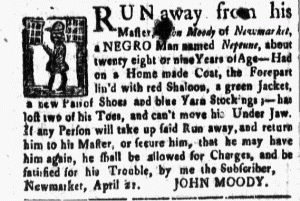
“RUN away from his Master … a NEGRO Man named Neptune.”

John Moody placed this advertisement when “a NEGRO Man named Neptune” – almost certainly not the name bestowed on him by his parents when he was born – ran away. This advertisement stands in stark contrast to the one featured yesterday, though both came from the same issue of the New-Hampshire Gazette. Yesterday’s “ADVERTISEMENT Extraordinary” encouraged readers to put on all kinds of displays upon receiving word that the Stamp Act had been repealed. This advertisement, however, asserted that black bodies should be on display and encouraged readers to take note of any “NEGRO Man” they encountered. Black bodies were figuratively on display in the crude woodcut that could have been any enslaved man. Black bodies were literally on display – scrutinized closely – any time readers attempted to assess if a black man fit the description in the advertisement. “Neptune” could change his clothing, but the fugitive could not disguise certain physical characteristics: “lost two of his Toes, and can’t move his Under Jaw.” Determining if a black man fit this description could require sustained observation; these are not attributes that would necessarily be noticed at a glance. While many colonial Americans engaged in public spectacles to celebrate the end of the Stamp Act, “Neptune” likely did all he could to avoid becoming a public spectacle, but today’s advertisement encouraged colonial Americans to think of all black bodies as some sort of public spectacle to be observed and scrutinized.