November 30

What was advertised in a colonial American newspaper 250 years ago today?
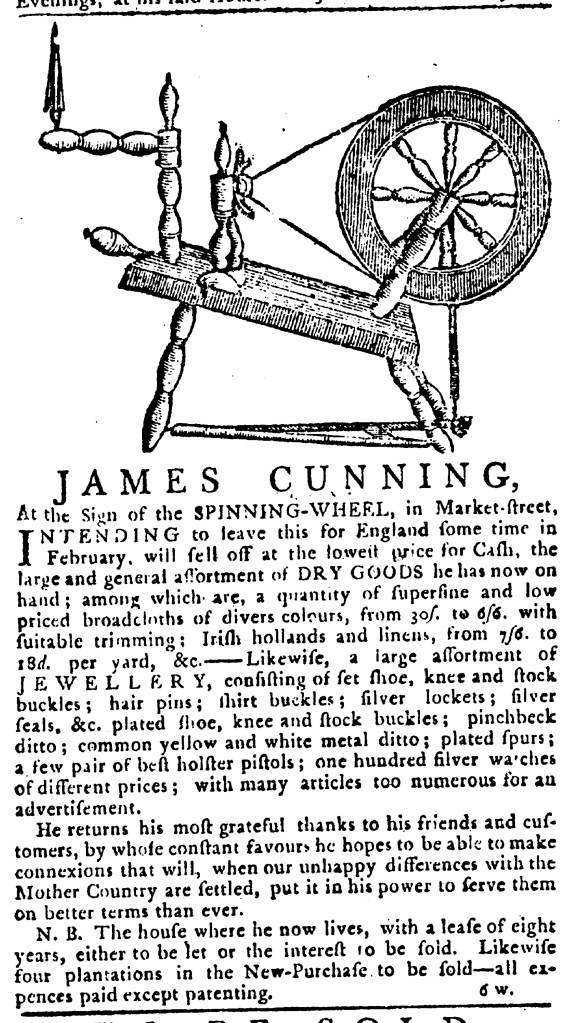
Pennsylvania Journal (November 30, 1774).

“The Sign of the SPINNING-WHEEL.”

James Cunning ran a shop “At the Sign of the SPINNING-WHEEL” in Philadelphia in the early 1770s, occasionally advertising in the local newspapers.  In the fall of 1774, he made plans to depart for England the following February.  His preparations included running a new notice and selling his remaining merchandise “at the lowest price for Cash.”  He did not indicate why he planned to leave Philadelphia or how long he would be away, but he did state that during his time on the other side of the Atlantic that he “hopes to be able to make connexions that will, when our unhappy differences with the Mother Country are settled, put it in his power to serve [his customers] on better terms than ever.”  Neither Cunning nor readers knew that armed conflict between the colonies and Britain would erupt in Massachusetts in April 1775 or that the “unhappy differences” would be settled with a war for independence that would last eight years.

They did know, however, that the imperial crisis had intensified to the point that delegates from twelve colonies convened the First Continental Congress in Philadelphia in September and October 1774.  They also knew that meeting resulted in the Continental Association, a nonimportation agreement intended to unify the colonies.  That pact was scheduled to go into effect on December 1, the day after Cunning’s advertisement made its first appearance in the Pennsylvania Journal. Envisioning the difficulty ahead, the shopkeeper may have decided to make the best of the situation by liquidating his inventory and making plans for what he hoped would be a better future.

Given the stakes, Cunning sought to increase the chances that readers would take note of his advertisement.  To that end, he included a woodcut that depicted a spinning wheel, the same device that marked the location of his shop.  He had incorporated that image into advertisements he placed in October 1771 and December 1772.  More recently, including in an advertisement in the December 6, 1773, edition of Dunlap’s Pennsylvania Packet, he did not feature a visual image.  When he decided to visit England, Cunning either remembered where he had stored the woodcut or managed to find it after some searching, determined to use it to his advantage during difficult times.  A nick in the spindle reveals that it was the same woodcut from his earlier advertisements, collected from the printing office where John Dunlap published the Pennsylvania Packet and later delivered to the printing office where William Bradford and Thomas Bradford published the Pennsylvania Journal.  The shopkeeper intended, at least one more time, to get a return on the investment he made when he commissioned the woodcut.
December 7

What was advertised in a colonial American newspaper 250 years ago today?

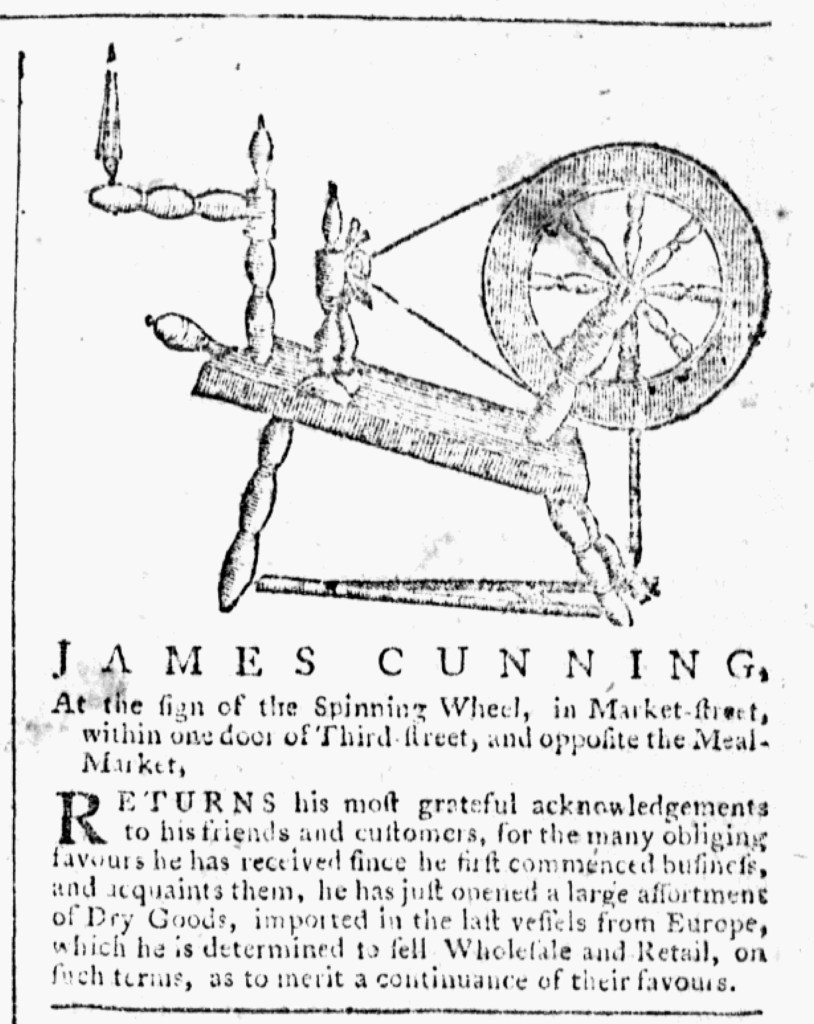
Pennsylvania Packet (December 7, 1772).

“At the sign of the Spinning Wheel.”

In December 1772, James Cunning took the pages of the Pennsylvania Packet to advertise the “large assortment of Dry Goods” available at his shop on Market Street in Philadelphia.  He took the opportunity to express his “grateful acknowledgments to his friends and customers,” thanking them for “the many obliging favours he has received since he first commenced business.”  In order to “merit a continuance of their favours,” Cunning declared that he would set favorable “terms” for both wholesale and retail sales.  Those “terms” certainly included price and likely credit as well.  They may have also included packaging, delivery, and other services.

Cunning advised readers that they would find his shop “At the sign of the Spinning Wheel.”  To strengthen the association between that symbol of industriousness and his business, Cunning adorned his advertisement with a woodcut that depicted a spinning wheel.  Larger than the stock images of vessels at sea and horses in the upper left corners of half a dozen advertisements in the December 7 issue and its supplement, the spinning wheel accounted for more than half the space occupied by Cunning’s advertisement.  That represented significant expense for Cunning, first for commissioning a woodcut tied to his business and for his exclusive use, then for the space required to publish it.  Printers charged by the amount of space, not the number of words.

Cunning apparently considered including the image in his notices worth the expense, especially since he continued to use it when placing new advertisements.  The image first appeared in advertisements Cunning inserted in the Pennsylvania Journal in October 1771.  By the end of the month, he transferred the woodcut to the printing offices of the newly-launched Pennsylvania Packet.  It appeared in an advertisement in the inaugural issue.  More than a year later, Cunning included the image in a new advertisement in the Pennsylvania Packet, convinced that it would result in a satisfactory return on his investment in commissioning it.  He could have retired the image after it appeared in that initial run of advertising if he did not believe that it resulted in greater attention for his business.  That he used it again suggests that he determined that image and text together helped to draw “friends and customers” to his shop.

October 30

What was advertised in a colonial American newspaper 250 years ago this week?

Pennsylvania Packet (October 28, 1771).

“JAMES CUNNING, At the sign of the SPINNING-WHEEL.”

When John Dunlap launched the Pennsylvania Packet on October 28, 1771, the first edition featured an astounding number of advertisements, enough that he distributed a supplement containing some of the news and advertising that did not fit in the standard issue.  Still, he did not print all of the advertisements submitted to his printing office.  Dunlap included a note that “Some Advertisements … are deferred till next week, when they shall be carefully regarded.”  Most colonial newspapers did not benefit from such an abundance of advertising in their inaugural issues.  Advertisers tended to wait to assess the success and circulation of new newspapers before investing in advertising that might not be seen by many readers.  Dunlap may have attracted so many advertisers because he announced in the subscription proposals that “The first Number shall be given gratis.”  Many advertisers may have assumed that free newspapers would result in high demand, at least for that first issue, making their own advertisements sound investments.

James Cunning, a merchant who did business “At the sign of the SPINNING WHEEL, in Third-street,” was among the advertisers who placed notices in the first issue of the Pennsylvania Packet.  He adorned his advertisement with an image of a spinning wheel, replicating the sign that marked his location.  That image, however, was not unique to the Pennsylvania Packet.  It previously appeared in advertisements Cunning placed in the Pennsylvania Journal on October 10 and October 17.  Colonial printers tended to supply stock images of ships, houses, horses, enslaved people, and indentured servants to advertisers, but advertisers who wished to publish other kinds of images had to commission woodcuts that then belonged to them, not the printers.  Three advertisements in the inaugural issue of the Pennsylvania Packet included images of ships at sea, but Cunning’s was the only advertisement with a specialized image keyed to his particular business.  To make that happen, he had to retrieve his woodcut of the spinning wheel from the printing office operated by William Bradford and Thomas Bradford at the corner of Front and Market Streets and deliver it, along with copy for his advertisement, to Dunlap’s “NEWEST PRINTING-OFFICE” on Market Street.  Already in the first issue of the Pennsylvania Packet, Dunlap participated in a longstanding practice of providing stock images for advertisers while also incorporating more specialized woodcuts that advertisers submitted with their copy.