
What was advertised in a revolutionary American newspaper 250 years ago today?
“SMALL SWORDS.”
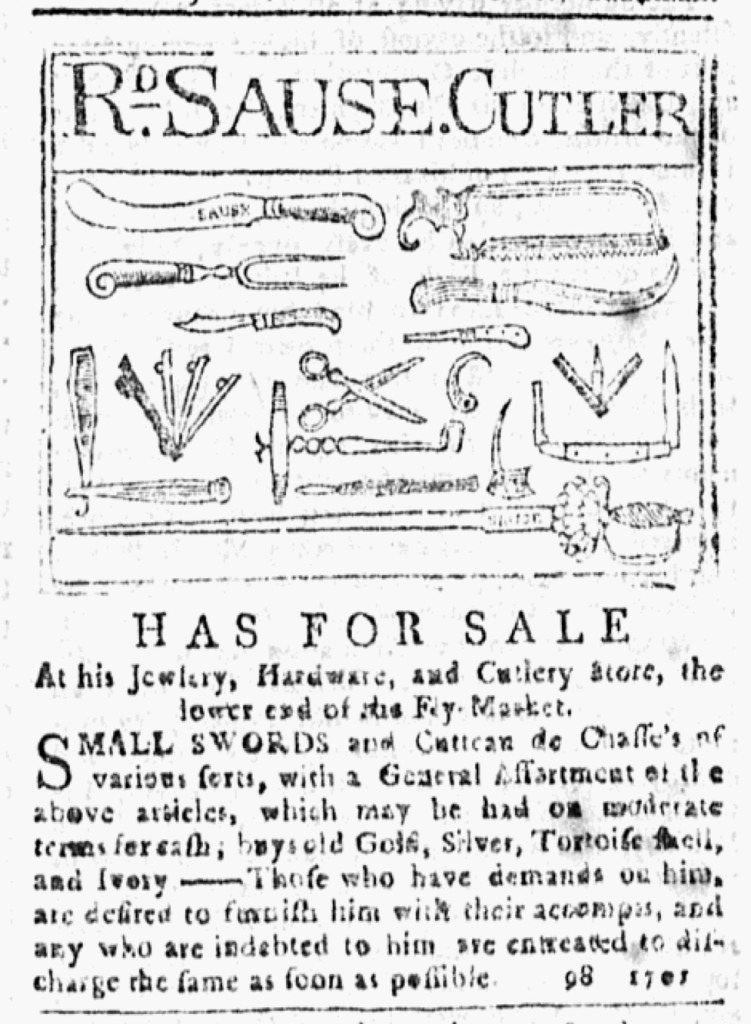
Richard Sause resorted to a familiar image to adorn his advertisement in the July 20, 1775, edition of the New-York Journal. It included his name and occupation, “RD. SAUSE. CUTLER,” and depictions of more than a dozen kinds of knives and other blades available at his “Jewlery, Hardware, and Cutlery Store.” Some of the items, a table knife and a sword, even had his name on the blade, suggesting that Sause marked the items he made. The image had periodically appeared in various newspapers published in New York since the early 1770s. Personalized woodcuts, commissioned by advertisers, belonged to those advertisers to submit to printing offices as they saw fit.
In Sause’s previous advertisements, the woodcut accounted for a relatively small amount of space compared to the copy that Sause composed to promote his business. This time, however, the image and the copy took up the same amount of space. Sause noted that he sold “a General Assortment of the above articles,” perhaps referring to the “Jewelry, Hardware, and Cutlery” listed in the name of his store or perhaps referring to the many items in the woodcut. In the copy, he highlighted only one sort of item: “SMALL SWORDS and Cutteau de Chasse’s of various sorts.” (See Steve Rayner and Jim Mullins’s extensively researched “Cuttoe Knives: A Material Culture Study” for more on “a variety of short swords known as cutteau de Chasse.” It includes an engraved trade card from 1739 for John Cargill, “Instrument Maker, at ye Saw & Crown in Lombard Street, London,” that featured an image of various blades and other instruments similar to Sause’s woodcut.) It made sense that Sause emphasized swords in an advertisement placed in the summer of 1775. Men in New York and other places prepared for the possibility that the fighting that began at Lexington and Concord in April and continued with the siege of Boston and the Battle of Bunkers Hill could occur in their own colonies. They formed new companies to defend their liberties. Merchants, shopkeepers, and artisans marketed military equipment while printers and booksellers published and sold military manuals. Under those circumstances, Sause made a savvy decision to promote “SMALL SWORDS” in his advertisement.