October 6

What was advertised in a colonial American newspaper 250 years ago today?
Pennsylvania Gazette (October 6, 1773).

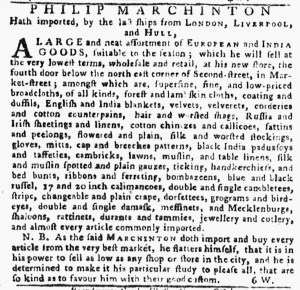
“He flatters himself, it is in his power to sell as low as any shop or store in the city.”

Philip Marchinton commenced a new advertising campaign at the beginning of October 1773.  His advertisements in the October 6 issues of the Pennsylvania Gazette and the Pennsylvania Journal both included a notation, “6 W,” that advised the compositors to run them for six weeks and then remove them from those newspapers.  Marchinton did not anticipate that anyone outside the printing offices would pay much attention to those notations.  Instead, he wanted prospective customers to focus on the “LARGE and neat assortment of EUROPEAN and INDIA GOODS” that he recently imported “by the last ships from LONDON, LIVERPOOL, and HULL.”

Marchinton’s advertisements followed a familiar format.  They commenced with a brief description of where and when he acquired his merchandise, suggesting to consumers that he did not merely peddle leftovers that he had not been able to sell.  The merchant declared that his new inventory was “suitable to the season” and made an appeal to price, offering “the very lowest terms.”  He devoted most of the advertisement to demonstrating the choices available his “assortment” of goods, listing a variety of textiles as well as “silk and worsted stockings” and “jewellery and cutlery.”  In addition, he claimed to stock “almost every article commonly imported,” putting him in competition with Andrew Bunner, William Price, and other merchants and shopkeepers who ran advertisements in the several newspapers published in Philadelphia.

Marchinton deviated from that familiar format in the final lines of his advertisement.  He appended a nota bene in which he provided a short explanation about how he could “sell at the very lowest terms,” circling back to the appeal that he made before listing his wares.  The merchant explained that he “doth import and buy every article from the very best market.”  In the process, he avoided unnecessary markups.  As a result, “it is in his power to sell as low as any shop or store in the city.”  He did not go into greater detail, content with reminding prospective customers of his low prices before making a final pledge “to make it particular study to please all, that are so kind as to favour him with their good custom.”  Low prices and good customer service went hand in hand at Marchington’s store.  Like many other merchants and shopkeepers, Marchinton mostly adhered to a familiar format while choosing a small variation to distinguish his advertisement from others.

December 8

What was advertised in a colonial American newspaper 250 years ago today?

Pennsylvania Gazette (December 8, 1768).

“THOMAS WEST … has imported in the last vessels from London and Liverpool, a neat assortment of MERCHANDIZE.”

When he placed an advertisement for “a neat assortment of MERCHANDIZE” in the December 8, 1768, edition of the Pennsylvania Gazette, Thomas West adopted a standard format for advertisements for consumer goods. The amount of variation in the graphic design of such advertisements varied from newspaper to newspaper, but tended to be fairly fixed among those placed in the Pennsylvania Gazette by merchants and shopkeepers in the late 1760s. The printers and compositors may have exercised some influence over this standardization, especially considering that the Pennsylvania Gazette featured an especially high volume of paid notices compared to its counterparts in Philadelphia and throughout the colonies. Those who worked in the printing office may have discouraged, or at least not encouraged, innovations in the visual aspects of advertisements, finding that a no-frills format streamlined setting type. Advertisers may not have insisted on introducing new design elements into advertisements, content to submit copy and leave the format to the compositors.

Consider West’s advertisement. His name, all in capital letters, served as a headline. Next his advertisement featured a short introductory paragraph that provided an overview of his location, the sorts of goods he sold, and their origins. The introduction concluded with a brief appeal to price. The remainder of the advertisement consisted of a lengthy list of his inventory, presented in a paragraph of dense text. Elsewhere in the same issue, Edward Cottrell and James Reynolds inserted advertisements that followed this format. Other advertisers of consumer goods opted for slight variations, reversing the order of the headline and introductory paragraph or placing the headline in the middle of that overview. Despite lists of merchandise that ranged from short to lengthy, Alexander Bartram, James Budden, Benjamin Gibbs, William Nicholls, Richard Parker, and Samuel Taylor all deployed one of those variations.

In this regard, the Pennsylvania Gazette was a fairly conservative newspaper, but given its extensive circulation perhaps neither printers nor advertisers considered innovative graphic design particularly imperative. Advertisements comprised of chunky blocks of text certainly appeared in other newspapers throughout the colonies. Advertisements that deviated from that standard also found their way into the Pennsylvania Gazette. In general, however, many other newspapers ran advertisements that varied in appearance to a much greater degree, incorporating different fonts and font sizes, creative use of white space, and columns within advertisements, even when they also included the advertiser’s name as the headline, an introductory paragraph, and a list of merchandise. The unvarying format of advertisements within its pages made the Pennsylvania Gazette easy to recognize at a glance, even when the masthead was not visible.

August 2

What was advertised in a colonial American newspaper 250 years ago this week?

Aug 2 - 7:30:1767 Pennsylvania Gazette
Pennsylvania Gazette (July 30, 1767).

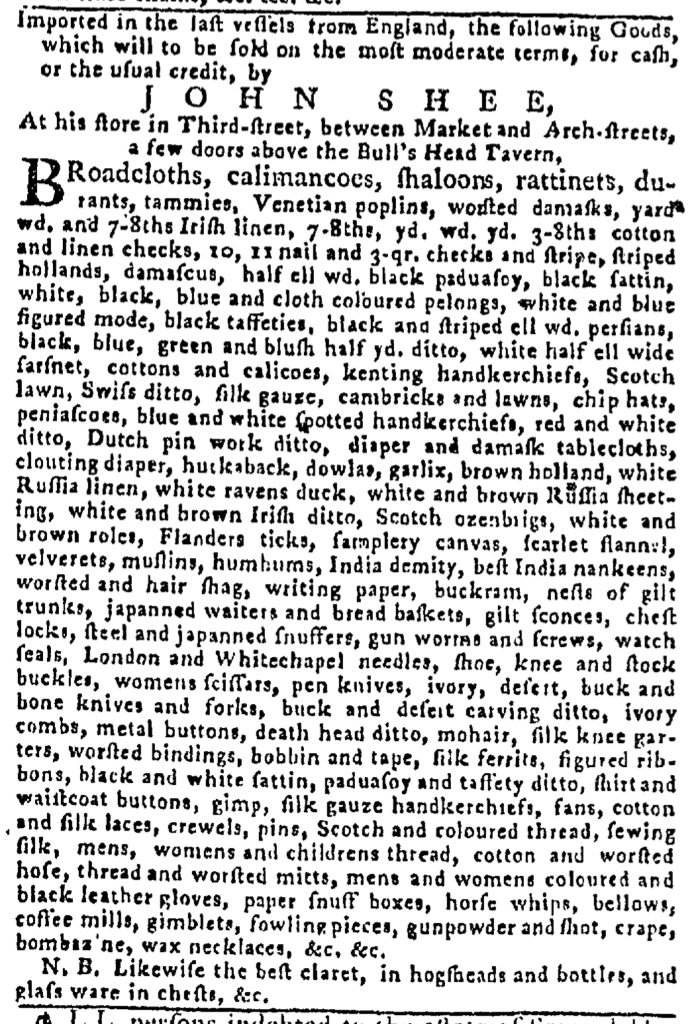
“The following Goods, which will to be sold … by JOHN SHEE.”

Consisting of a block of densely formatted text with little white space and almost no variation in font size, John Shee’s advertisement certainly would not have been considered flashy, but that did not necessarily mean that it was ineffective by eighteenth-century standards.

Shee observed many of the conventions of the day. He made an appeal to price (“sold on the most moderate terms”) and offered more than one option for payment (“cash, or the usual credit”). In noting that his merchandise had been “Imported in the last vessels from England,” he reminded potential customers that they were participating in transatlantic consumer culture that linked them to their counterparts in London and the English provinces. That these goods arrived via the “last vessels” also suggested that they were the most current fashions available.

Shee expended the most effort in detailing the assortment of items he stocked, everything from textiles and adornments (comprising more than half the advertisement) to coffee mills to pen knives to gunpowder and shot. Even then, he had not exhausted his inventory. Eighteenth-century readers knew that the “&c. &c.” that concluded his list meant “etc. etc.,” a promise that potential customers could examine an even greater array of goods upon visiting Shee’s shop. By listing dozens and dozens of items, Shee made an appeal to consumer choice. He invited potential customers to imagine acquiring, wearing, admiring, using, displaying, and possessing the goods he sold. He also offered them independence, the ability to make their own decisions about which items to purchase to fit their own tastes or to distinguish themselves from friends and neighbors. Such a lengthy list meant that customers did not have to content themselves with whatever happened to be on the shelves. A nota bene appended to the conclusion even suggested that the shopkeeper was constantly adding new merchandise to the selection he offered for sale.

In terms of the graphic design elements, Shee’s advertisement replicated others in the Pennsylvania Gazette. Short of paying extra for a woodcut to accompany his advertisement, he likely had little control over the layout. Instead, he accepted the standard format adopted by a compositor who squeezed as much content as possible onto the pages of the Pennsylvania Gazette. It was not the visual appeal of their advertisements that Shee and many of his counterparts were convinced would sell their goods. Instead, they relied on careful attention to a set of appeals they believed resonated with consumers. In the absence of varied graphic elements, Shee and other shopkeepers expected potential customers to approach their advertisements as active readers.