
What was advertised in a colonial American newspaper 250 years ago today?
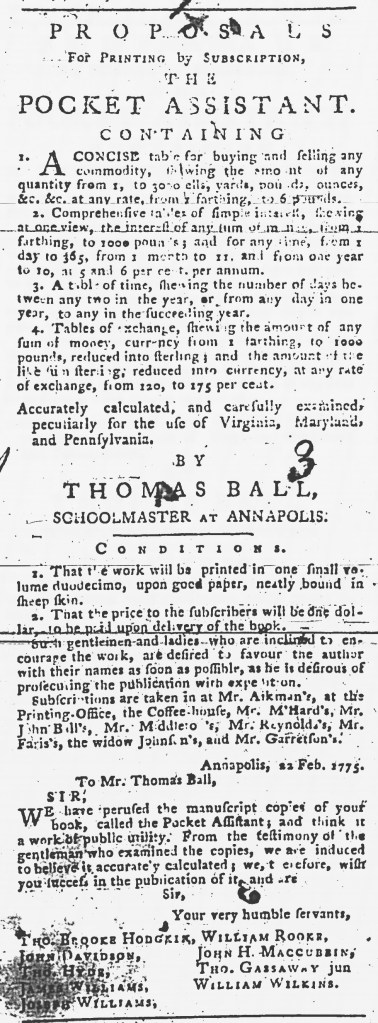
“WE have perused the manuscript copies of your book … and think it a work of public utility.”
Thomas Ball, a schoolmaster in Annapolis, had an entrepreneurial spirit. He wrote and distributed subscription proposals for “THE POCKET ASSISTANT,” a reference manual that included a “CONCISE table for buying and selling any commodity … at any rate,” “Comprehensive tables of simple interest,” a “table of time, shewing the number of days between any two in the year, or from any day in one yea, to any in the succeeding year,” and “Tables of exchange.” Merchants, brokers, shopkeepers, and others would certainly find each of those calculations helpful when conducting business.
Ball claimed that each table as “Accurately calculated and carefully examined” so subscribers could trust them. To that end, he added an endorsement from nine residents of Annapolis after the “CONDITIONS” for subscribing. “WE have perused the manuscript copies of your book, called the Pocket Assistant,” they declared, “and think it a work of public utility. From the testimony of the gentleman who examined the copies, we are induced to believe it accurately calculated; we, therefore, wish you success in the publication of it.” Ball engaged in a bit of sleight of hand: the signatories did not report that they had confirmed the calculations themselves, only that they trusted the unnamed “gentleman” who had looked over them. Still, Ball considered that recognition significant enough that it might sway prospective subscribers to reserve copies so he could move forward with the project.
The schoolmaster also enlisted the assistance of several local agents who accepted subscriptions on his behalf. Subscribers could submit their names at popular places for doing business, including the coffeehouse where merchants regularly gathered and the printing office where Anne Catharine Greene and Son published the Maryland Gazette, as well as at William Aikman’s circulating library. Seven other men and women also took the names of subscribers, though none of them collected any money. Subscribers only paid “upon delivery of the book,” provided that the proposals generated enough interest to justify Ball taking the “small volume” to press. Even a carefully orchestrated marketing campaign, however, did not guarantee success. Many subscription proposals did not result in publication. Unfortunately for Ball, it does not appear that his Pocket Assistant made it to press.