August 6

What was advertised in a colonial American newspaper 250 years ago today?

New-Hampshire Gazette (August 6, 1773).

“RAN-AWAY … a Sailor, named John Morgan … Portsmouth, Aug. 5.”

The notice arrived in the printing office too late to appear in the August 6, 1773, edition of the New-Hampshire Gazette… almost.  John Morgan, a sailor, deserted or “RAN-AWAY from the Ship Exeter Galley” and William Pearne offered a reward to “Whoever will bring the said Man” to him in Portsmouth.  Readers could recognize Morgan, “pretty tall, well built, about 30 Years of Age,” by his “dark Complexion, & black short Hair” as well as his “blue Jacket, check Shirt, Oznabrigs Trousers, and a new Pair of Shoes.”

The advertisement was dated “Portsmouth, Aug. 5.”  The August 6 edition was already in production when Pearne delivered the notice to the printing office.  Like other colonial newspapers, the New-Hampshire Gazette consisted of four pages created by printing two pages on each side of a broadsheet and then folding it in half.  Daniel Fowle, the printer, and others in the printing office would have selected the contents, set the type, and printed the first and fourth pages on one side of the broadsheet in advance of working on the second and third pages on the other side.  They needed to hang the incomplete newspapers to dry after the first printing.  Fowle and the rest apparently had the type set for the second and third pages and were ready to take it to press when Pearne’s advertisement arrived.  Pearne may have pleaded or insisted that it needed to appear in the August 6 edition rather than wait an entire week for the next issue.  That would have given Morgan even more time to make good on his escape.

Fowle or one of the compositors made room for the advertisement in the margin at the bottom of the second page.  It consisted of nine lines, too many to appear together, but there was enough space to add three lines below each of the three columns of news on that page.  The text of the advertisement featured a larger font, a subtle visual cue to alert readers that they encountered content that was not part of the news items originally planned for that page.  The following week, the advertisement did appear as a single piece along with other paid notices on the third page of the August 13 edition.  For immediate publication, however, the printing office resorted to the margin to satisfy a customer who submitted a time-sensitive advertisement at the last minute.
January 12

What was advertised in a colonial American newspaper 250 years ago today?

New-York Journal (January 12, 1769)

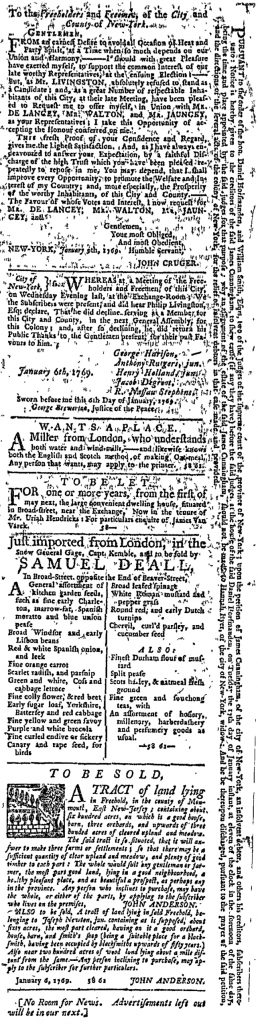
“[No Room for News. Advertisements left out will be in our next.]”

John Holt, the printer of the New-York Journal, faced a dilemma when he prepared the January 12, 1769, edition to go to press. He had too much content for the standard four-page issue. A short notice at the bottom of the final column on the third page advised readers that there was “[No Room for News. Advertisements left out will be in our next.]”

Why place this notice on the third page instead of the last? Consider the mechanics of printing a four-page newspaper on a hand-operated press in eighteenth-century America. Minimizing the number of impressions reduced the amount of time required working at the press. To maximize efficiency, printers produced the standard four-page edition by printing two pages on each side of a broadsheet and then folding it in half. This required setting type for the fourth and first pages to print simultaneously and then the second and third pages to print together. Compositors usually set the exterior pages first, in part because they included material that repeated from week to week, such as the masthead on the first page and the colophon and advertisements on the fourth page. The type for the third page often would have been the last set for the issue, explaining why Holt’s notice about not having enough space for all the news and advertisements appeared at the bottom of the final column of that page.

Still, Holt made additional efforts to serve his customers. A legal notice concerning James Cunningham, “an insolvent debtor,” that otherwise would have appeared among the advertisements instead ran along the right margin of the third page. It concerned a hearing that would take place on January 17, before publication of the next edition of the New-York Journal. If Holt wished to generate the advertising revenue, it was imperative to find a way to insert that advertisement in the January 12 issue. Printers sometimes ran short advertisements in the margins, rotating the text so it appeared perpendicular to the rest of the column. In most cases such advertisements ran in several columns, only a few lines each and the same width as the columns that ran the length of the entire page. Compositors used advertisements that already appeared in previous issues, transferring lines of type already set. The legal notice concerning Cunningham, however, had not previously appeared in the New-York Journal. It appeared as a short but wide paragraph that ran the length of the page.

Holt also issued a two-page Supplement to the New-York Journal. Except for the masthead, the first page consisted entirely of “The ANATOMIST, No. XIV,” the next installment in a series of essays that ran in the weekly supplement. The essay concluded on the following page, leaving space for some news (“JOURNAL of OCCURRENCES, continued,” with the dateline “BOSTON, December 10”) and two advertisements. One of those advertisements included a notation on the final line, “56 59,” to remind the compositor that the advertisement was to appear in issues 1356 through 1359. The January 12 edition and its supplement comprised issue 1358. Though he did not have sufficient space in the standard issue, Holt made room in the supplement to insert that advertisement.

As the January 12, 1769, edition of the New-York Journal demonstrates, colonial printers and compositors made creative choices in their efforts to circulate news and advertising to colonial readers and consumers. Even as he offered assurances to advertisers that their notices would indeed appear in the next issue, Holt finagled additional space that allowed some to circulate immediately rather than being delayed a week.