March 3

What was advertised in a colonial American newspaper 250 years ago today?

Pennsylvania Journal (March 3, 1773).

“ALL kinds of ribbons, which he will sell for cash at 65 per cent, on sterling cost.”

David Shakespear marketed “ALL kinds of ribbons” and “sundry other dry Goods, hardware, jewellery,” and other merchandise in advertisements that ran in the Pennsylvania Journal in February and March 1773.  He did not, however, invite consumers to browse his wares and make purchases.  Instead, he made clear that he restricted his commercial activities to wholesale transactions.  He addressed “City and Country Shopkeepers” in his notice.

In promoting his selection of ribbons, an especially popular accessory for enhancing garments, millinery, and women’s elaborate hairstyles, Shakespear informed prospective buyers that he “will sell for cash at 65 per cent, on sterling cost.”  He apparently believed that such transparency would entice “City and Country Shopkeepers” to do business with him, provided that they had the cash to take advantage of the bargain prices he charged.  Given the discount, it made sense that Shakespear wished to sell by volume to retailers rather than deal directly with consumers who made smaller purchases.

He outlined his business model, stating that he “purposes to continue importing to sell by wholesale only” and “hopes that the small advance put on [his wares], will recommend him to the custom of the City and Country Shopkeepers.”  Shakespear envisioned distributing his inventory throughout Philadelphia, a bustling urban port and the largest city in the colonies, and towns in Pennsylvania, Delaware, New Jersey, and Maryland.  He provided an alternative to doing business with English merchants in London, positioning himself as a middleman who offered deals that allowed retailers who made wholesale purchases from him to pass along the savings to their own customers.

Although Shakespear mentioned the discount only in relation to ribbons, he may have anticipated that prospective customers would associate bargain rates with his other merchandise.  Even if those deals for dry goods, hardware, and other items were not as generous as his prices for ribbons, some of those “City and Country Shopkeepers” may have anticipated that they could negotiate with Shakespear for favorable prices.  His advertisement signaled that he was open to such overtures.

April 3

What was advertised in a colonial American newspaper 250 years ago today?

Massachusetts Gazette and Boston Weekly News-Letter (April 3, 1772).

“Country Traders … may be supplied with all Kinds of Writing-Paper … at any Store in Town.”

John Fleeming published the Boston Chronicle in partnership with John Mein from 1767 to 1770.  That newspaper folded, in large part due to the blatant Tory sympathies espoused by Fleeming’s partner.  Mein fled Boston, leaving Fleeming to oversee the business for the few months that the newspaper continued publication in his absence.  With the Boston Chronicle behind him, Fleeming turned to job printing and selling stationery and writing supplies.  In the April 3, 1772, edition of the Massachusetts Gazette and Boston Weekly News-Letter, for instance, he advertised a “large Assortment of STATIONARY” that included “Writing Paper of all Kinds, Quills, Wax, Wafers, Ink-Chests & Stands of various Kinds, Ivory Folders, Leather Ink Bottles, Ink-Powder, and Patent Cake Ink.”

Fleeming hoped to encourage retail sales among residents of Boston who visited his shop, but he also made an appeal to “Country Traders and Shopkeepers” looking to make wholesale purchases.  He promised them that they “may be supplied with all Kinds of Writing-Paper by the Ream, as Cheap as at any Store in Town.”  Fleeming competed with a number of stationers who imported paper from England, especially after Parliament repealed the duties on paper and other items and merchants called an end to the nonimportation agreement adopted to achieve that goal.  Eager to maximize revenues, Fleeming aimed to attract wholesale as well as retail customers.

In so doing, he resorted to a familiar marketing strategy, one adopted by merchants who sold a variety of imported goods ranging from textiles to housewares to hardware to patent medicines.  Some advertised that they filled retail orders sent from colonizers in the countryside.  Others did not work directly with consumers outside of Boston, but that did not mean that they neglected to capture wider markets as wholesalers.  Merchants frequently assured “Country Traders” that they offered the best bargains, allowing them to generate sales by passing along the savings to their customers.  By modern standards, Fleeming’s advertisement may not appear flashy, but that does not mean that it lacked a sound marketing strategy in the eighteenth century.

June 14

What was advertised in a colonial American newspaper 250 years ago today?

Connecticut Journal (June 14, 1771).

“Town and Country Shopkeepers may supply themselves as cheap as in New York or Boston.”

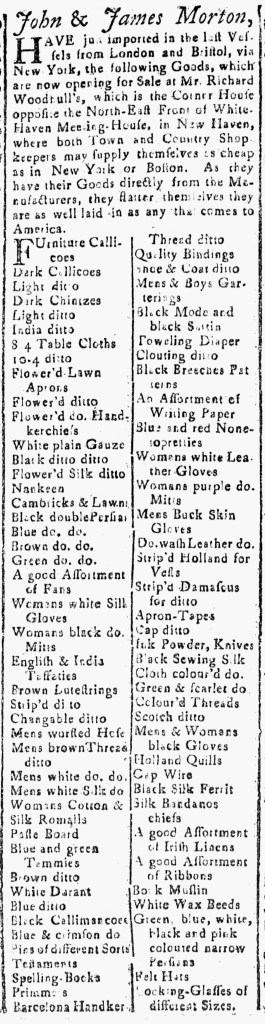
In an advertisement that filled an entire column and overflowed into the next, John Morton and James Morton informed readers of the Connecticut Journal and New-Haven Post-Boy that they carried “all Sorts of English and India Goods.”  To entice prospective customers, the Mortons listed dozens of items, including “Womans White Silk Gloves,” “Mens worsted Hose,” and textiles in many colors and designs. Choices for consumers and retailers alike abounded at the shop; customers made selections among “An Assortment of Writing Paper,” “Looking-Glasses of different Sizes,” “A good Assortment of Ribbons,” “Pins of different Sorts,” and “A good Assortment of Fans.”  Despite the length of the advertisement, it only hinted at the variety of goods offered by the Mortons.

The merchants stocked this inventory at two shops, one in New Haven “at Mr. Richard Woodhull’s, which is the Corner House opposite the North-East Front of White-Haven Meeting-House” and the other in New York “in Queen-Street, near the Fly-Market.”  They intended their advertisement in the Connecticut Journal primarily for residents of New Haven and nearby towns, but noted their original location in New York for the convenience of other customers.  The Mortons underscored that purchasing goods at their shop in New Haven was in no way inferior to acquiring merchandise in any of the major urban ports.  They imported their wares “in the last Vessels from London and Bristol, via New York,” but the additional step in transporting them to New Haven did not result in higher prices.  Customers, especially “Town and Country Shopkeepers,” could “supply themselves as cheap as in New York or Boston.”  The Mortons declared that they would not be undersold by their competitors.  In addition, they offered the same range of choices as merchants in larger port cities.  The Mortons proclaimed “they are as well laid in as any that comes to America.”

The Mortons’ advertisement continued in a second column of the Connecticut Journal (June 14, 1771).

Compared to the New-York Gazette and Weekly Mercury and the New-York Journal, the Connecticut Gazette carried significantly less advertising for imported goods.  That did not mean, however, that consumer culture in New Haven and other towns in Connecticut was any less vibrant than in New York, Boston, and other urban centers.  The Mortons suggested to both shopkeepers and consumers that they had access to the same merchandise available at their store in New York … and at the same prices.  The consumer revolution did not occur only in cities.  The Mortons did their part in making it possible for prospective customers in the countryside to acquire a vast array of goods that rivaled the choices they offered to shoppers in New York.