March 30

What was advertised in a colonial American newspaper 250 years ago today?
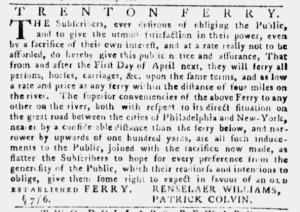
Pennsylvania Gazette (March 30, 1774).

“The superior conveniencies of the above Ferry.”

Rensselaer Williams and Patrick Colvin provided a public service.  At least that was how they wanted prospective clients to think about the “TRENTON FERRY” that they operated.  They opened their advertisement in the March 30, 1774, edition of the Pennsylvania Gazette with a declaration that they were “ever desirous of obliging the Public, and to give the utmost satisfaction in their power.”  To that end, they even set prices (or so they claimed) “by a sacrifice of their own interest, and at a rate really not be afforded.”  Williams and Colvin hoped such proclamations would attract attention in advance of opening for business on “the First Day of April next.”

At that time, they pledged to “ferry all persons, horses, [and] carriages” at “as low a rate and price as any ferry within four miles on the river.”  They certainly had in mind unnamed competitors that they expected were already familiar to prospective clients.  To make their service even more attractive, Williams and Colvin asserted that the “superior conveniencies” of their ferry compared to “any other on the river” included “its direct situation on the great road between the cities of Philadelphia and New-York,” a well-travelled corridor between the two largest cities in British mainland North America.  They emphasized that their location was “nearer by a considerable distance than the ferry below,” once again alluding to the competition.  Prospective clients might even consider passage on Williams and Colvin’s ferry faster and safer since the Delaware River was “narrower by upwards of one hundred yards” at their location.

This advertisement, along with others for ferries and stages, helps in mapping the transportation infrastructure in place in the colonies on the eve of the American Revolution.  Advertisements for almanacs frequently included descriptions of roads among the contents of those annual volumes.  Rather than relying on maps as they traveled from place to place, colonizers instead took into account general knowledge acquired through word of mouth as well as printed sources that included newspaper advertisements and almanacs.  Williams and Colvin certainly anticipated that merchants, travelers, and others would share with others what they read about the “TRENTON FERRY,” what they heard about it, and their own experiences hiring the service.
April 7

What was advertised in a colonial American newspaper 250 years ago today?

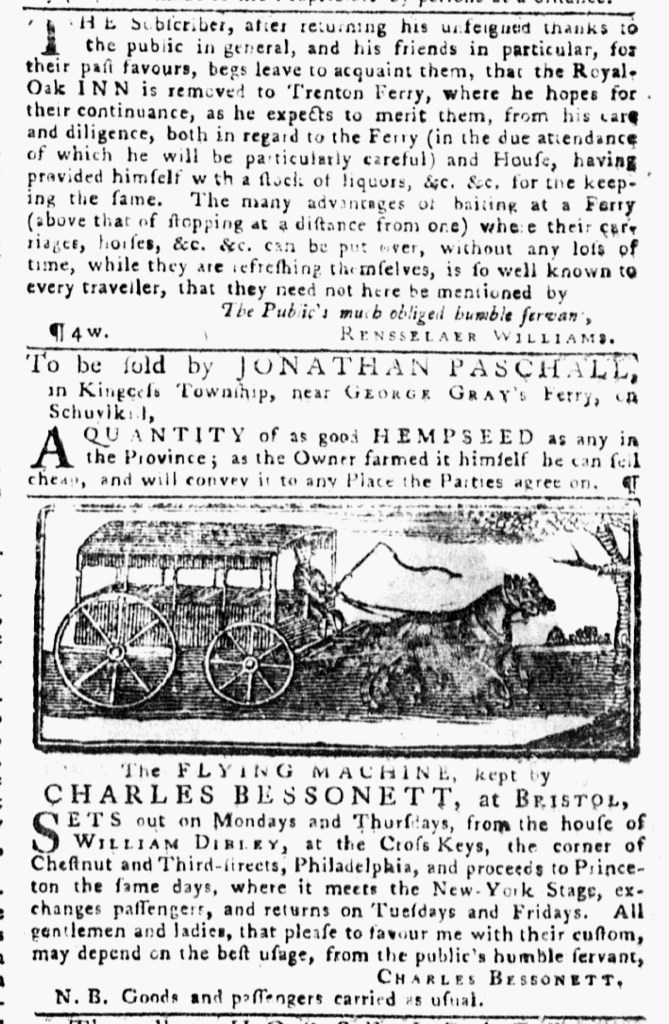
Pennsylvania Gazette (April 7, 1773).

“The Royal-Oak INN is removed to Trenton Ferry.”

“The FLYING MACHINE … SETS out on Mondays and Thursdays.”

Several kinds of documents testify to the transportation infrastructure in the colonies during the era of the American Revolution.  Almanacs often included information about roads and ferries that connected cities and towns.  Newspaper advertisements gave details about the stagecoaches that transported passengers and packages from town to town as well as the inns and taverns that provided services along the way.

Such was the case in the April 7, 1773, edition of the Pennsylvania Gazette.  In one advertisement, Rensselaer Williams promoted the “Royal-Oak INN” near the Trenton Ferry that connected the New Jersey and Pennsylvania sides of the Delaware River.  Williams previously operated the inn at another location, but recently “removed” to a new location for the convenience of his guests.  He hoped that “the public in general, and his friends in particular” would express their appreciation for this new arrangement by continuing their patronage.  He pledged his “care and diligence” in operating both the inn (“with a stock of liquors”) and the ferry.  Williams asked prospective customers to consider the “many advantages of baiting at a Ferry.”  Modern readers may not be familiar with the term that Williams used, but eighteenth-century readers would have known that “to bait” referred to travelers, as the Oxford English Dictionary indicates, “to stop at an inn, originally to feed the horses, but later also to rest and refresh themselves; hence, to make a brief stay or sojourn.”  By “baiting at a Ferry,” Williams declared, travelers saved time compared to making additional stops to refresh themselves and take care of horses and carriages elsewhere.

In another advertisement, Charles Bessonett similarly emphasized efficiency in marketing the stage service he operated for passengers and goods.  He named his stage the “FLYING MACHINE” to suggest how quickly it covered the distance between Philadelphia and Princeton.  Bessonnett also provided a schedule to demonstrate the speed of the journey to prospective customers.  The stage departed from Philadelphia on Mondays and Thursdays and returned from Princeton on Tuesdays and Fridays.  In Princeton, the Flying Machine met a stagecoach from New York and exchanged passengers.  Bessonnett collaborated with another operator in connecting the two cities.

Colonial printers did not usually organize or classify newspaper advertisements.  That an advertisement for the Royal Oak Inn and Trenton appeared in close proximity to an advertisement for the Flying Machine, separated only by a notice offering hempseed for sale, happened more by coincidence than by design.  Still, the two advertisements gave readers of the Pennsylvania Gazette information about some of the options available to them if they wished to travel to New Jersey or New York or even continue on to New England.