December 17

What was advertised in a revolutionary American newspaper 250 years ago this week?
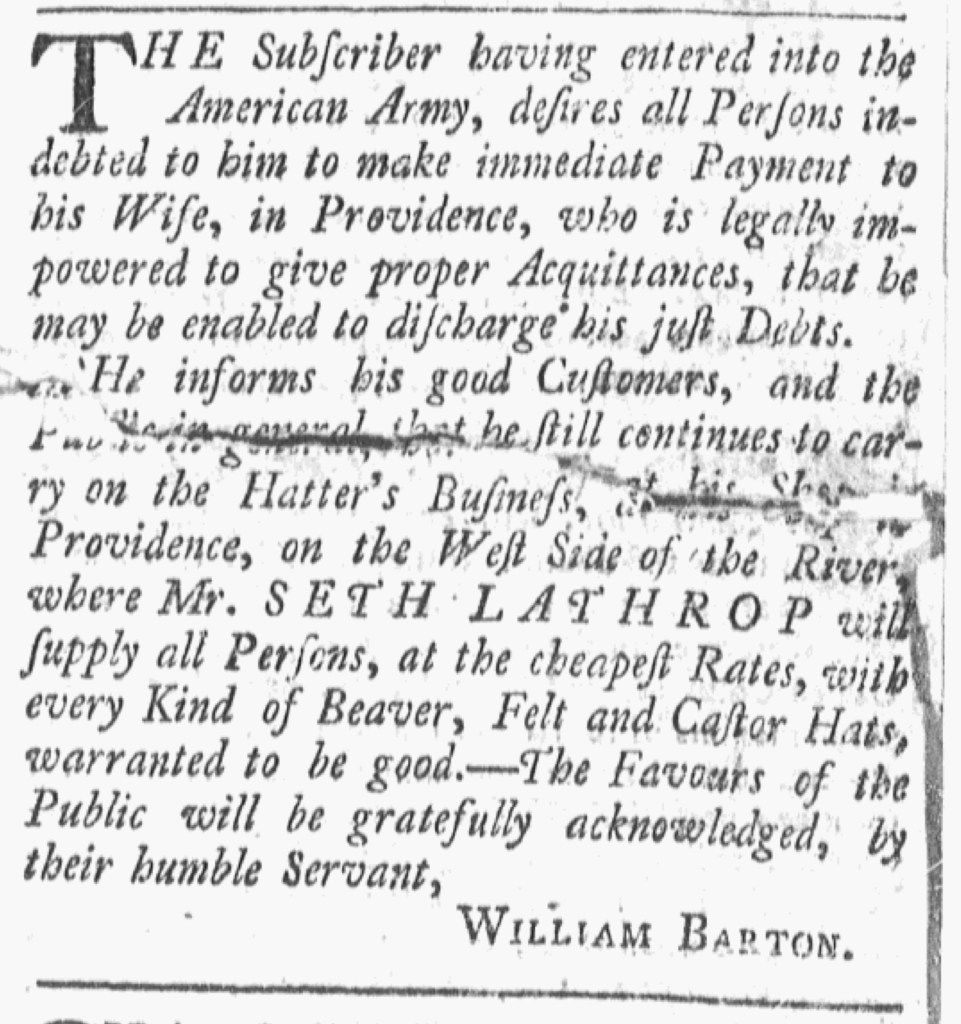
Providence Gazette (December 16, 1775).

“THE Subscriber having entered into the American Army, desires all Persons indebted to him to make immediate Payment to his Wife.”

When William Barton, a hatter in Providence, “entered into the American Army” in 1775, he ran a newspaper advertisement that delegated responsibilities to his wife and a business associate.  He requested that “all Persons to indebted to him … make immediate Payment to his Wife, … who is legally impowered to give proper Acquittances, that he may be enabled to discharge his just Debts.”  It may not have been the first time that his unnamed wife oversaw accounts for the Barton household and her husband’s shop.  Like many other wives of shopkeepers and artisans, she could have had experience assisting her husband by tending to customers while he was busy or away from the shop.  She did not, however, assume responsibility for making sales during her husband’s extended absence while he served in the Continental Army, at least not initially.

Instead, Barton “inform[ed] his good Customers, and the Public in general, that he still continues to carry on the Hatter’s Business, at his Shop … where Mr. SETH LATHROP will supply all Person … with every Kind of Beaver, Felt and Castor Hats.”  Barton did not indicate whether Lathrop previously played a role in the business.  Had Lathrop been an employee or an apprentice who now ran the shop while Barton was away?  Did he take new orders and make new hats according to the tastes of Barton’s “good Customers” and new clients who responded to the advertisement?  Or did he merely sell hats already in stock when Barton enlisted in the army?  Barton’s notice did promise low prices, “the cheapest Rates,” and made assurances about the quality of the hats available at the shop, proclaiming that they were “warranted to be good.”

Barton also declared, “The Favours of the Public will be gratefully acknowledged, by their humble Servant.”  Although he deployed language that often appeared in newspaper advertisement to conclude his notice, he may have intended that his introduction would entice both his existing “good Customers” as well as new customers to support his business and, in doing so, his wife and their household.  Barton likely hoped to leverage his service in the “American Army” as a selling point for his hats.  After all, he chose to disclose that information first, making sure that it framed the overview of his shop that remained open during his absence.  Some advertisers espoused support for the American cause in their newspaper advertisements.  More significantly, Barton demonstrated his commitment to his political principles through his enlistment.  That merited special consideration for his “Hatter’s Business, at his Shop” that remained open in Providence.
September 10

What was advertised in a colonial American newspaper 250 years ago today?

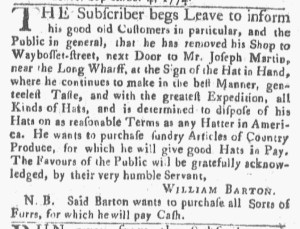
Providence Gazette (September 10, 1774).

“He has removed his Shop to … the Sign of the Hat in Hand.”

When William Barton moved to a new location as the summer came to a close in 1774, he placed an advertisement in the Providence Gazette to inform “his good old Customers in particular, and the Public in general” where to find him.  Having established a clientele, the hatter did not wish to miss out on subsequent business if customers went to his former shop and did not discover him there.  All prospective customers, whether or not they previously acquired hats from Barton, could recognize his new location by the “Sign of the Hat in Hand.”  The hatter did not indicate whether that marketing device had marked his previous location or if it was an innovation on the occasion of setting up shop on Weybosset Street.  Either way, it became part of the landscape of advertising that colonizers encountered as they traversed the streets “near the Long Wharff” in Providence.

To entice consumers to visit his shop, Barton made a variety of appeals.  He promised quality, stating that he made hats “in the best Manner.”  He emphasized fashion, declaring that his hats reflected “genteelest Taste.”  He touted his own skill and industriousness, asserting that “the greatest Expedition” went into producing his hats.  He offered choices to consumers, proclaiming that his inventory included “all Kinds of Hats.”  For his boldest appeal, he trumpeted that he was “determined to dispose of his Hats on as reasonable Terms as any Hatter in America.”  Barton did not merely compare his prices to his local competitors.  He confidently declared that consumers would not find any better deal anywhere, even if they sent away to Boston or New York or any other city or town in the colonies.  He challenged readers to visit his shop, learn his prices, and judge for themselves.  If his claim could get potential customers through the doors, that increased his chances of making sales.  Though his advertisement was not particularly lengthy, Barton incorporated many of the most common marketing appeals advanced by artisans in eighteenth-century America, anticipating that they collectively became more even more convincing.

October 10

What was advertised in a colonial American newspaper 250 years ago today?

Providence Gazette (October 10, 1772).

“The Shop of Holden and Grainger, Taylors, was broke open.”

Advertisements in eighteenth-century newspapers sometimes served as precursors to police blotters that recorded crimes in later centuries.  In particular, they most often provided details about burglaries, in part because the victims offered rewards for the return of stolen goods and the conviction of the culprits.

Two burglaries occurred in Providence on the night of September 22, 1772.  Perhaps the same “Thief or Thieves” perpetrated both crimes.  William Barton reported his shop “was broke open, and robbed of … five new Beaver Hats, not coloured; one second handed Hat, cut in the new Fashion; and one Cloth coloured Surtout, with Basket Buttons.”  Similarly, tailors Holden and Grainger declared that their shop “was broke open” and an even greater array of items taken.  The details that the tailors provided would have made it easy to identify the stolen goods, including “one Suit of Claret coloured Broadcloth, not finished, the Lining nearly of the same Colour, with Leather Pockets, a Pocket in the Lining of the left Forebody, having Gold Basket Buttons, and Gold Knee-straps, the Breeches not lined” and “a light grey Broadcloth lapelled Jacket, with Basket Buttons of the same Colour, partly worn, having new Lining to the Skirts, and Tow-cloth Pockets.”  Holden and Grainger also stated that “the same Shop was broke open” near the end of August.  Unfortunately for Barton, that had been the case for his shop as well.  The “Thief or Thieves” may have kept some or all of the stolen items for themselves, but they more likely fenced them.  The articles then entered what Serena Zabin has called an “informal economy” that made participating in the consumer revolution more accessible to the lower sorts – free, indentured, and enslaved – who did not have the means to purchase new goods directly from shopkeepers who retailed them or artisans who produced them.

Barton offered a reward of fifteen dollars for apprehending the burglars or five dollars for recovering the stolen articles.  Similarly, Holden and Grainger promised twelve dollars to “Whoever apprehends the Thief or Thieves” and six dollars for the stolen items.  They also decided to take advantage of placing their notice in the Providence Gazette by concluding with a nota bene that informed the public that they “have for Sale choice Deer Skins, and ready made Breeches, cheap for Cash or Grain.”  Like many other advertisers, they placed an advertisement with more than one purpose.  As long as they had the public’s attention, they figured they could benefit from promoting their services in addition to seeking assistance in recovering their stolen goods.