January 3

What was advertised in a colonial American newspaper 250 years ago today?

Jan 3 1770 - 1:3:1770 Georgia Gazette
Georgia Gazette (January 3, 1770.)

“The whole taken from the Boston Chronicle, in which they were first published.”

Newspaper printers participated in networks of exchange in eighteenth-century America, liberally reprinting articles, letters, and editorials from one newspaper to another. Items originally published in, for example, Philadelphia’s newspapers found their way into newspapers printed in other colonies, both north and south. Over time, information radiated outward from the original place of publication. “Letters from a Farmer in Pennsylvania,” penned by Pennsylvania lawyer and legislator John Dickinson, originally ran as a series of essays in newspapers printed in that colony, but printers from New England to Georgia reprinted the essays over the course of several months as they came into possession of them.

Although the most common, this was not the only means of acquiring coverage of current events published in newspapers in faraway colonies. Sometimes printers collected together several news items and republished them as pamphlets. At least four printers issued their own edition of the popular series of “Letters from a Farmer” in 1768. A couple of years later, an advertisement in the January 3, 1770, edition of the Georgia Gazette informed readers that they could purchase a different pamphlet, A State of the Importations from Great-Britain into the Port of Boston, from the Beginning of Jan. 1769, to Aug. 17th 1769. The entire narrative came directly “from the Boston Chronicle, in which they were first published.” John Mein and John Fleeming, printers of the Boston Chronicle, had collected together a series of articles that ran on the front page for several months.

The advertisement in the Georgia Gazette merely reiterated the lengthy title of this pamphlet, adopting a common marketing strategy in the eighteenth century when titles sometimes provided detailed overviews of the contents of books and pamphlets. Prospective customers learned that it included “the Advertisements of a Set of Men who assumed to themselves the Title of ‘All the Well Disposed Merchants,’ who entered into the a solemn Agreement, (as they called it) not to import Goods from Britain, and who undertook to give a ‘True Account’ of what should be imported by other persons.” Even the notation about “The whole taken from the Boston Chronicle, in which they were first published” appeared on the title page.

This pamphlet collected together lively coverage of recent events in Boston, including Mein’s accusations that prominent merchants played the part of patriots in public while secretly violating the nonimportation agreements for their own benefit. Mein, a Loyalist who resented such hypocrisy, named several of these “Well Disposed Merchants,” taking particular aim at John Hancock. His essays drew the ire of Boston’s patriots and led to violence, especially when Mein published insulting caricatures of many of Boston’s patriot leaders. By the time the advertisement for A State of the Importations ran in the Georgia Gazette, Mein had fled Boston to escape an angry mob.

James Johnston, printer of the Georgia Gazette, did not have enough space in the pages of his newspaper to reprint all of Mein’s explosive essays about Boston’s “Well Disposed Merchants.” Selling the pamphlet that collected them together, however, provided an alternative for sharing items that originally appeared in Boston’s newspaper with notorious Loyalist sympathies. Even if readers did not agree with Mein’s politics, they might have been curious to examine for themselves the spectacle that led to his flight from Boston.

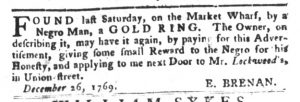
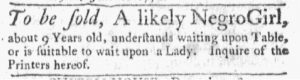
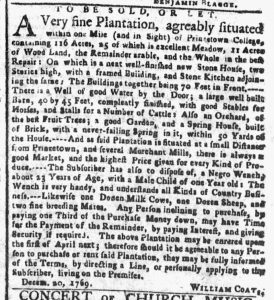
Slavery Advertisements Published January 3, 1770

The Slavery Adverts 250 Project chronicles the role of newspaper advertising in perpetuating slavery in the era of the American Revolution. The project seeks to reveal the ubiquity of slavery in eighteenth-century life from New England to Georgia by republishing advertisements for slaves – for sale, wanted to purchase, runaways, captured fugitives – in daily digests on this site as well as in real time via the @SlaveAdverts250 Twitter feed, utilizing twenty-first-century media to stand in for the print media of the eighteenth century.

The project aims to provide modern audiences with a sense of just how often colonists encountered these advertisements in their daily lives. Enslaved men, women, and children appeared in print somewhere in the colonies almost every single day. Those advertisements served as a constant backdrop for social, cultural, economic, and political life in colonial and revolutionary America. Colonists who did not own slaves were still confronted with slavery as well as invited to maintain the system by purchasing slaves or assisting in the capture of runaways. The frequency of these newspaper advertisements suggests just how embedded slavery was in colonial and revolutionary American culture in everyday interactions beyond the printed page.

These advertisements also testify to the experiences of enslaved men, women, and children, though readers must consider that those experiences have been remediated through descriptions offered by slaveholders rather than the slaves themselves. Often unnamed in the advertisements, enslaved men, women, and children were not invisible or unimportant in early America.

These advertisements appeared in colonial American newspapers 250 years ago today.

Jan 3 1770 - Georgia Gazette Slavery 1
Georgia Gazette (January 3, 1770).

**********

Jan 3 1770 - Georgia Gazette Slavery 2
Georgia Gazette (January 3, 1770).

**********

Jan 3 1770 - Georgia Gazette Slavery 3
Georgia Gazette (January 3, 1770).

**********

Jan 3 1770 - Georgia Gazette Slavery 4
Georgia Gazette (January 3, 1770).

**********

Jan 3 1770 - Georgia Gazette Slavery 5
Georgia Gazette (January 3, 1770).

**********

Jan 3 1770 - Georgia Gazette Slavery 6
Georgia Gazette (January 3, 1770).

**********

Jan 3 1770 - Georgia Gazette Slavery 7
Georgia Gazette (January 3, 1770).

**********

Jan 3 1770 - Georgia Gazette Slavery 8
Georgia Gazette (January 3, 1770).

**********

Jan 3 1770 - Georgia Gazette Slavery 9
Georgia Gazette (January 3, 1770).


January 2

What was advertised in a colonial American newspaper 250 years ago today?

Jan 2 1770 - 1:2:1770 South-Carolina Gazette and Country Journal
South-Carolina Gazette and Country Journal (January 2, 1770).

“NEW ADVERTISEMENTS.”

It has been more than a year since any “NEW ADVERTISEMENTS” from Charles Crouch’s South-Carolina Gazette and Country Journal have been featured on the Adverts 250 Project. Why? The project relies on eighteenth-century newspapers that have been digitized and made available via Accessible Archives’s collection of South Carolina Newspapers, Colonial Williamsburg’s Digital Library, and Readex’s America’s Historical Newspapers. These sources provide extensive access to newspapers published in the colonies in the late 1760s and early 1770s, but they are not comprehensive and complete.

Consider the newspapers printed in Charleston, South Carolina, on the eve of the American Revolution. For nearly a decade before the outbreak of military hostilities, three newspapers circulated in that busy urban port. In addition to Crouch’s South-Carolina Gazette and Country Journal, Peter Timothy published the South-Carolina Gazette and Robert Wells published the South-Carolina and American General Gazette.

Today, all three are available, to varying degrees, via Accessible Archives. That database includes transcriptions of those newspapers as well as digitized images of most issues. However, it does not include such images of issues of the South-Carolina Gazette and Country Journal published in 1769. The transcriptions for that year are certainly valuable, giving scholars and others greater access to the past, but that form of remediation and the methods for navigating that kind of database do not lend themselves well to the Adverts 250 Project. As a result, the South-Carolina Gazette and Country Journal temporarily dropped from both the Adverts 250 Project and, even more significantly, the Slavery Adverts 250 Project. The projects both had good coverage, but not complete coverage, of South Carolina, incorporating two of the three newspapers published in the colony in 1769.

In 2020, the South-Carolina Gazette and Country Journal returns to those projects. The Slavery Adverts 250 Project identifies fourteen advertisements concerning enslaved men, women, and children published in the January 2, 1770, edition of the South-Carolina Gazette and Country Journal. The Adverts 250 Project will examine advertisements for consumer goods and services as well as other kinds of paid notices in the coming months. For the past year, the project has relied on the Essex Gazette, the only newspaper published on Tuesdays in 1769 (with dates that correspond to Thursdays in 2019) available via these databases. As a result, that newspaper has been disproportionately featured in the project.

Having access once again to digitized images of the South-Carolina Gazette and Country Journal will shift the scope of the Adverts 250 Project and the Slavery Adverts 250 Project. This will clearly benefit the Slavery Adverts 250 Project by generating a more complete archive that demonstrates the ubiquity of advertisements concerning enslaved men, women, and children in early America. This also has the potential to benefit the Adverts 250 Project by reducing coverage of the Essex Gazette. On the other hand, having no choice but to feature advertisements from that newspaper guaranteed that a less prominent publication from a smaller town regularly found its ways into the Adverts 250 Project. That is a goal that must continue to be observed, even while featuring the Essex Gazette less often thanks to restored access to the South-Carolina Gazette and Country Journal.

Slavery Advertisements Published January 2, 1770

The Slavery Adverts 250 Project chronicles the role of newspaper advertising in perpetuating slavery in the era of the American Revolution. The project seeks to reveal the ubiquity of slavery in eighteenth-century life from New England to Georgia by republishing advertisements for slaves – for sale, wanted to purchase, runaways, captured fugitives – in daily digests on this site as well as in real time via the @SlaveAdverts250 Twitter feed, utilizing twenty-first-century media to stand in for the print media of the eighteenth century.

The project aims to provide modern audiences with a sense of just how often colonists encountered these advertisements in their daily lives. Enslaved men, women, and children appeared in print somewhere in the colonies almost every single day. Those advertisements served as a constant backdrop for social, cultural, economic, and political life in colonial and revolutionary America. Colonists who did not own slaves were still confronted with slavery as well as invited to maintain the system by purchasing slaves or assisting in the capture of runaways. The frequency of these newspaper advertisements suggests just how embedded slavery was in colonial and revolutionary American culture in everyday interactions beyond the printed page.

These advertisements also testify to the experiences of enslaved men, women, and children, though readers must consider that those experiences have been remediated through descriptions offered by slaveholders rather than the slaves themselves. Often unnamed in the advertisements, enslaved men, women, and children were not invisible or unimportant in early America.

These advertisements appeared in colonial American newspapers 250 years ago today.

Jan 2 1770 - Essex Gazette Slavery 1
Essex Gazette (January 2, 1770).

**********

Jan 2 1770 - South-Carolina Gazette and Country Journal Slavery 1
South-Carolina Gazette and Country Journal (January 2, 1770).

**********

Jan 2 1770 - South-Carolina Gazette and Country Journal Slavery 2
South-Carolina Gazette and Country Journal (January 2, 1770).

**********

Jan 2 1770 - South-Carolina Gazette and Country Journal Slavery 3
South-Carolina Gazette and Country Journal (January 2, 1770).

**********

Jan 2 1770 - South-Carolina Gazette and Country Journal Slavery 4
South-Carolina Gazette and Country Journal (January 2, 1770).

**********

Jan 2 1770 - South-Carolina Gazette and Country Journal Slavery 5
South-Carolina Gazette and Country Journal (January 2, 1770).

**********

Jan 2 1770 - South-Carolina Gazette and Country Journal Slavery 6
South-Carolina Gazette and Country Journal (January 2, 1770).

**********

Jan 2 1770 - South-Carolina Gazette and Country Journal Slavery 7
South-Carolina Gazette and Country Journal (January 2, 1770).

**********

Jan 2 1770 - South-Carolina Gazette and Country Journal Slavery 8
South-Carolina Gazette and Country Journal (January 2, 1770).

**********

Jan 2 1770 - South-Carolina Gazette and Country Journal Slavery 9
South-Carolina Gazette and Country Journal (January 2, 1770).

**********

Jan 2 1770 - South-Carolina Gazette and Country Journal Slavery 10
South-Carolina Gazette and Country Journal (January 2, 1770).

**********

Jan 2 1770 - South-Carolina Gazette and Country Journal Slavery 11
South-Carolina Gazette and Country Journal (January 2, 1770).

**********

Jan 2 1770 - South-Carolina Gazette and Country Journal Slavery 12
South-Carolina Gazette and Country Journal (January 2, 1770).

**********

Jan 2 1770 - South-Carolina Gazette and Country Journal Slavery 13
South-Carolina Gazette and Country Journal (January 2, 1770).

**********

Jan 2 1770 - South-Carolina Gazette and Country Journal Slavery 14
South-Carolina Gazette and Country Journal (January 2, 1770).

January 1

What was advertised in a colonial American newspaper 250 years ago today?

Jan 1 1770 - 1:1:1770 Boston-Gazette
Boston-Gazette (January 1, 1770).

“Imported from LONDON (before the Non-Importation Agreement took Place).”

Cyrus Baldwin hoped for prosperity in the new year, greeting 1770 with an invitation for prospective customers to visit his shop at “the Sign of the Three Nuns and Comb” on Cornhill Street in Boston. His advertisement listed a variety of items in stock, including textiles (“Shalloons, Tammies, Durants” and others), tea, coffee, and “other Articles too many to be here enumerated.” Baldwin made clear that he offered choices to consumers.

He also made clear that he abided by the nonimportation agreement adopted by Boston’s merchants and traders in protest of the duties imposed on imported paper, glass, lead, paint, and tea by the Townshend Acts. Like other eighteenth-century retailers, he noted that his goods were “Imported from LONDON,” but he carefully clarified that they had arrived in the colonies “before the Non-Importation Agreement took Place.” Usually advertisers emphasized how recently their merchandise arrived from London and other English cities, but in this case Baldwin realized that many prospective customers would find items imported more than a year ago more attractive and more politically palatable.

It made sense for Baldwin to take this approach. His advertisement appeared at the bottom of the center column on the first page of the January 1, 1770, edition of the Boston-Gazette. Edes and Gill, the noted patriot printers of that newspaper, set the tone for the entire issue with the first item in the first column: “A LIST of the Names of those who AUDACIOUSLY continue to counteract the UNITED SENTIMENTS of the BODY of Merchants thro’out NORTH-AMERICA, by importing British Goods contrary to the Agreement.” This was a regular update that ran in several newspapers printed in Boston. The article accused six merchants and shopkeepers in Boston and another in Marlborough of preferring “their own little private Advantage to the Welfare of America,” labeling them “Enemies to their Country” and promising to view those who “give them their Custom … in the same disagreeable Light.”

Baldwin wanted that neither for himself nor his customers. He needed to make a living, but he did not wish to run afoul of the committee that oversaw the nonimportation agreement or his fellow colonists. To further demonstrate his compliance, he informed prospective customers that he sold “Red Drapery Baize manufactured in this Country, superior in Quality to those imported from England” in addition to goods that arrived from London many months earlier. The imperial crisis continued as a new year and a new decade began. In addition to news items and editorials, many advertisements for consumer goods and services captured the political tensions of the period.

Slavery Advertisements Published January 1, 1770

The Slavery Adverts 250 Project chronicles the role of newspaper advertising in perpetuating slavery in the era of the American Revolution. The project seeks to reveal the ubiquity of slavery in eighteenth-century life from New England to Georgia by republishing advertisements for slaves – for sale, wanted to purchase, runaways, captured fugitives – in daily digests on this site as well as in real time via the @SlaveAdverts250 Twitter feed, utilizing twenty-first-century media to stand in for the print media of the eighteenth century.

The project aims to provide modern audiences with a sense of just how often colonists encountered these advertisements in their daily lives. Enslaved men, women, and children appeared in print somewhere in the colonies almost every single day. Those advertisements served as a constant backdrop for social, cultural, economic, and political life in colonial and revolutionary America. Colonists who did not own slaves were still confronted with slavery as well as invited to maintain the system by purchasing slaves or assisting in the capture of runaways. The frequency of these newspaper advertisements suggests just how embedded slavery was in colonial and revolutionary American culture in everyday interactions beyond the printed page.

These advertisements also testify to the experiences of enslaved men, women, and children, though readers must consider that those experiences have been remediated through descriptions offered by slaveholders rather than the slaves themselves. Often unnamed in the advertisements, enslaved men, women, and children were not invisible or unimportant in early America.

These advertisements appeared in colonial American newspapers 250 years ago today.

Jan 1 1770 - Boston-Gazette Slavery 1
Boston-Gazette (January 1, 1770).

**********

Jan 1 1770 - Massachusetts Gazette and Boston Post-Boy Slavery 1
Massachusetts Gazette and Boston Post-Boy (January 1, 1770).

**********

Jan 1 1770 - New-York Gazette and Weekly Mercury Slavery 1
New-York Gazette and Weekly Mercury (January 1, 1770).

**********

Jan 1 1770 - New-York Gazette and Weekly Mercury Slavery 2
New-York Gazette and Weekly Mercury (January 1, 1770).

**********

Jan 1 1770 - New-York Gazette and Weekly Mercury Slavery 3
New-York Gazette and Weekly Mercury (January 1, 1770).

**********

Jan 1 1770 - New-York Gazette and Weekly Mercury Slavery 4
New-York Gazette and Weekly Mercury (January 1, 1770).

**********

Jan 1 1770 - New-York Gazette and Weekly Mercury Slavery 5
New-York Gazette and Weekly Mercury (January 1, 1770).

**********

Jan 1 1770 - New-York Gazette and Weekly Mercury Slavery 6
New-York Gazette and Weekly Mercury (January 1, 1770).

**********

Jan 1 1770 - New-York Gazette or Weekly Post-Boy Slavery 1
New-York Gazette or Weekly Post-Boy (January 1, 1770).

**********

Jan 1 1770 - Newport Mercury Slavery 1
Newport Mercury (January 1, 1770).

**********

Jan 1 1770 - Newport Mercury Slavery 2
Newport Mercury (January 1, 1770).

**********

Jan 1 1770 - Newport Mercury Slavery 3
Newport Mercury (January 1, 1770).

**********

Jan 1 1770 - Pennsylvania Chronicle Slavery 1
Pennsylvania Chronicle (January 1, 1770).

**********

Jan 1 1770 - Pennsylvania Chronicle Slavery 2
Pennsylvania Chronicle (January 1, 1770).