
What was advertised in a colonial American newspaper 250 years ago today?
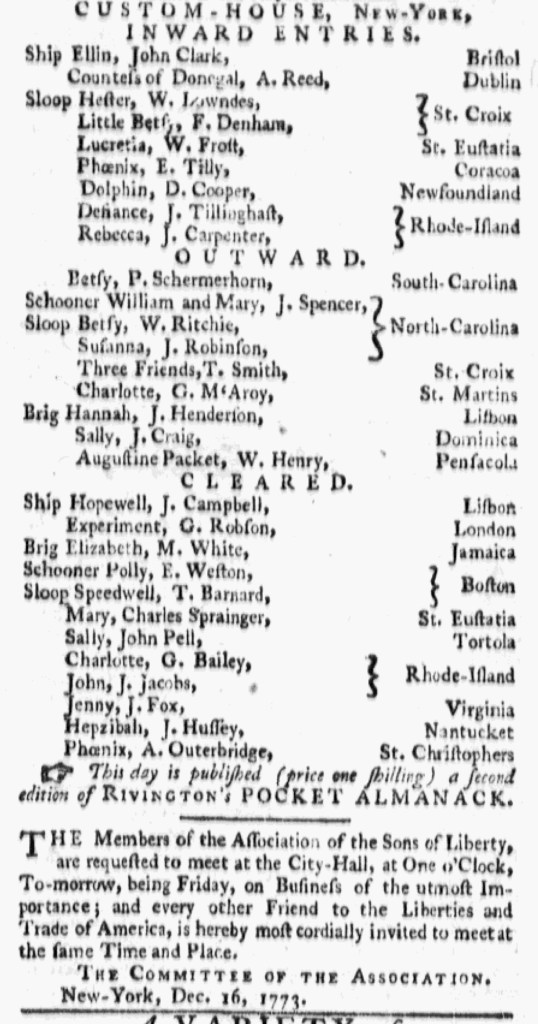
“The Sons of Liberty, are requested to meet at the City-Hall.”
James Rivington, bookseller and printer of Rivington’s New-York Gazetteer, is most often remembered as a Loyalist. He began publishing his newspaper in April 1773. According to Isaiah Thomas, a staunch Patriot printer and author of The History of Printing in America (1810), Rivington’s newspaper “was soon devoted to the royal cause,” yet he does not elaborate on what constituted “soon.”[1] Rivington became so vociferous in expressing Tory sentiments in his newspaper that on November 27, 1775, the Sons of Liberty attacked his printing office and destroyed his press and type. Rivington departed for England, but later returned to New York during the British occupation during the Revolutionary War. He brought a new press and type with him, started publishing his newspaper again, and quickly changed the name to Rivington’s New York Loyal Gazette and then the Royal Gazette. That newspaper continued publication under that title until the end of the war in 1783, then became Rivington’s New-York Gazette. It ceased publication on the final day of that year.
Despite the positions that Rivington ultimately advocated in his newspapers, Thomas acknowledged in his biographical sketch of the printer that “[i]t is but justice to add, that Rivington, for some time, conducted his Gazette with such moderation and impartiality as did him honor.”[2] Thomas reiterated that assessment in his overview of Rivington’s New-York Gazetteer, stating that “for some time Rivington conducted his paper with as much impartiality as most of the editors of that period.”[3] That helps to explain the privileged place that an advertisement placed by the Sons of Liberty occupied in the December 16, 1773, edition of Rivington’s New-York Gazetteer. That notice called on the “Members of the Association of the Sons of Liberty … to meet at the City-Hall” on the following day to discuss “Business of the utmost Importance.” The “COMMITTEE OF THE ASSOCIATION” that placed the advertisement invited “every other Friend to the Liberties and Trade of America” to attend the meeting. Rivington not only published the advertisement, he placed it immediately below the shipping news from the customs house. Like many other colonial newspapers, Rivington’s New-York Gazetteer followed a particular format that placed news items and editorials first, then the shipping news, and finally advertisements. The shipping news, a weekly feature, marked the end of news coverage and the beginning of advertisements. Readers who were not especially interested in perusing the advertisements, many of which repeated from week to week, may have been more likely to take note of the first advertisement that followed the shipping news as they recognized the transition from one type of content to another. That gave the notice from the Sons of Liberty greater visibility than had it appeared embedded among the dozens of advertisements on the next two pages of the newspaper. The savvy Rivington inserted a two-line notice about a pocket almanac he just published, not even separating it from the shipping news, before the announcement by the Sons of Liberty. He certainly tended to his own interests, but he also provided impartial space in the public prints for a while after he commenced publishing Rivington’s New-York Gazetteer.
**********
[1] Isaiah Thomas, The History of Printing in America: With a Biography of Printers and an Account of Newspapers (1810; New York: Weathervane Books, 1970), 479.
[2] Thomas, History of Printing in America, 480.
[3] Thomas, History of Printing in America, 511.