
What was advertised in a colonial American newspaper 250 years ago today?
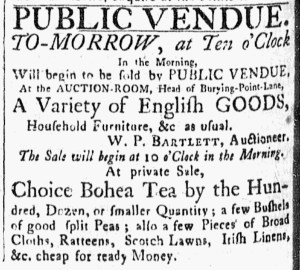
“At private Sale, Choice Bohea Tea.”
Tea, tea, tea. Everyone was talking about tea after Parliament passed the Tea Act in 1773. That legislation allowed the East India Company to sell tea directly in colonies without paying export taxes in London. This reduced the cost of tea for American consumers, but many colonizers resisted because this arrangement included paying duties when the tea was unloaded from the vessels once they arrived in American ports. If they paid those duties, colonizers would implicitly recognize Parliament’s right to tax them. They had rejected such assertions when they protested the Townshend Acts and, as a matter of principle, rejected them once again, even when presented with the prospect of buying tea at lower prices. Many also worried about greater enforcement to prevent smuggling, realizing that they illicit trade also yielded bargain prices.
The talk about tea continued as colonizers anticipated the arrival of ships carrying tea belonging to the East India Company. The talk about tea continued when three of ships arrived in Boston and residents prevented them from unloading their cargo. The talk about tea continued after the destruction of that tea during a protest now known as the Boston Tea Party. The December 28, 1773, edition of the Essex Gazette, for instance, featured plenty of talk about tea. Two of the three columns on the first page covered the “Proceedings of the PEOPLE, previous to the Destruction of the Tea at Boston.” The final column followed up with “the following Particulars respecting that HAPPY EVENT, the Destruction of the East-India Company’s ministerial Tea,” reprinted from the December 23 edition of the Massachusetts Gazette and Boston Weekly News-Letter. At the bottom of that column, a short item with a dateline from “NEWPORT, December 13,” reported that “[b]y a letter from Boston, it seems as though our brethren there had some fears that we should receive the India Company’s detestable Tea; but we think it may be safely affirmed, that it will not be suffered to be sold here.” Furthermore, there would be consequences “if landed, which is scare possible.” The article proclaimed that such tea “will be reshipped on board the LIBERTY, and sent to GASPEE, the first favourable wind or weather,” invoking memories of another significant protest, the burning of the Gaspee in June 1772. Elsewhere in that issue, news articles of varying lengths summarized talk about tea in New York, Philadelphia, and Portsmouth.
Among all that talk about tea, W.P. Bartlett, an auctioneer, advertised “Choice Bohea Tea” available “At private Sale.” In Salem as in Boston, advertising, selling, buying, and drinking tea did not cease immediately as a rection to the Boston Tea Party. Tea remained on the market as colonizers continue to debate what to do about tea and how to continue protesting against the Tea Act.