What was advertised in a colonial American newspaper 250 years ago today?

“GARDEN SEEDS. Just imported … from LONDON.”
Each year the Adverts 250 Project chronicles the marketing efforts of women who sold garden seeds in Boston. The appearance of their advertisements in the several newspapers published in that city heralded the changing of the seasons from winter to spring. They participated in an annual ritual, not unlike printers who began advertising almanacs for the coming year each fall. Their advertisements in the public prints signaled to readers that spring was indeed on its way.
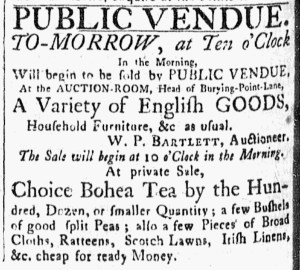
Those advertisements sometimes appeared as early as the middle of February in years before the Continental Association went into effect on December 1, 1774. The First Continental Congress devised that nonimportation agreement in response to the Coercive Acts. By the end of the third week of February 1775, neither Susanna Renken, who was often the first to advertise garden seeds in the Boston press, nor any of her sister seed sellers published any advertisements. In addition to the Continental Association constraining trade, the harbor had been closed to commerce because of the Boston Port Act since June 1, 1774. In Salem, however, W.P. Bartlett advertised a “fresh Assortment of GARDEN SEEDS” in the February 21 edition of the Essex Gazette.
Bartlett reported that the seeds were “JUST IMPORTED, in the Venus, from LONDON.” The “INWARD ENTRIES” from the custom house in the January 24 edition document the arrival of the Venus, establishing Bartlett received the shipment of seeds in the period between December 1, 1774, and February 1, 1775. The tenth article of the Continental Association made provision for goods that arrived during that period, specifying that importers could refuse them, surrender them to the local Committee of Inspection to store while the nonimportation agreement remained in force, or transfer them to the committee to sell to recover the costs with any profits donated for the relief of Boston.
Some advertisements in the Essex Gazette and other newspapers indicated that importers opted for the third option, but other advertisements suggest that some disregarded the Continental Association. In the same issue that carried Bartlett’s advertisement for garden seeds, Stephen Higginson hawked “English and India GOODS” that he “Just IMPORTED in the Venus … from London.” That certainly defied the Continental Association. What about the garden seeds that Bartlett peddled? Did they deserve special consideration since they contributed to the “Frugality, Economy, and Industry” and promotion of “Agriculture, Arts, and the Manufactures of this Country” called for by the eighth article of the Continental Association?