
What was advertised in a colonial American newspaper 250 years ago today?
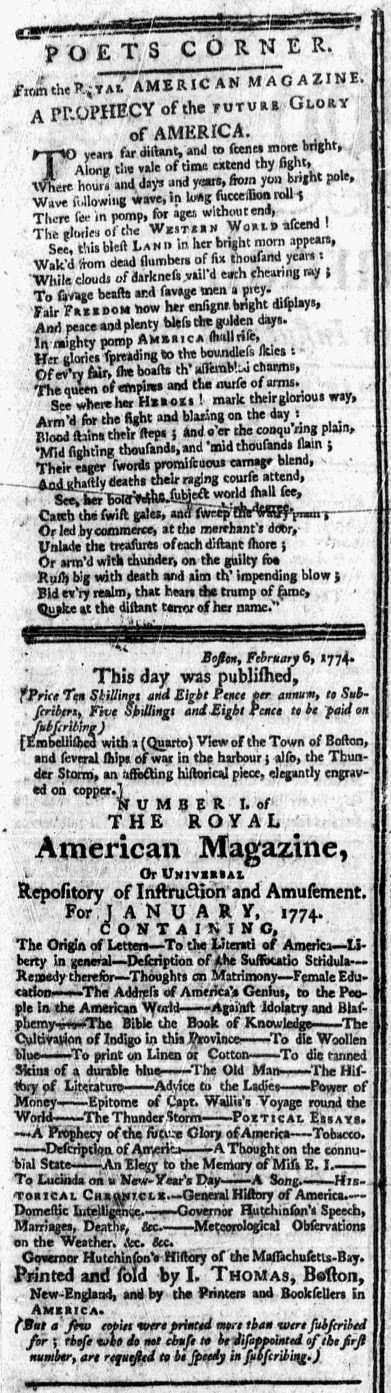
“POETS CORNER. From the ROYAL AMERICAN MAGAZINE.”
Isaiah Thomas, printer of the Massachusetts Spy, continued promoting a new venture, the Royal American Magazine, in the February 24, 1774, edition of his newspaper. He once again ran an advertisement announcing that “This day was published … NUMBER I. of THE ROYAL American Magazine,” noting the price, promoting the two copperplate engravings that accompanied the inaugural issue, listing the contents, and encouraging “those who do not chuse to be disappointed of the first number … to be speedy in subscribing.” That was not the extent of Thomas’s efforts to market the Royal American Magazine in that issue of the Massachusetts Spy. The “POETS CORNER,” a regular feature in the upper left corner of the final page, featured a poem entitled, “A PROPHECY of the FUTURE GLORY of AMERICA.” A note of introduction indicated that the verses came “From the ROYAL AMERICAN MAGAZINE.” Thomas conveniently placed the advertisement for the magazine immediately below the poem, guiding readers toward subscribing.
That was not the only instance of the industrious printer publishing an excerpt from the magazine in his efforts to increase its visibility and gain new subscribers. On February 23, the Essex Journal, a newspaper that Thomas recently launched in Newburyport in partnership with Henry-Walter Tinges, carried the advertisement on the final page and an excerpt “From the Royal American Magazine” on the first page. In this instance, the excerpt was a short essay “Against IDOLATRY and BLASPHEMY” that critiqued the practice of using “epithets” including “Most gracious Sovereign” and “Most excellent Majesty” because they “can justly be applied to none but GOD; and therefore, applying them to men, is idolatry.” The author, identified only as “A CHRISTIAN,” took the opportunity to take a swipe at “Roman catholics … paying divine honours to a vain empty Pope.” Yet they were not much better than “protestants and Englishmen” who were “in some degree partakers of the same guilt.” Americans, on the other hand, could avoid “this sin” by “pay[ing] honour to whom honour is due, among men” and “pay[ing] supreme honour to none by the SUPREME.” In selecting that piece to excerpt, Thomas played to the prejudices of Protestants in New England, many of them descended from Puritans who first colonized the region. The excerpt on the first page and the advertisement on the last page bookended the contents of that issue of the Essex Journal, the reiterating reminding readers to subscribe and read the new magazine.
In both newspapers, Thomas inserted excerpts to create a buzz around the Royal American Magazine. He offered previews to prospective subscribers, both in the list of contents and the excerpts themselves, in hopes of inciting curiosity and demand for the new publication.
[…] in Boston to his partner in Newburyport. Those two newspapers were the only ones that carried excerpts from the Royal American Magazine to entice readers. Except for the Boston-Gazette, each of the newspapers published in Boston […]
[…] office, where he published the Essex Journal in partnership with Thomas. As Tinges had done in connection with the first issue of the magazine, he previewed some of the contents in the Essex Journal. For the weekly selection in the […]