
What was advertised in a colonial American newspaper 250 years ago today?
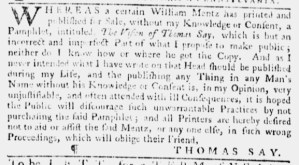
“It is hoped the Public will discourage such unwarrantable Practices by not purchasing the said Pamphlet.”
In the winter of 1774, William Mentz published The Visions of a Certain Tho. Say, of the City of Philadelphia, Which He Saw in a Trance. That pamphlet did not receive attention in the public prints because Mentz advertised it but instead because Thomas Say ran notices repudiating the work. On March 2, Say inserted advertisements in the Pennsylvania Gazette and the Pennsylvania Journal. Five days later, he ran the same notice in Dunlap’s Pennsylvania Packet. He was so intent on disseminating his message as widely as possible that he invested in advertisements in all three of the English-language newspapers published in Philadelphia at the time.
Mentz did not advertise the pamphlet, so Say’s notices may have generated more attention than anything else. Did they have the intended effect? Did colonizers refrain from purchasing the pamphlet because Say reacted so strongly to its publication? Or did the controversy whet their appetites to see what was contained within its pages? Say denounced “a certain Mentz [who] has printed and published for Sale, without my Knowledge or Consent, a Pamphlet … which is but an incorrect and imperfect Part of what I propose to make public.” Furthermore, Say did not know “how or where he got the Copy.” He excoriated Mentz: “publishing any Thing in any Man’s Name without his Knowledge or Consent is, in my Opinion, very unjustifiable, and often attended with ill Consequences.” Addressing the public, Say made a plea that they “will discourage such unwarrantable Practices by not purchasing said Pamphlet.” He also requested that printers neither aid nor assist Mentz “in such wrong Proceedings.”
Did that incite instead of quell demand for the pamphlet? Mentz issued a second version, The Visions of a Certain Thomas Say, of the City of Philadelphia, Which He Saw in a Trance: To Which Is Added, Another Vision. By the Late Reverend Isaac Watts, D.D. Perhaps he did so because Say’s unintended marketing of the pamphlet yielded interest in it. On the other hand, Say may have managed to inhibit sales, prompting Mentz to package the pamphlet with a similar item by a popular author in hopes of rescuing the endeavor from financial failure. Either way, the visibility that the pamphlet received in Philadelphia’s newspapers came solely from Say’s efforts to constrain sales rather than marketing undertaken by the publisher.
[…] One advertisement even discouraged readers from purchasing a book. Thomas Say once again ran his notice pleading with the public to refrain from buying William Mentz’s unauthorized edition of “The […]
[…] Thomas Say, of the City of Philadelphia, Which He Saw in a Trance without permission, Say placed an advertisement in the Pennsylvania Gazette to voice his objection. He described the text as an “incorrect and imperfect” rendition of […]
[…] he saw in a Trance.” Wells was either unaware that Say had disavowed that publication in an advertisement in the Pennsylvania Gazette several months earlier or he disregarded it in favor of generating revenue from selling the curious […]