
What was advertised in a colonial American newspaper 250 years ago today?
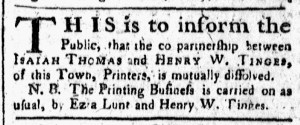
“The co partnership between ISAIAH THOMAS and HENRY W. TINGES, of this Town, Printers, is mutually dissolved.”
When the Essex Journal commenced publication on December 4, 1773, Henry-Walter Tinges printed it in partnership with Isaiah Thomas. Tinges managed the printing office in Newburyport, while Thomas continued printing the Massachusetts Spy in Boston. Less than a year passed before their partnership ended. On August 17, 1774, “No. 35” of the Essex Journal carried a notice “to inform the Public, that the co partnership between ISAIAH THOMAS and HENRY W. TINGES, of this Town, Printers, is mutually dissolved.” A nota bene further explained, “The Printing Business is carried on as usual, by Ezra Lunt and Henry W. Tinges.” The young printer had a new partner. He also updated the colophon on the final page to reflect this change.
Many decades later, Thomas provided a brief account of his partnership with Tinges in The History of Printing in America (1810). Thomas recollected that he “opened a printing house” in Newburyport “[a]t the request of several gentlemen,” taking Tinges as a partner “who had the principal management of the concerns at Newburyport.”[1] The young man had previously “served part of his apprenticeship with [John] Fleming,” one of the Tory printers of the Boston Chronicle, “and the residue with Thomas.”[2] Although the newspaper’s colophon stated that the new printing office in Newburyport accepted job printing orders that would be completed “in a neat manner, on the most reasonable Terms, with the greatest Care and Dispatch,” Tinges devoted most of his time to printing the Essex Journal. Thomas did not specify why the partnership was “mutually dissolved,” though he may have been frustrated that the printing office did not attract more business or distracted with the responsibilities of running his busy shop in Boston at the same time that the closure of the harbor mandated by the Boston Port Act introduced all sorts of challenges. Whatever the reason, Thomas “sold the printing materials to Ezra Lunt, the proprietor of a stage, who was unacquainted with printing; but he took Tinges as a partner.”[3] Tinges contributed his experience and knowledge of the printing trade, while Lunt provided the capital for the necessary equipment. Even though Tinges performed the bulk of the labor in the printing office, his name appeared second in the colophon during his partnership with Thomas and again during his partnership with Lunt. Although he may have taken direction from his partners on occasion, Tinges collated the news, engaged with subscribers, advertisers, and other customers, and disseminated additional information in response to “enquire of the printer” advertisements in the Essex Journal.

**********
[1] Isaiah Thomas, The History of Printing in America: With a Biography of Printers and an Account of Newspapers (1810; New York; Weathervane Books, 1970), 179.
[2] Thomas, History of Printing, 180.
[3] Thomas, History of Printing, 179.