February 15

What was advertised in a colonial American newspaper 250 years ago today?
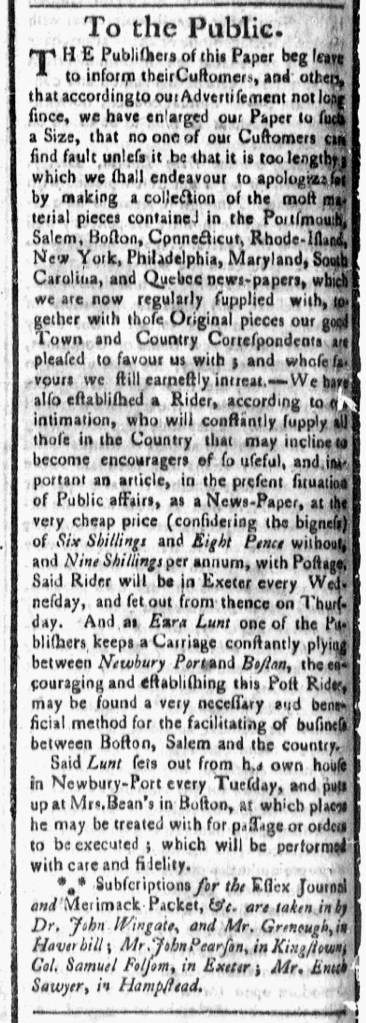
Essex Journal (February 15, 1775).

“We have enlarged our Paper to such a Size, that no one of our Customers can find fault.”

An advertisement in the February 15, 1775, edition of the Essex Journal, printed in Newburyport, Massachusetts, revealed important details about its production and circulation.  Ezra Lunt and Henry-Walter Tinges, the publishers, inserted an address “To the Public” to celebrate that they recently “enlarged our Paper to such a Size, that no one of our Customers can find fault unless it be that it is too lengthy.”  Lunt and Tinges coyly declared that they would “apologize” for the length by “making a collection of the most material pieces contained the Portsmouth, Salem, Boston, Connecticut, Rhode-Island, New York, Philadelphia, Maryland, South Carolina, and Quebec news-papers.”  They asserted that they “are now regularly supplied with” newspapers from all those places.  Like other colonial printers, Lunt and Tinges participated in exchange networks with their counterparts in other cities and towns.  Upon receiving newspapers, they scoured them for content to include in their own publication, usually reprinting articles, editorials, essays, and letters word for word.  One header in the February 15 edition, for instance, stated, “From the Massachusetts Spy.”  They supplemented news from far and wide with “Original pieces our good Town and Country Correspondents are pleased to favour us with.”

Lunt and Tinges’s also gave details about the circulation of the Essex Journal, both where to subscribe and logistics for delivery.  They informed readers that subscriptions “are taken in by Dr. John Wingate, and Mr. Grenough, in Haverhill; Mr. John Pearson, in Kingstown; Col. Samuel Folsom, in Exeter; Mr. Enoch Sawyer, in Hampstead.”  That list of local agents resembled the one that appeared in the colophon of each issue of the Massachusetts Spy, printed by Isaiah Thomas in Boston.  At the bottom of the last page, readers glimpsed an announcement that “J. Larkin, Chairmaker, and Mr. W. Calder, Painter, in Charlestown; Mr. J. Hiller, Watch maker, in Salem; Mr. B. Emerson, Bookseller, in Newbury-Port; Mr. M. Belcher, in Bridgewater; and [] Dr. Elijah Hewins, in Stoughtonham” collected subscriptions for the Massachusetts Spy.  Tinges likely learned about recruiting local agents from Thomas, a founding partner of the Essex Journal.  When it came to delivering the newspaper to subscribers, Lunt and Tinges promoted the services of both a post rider whose route included Exeter, New Hampshire, and the carriage that Lunt operated between Newburyport and Boston.  This network “facilitate[ed] business between Boston, Salem, and the country” in addition to disseminating newspapers.

Intended to increase the number of subscribers (and, in turn, advertisers), this advertisement in the Essex Journal testified to several business practices followed by printers throughout the colonies.  Lunt and Tinges described the various kinds of networks that played a role in gathering subscriptions, collecting news and other content, and delivering newspapers to readers.  Each played a role in making information more widely available to the public during the era of the American Revolution.
December 21

What was advertised in a colonial American newspaper 250 years ago today?

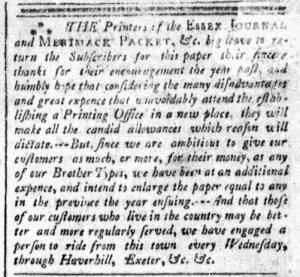
Essex Journal (December 21, 1774).

Intend to enlarge the paper equal to any in the province the year ensuing.”

The Essex Journal and Merimack Packet: Or The Massachusetts and New-Hampshire General Advertiser completed its first year of publication with its December 21, 1774, edition.  For the last time, the masthead stated, “VOL. I.”  The compositor updated that to “VOL. II” the following week.  Isaiah Thomas and Henry-Walter Tinges launched the newspaper, published in Newburyport, with a free preview issue on December 4, 1773, then commenced weekly publication on December 29.  Thomas withdrew from the partnership in August 1774, about the same time that he transferred proprietorship of the Royal American Magazine to Joseph Greenleaf.  Ezra Lunt joined Tinges in publishing the Essex Journal without a disruption in distributing the newspaper to subscribers.  Despite those disruptions and the “many disadvantages and great expence that unavoidably attend the establishing a Printing Office in a new place,” the Essex Journal made it through its first year and continued into a second.

In a notice in the final issue of Volume I, Lunt and Tinges announced their plans to improve and expand the newspaper.  They proclaimed that they “are ambitious to give our customers as much, or more, for their money, as any of our Brother Types” who published the Essex Gazette in Salem, the New-Hampshire Gazette in Portsmouth, or any of the five newspapers printed in Boston at the time.  To that end, Lunt and Tinges confided, “we have been at an additional expence, and intend to enlarge the paper equal to any in the province the year ensuing.”  Furthermore, they sought to improve the newspaper for subscribers in other ways.  In order that “those of our customers who live in the country may be better and more regularly served, we have engaged a person to ride from this town every Wednesday, through Haverhill, Exeter,” and other towns.  Lunt and Tinges published the Essex Journal on Wednesdays.  As soon as the ink dried, they gave copies to a postrider to deliver to subscribers throughout the countryside, improving on the services provided throughout the previous year.

Printers often noted when their newspapers completed another year of publication, often marking the occasion with calls for subscribers and others to settle overdue accounts.  Lunt and Tinges did not make any mention of subscribers who were delinquent in making payment.  Instead, they expressed their appreciation and sketched their plans for the next year, hoping to increase support and enthusiasm for the newest newspaper published in Massachusetts.

August 17

What was advertised in a colonial American newspaper 250 years ago today?

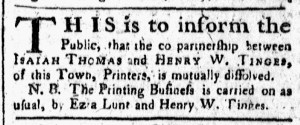
Essex Journal (August 17, 1774).

“The co partnership between ISAIAH THOMAS and HENRY W. TINGES, of this Town, Printers, is mutually dissolved.”

When the Essex Journal commenced publication on December 4, 1773, Henry-Walter Tinges printed it in partnership with Isaiah Thomas.  Tinges managed the printing office in Newburyport, while Thomas continued printing the Massachusetts Spy in Boston.  Less than a year passed before their partnership ended.  On August 17, 1774, “No. 35” of the Essex Journal carried a notice “to inform the Public, that the co partnership between ISAIAH THOMAS and HENRY W. TINGES, of this Town, Printers, is mutually dissolved.”  A nota bene further explained, “The Printing Business is carried on as usual, by Ezra Lunt and Henry W. Tinges.”  The young printer had a new partner.  He also updated the colophon on the final page to reflect this change.

Many decades later, Thomas provided a brief account of his partnership with Tinges in The History of Printing in America (1810).  Thomas recollected that he “opened a printing house” in Newburyport “[a]t the request of several gentlemen,” taking Tinges as a partner “who had the principal management of the concerns at Newburyport.”[1]  The young man had previously “served part of his apprenticeship with [John] Fleming,” one of the Tory printers of the Boston Chronicle, “and the residue with Thomas.”[2]  Although the newspaper’s colophon stated that the new printing office in Newburyport accepted job printing orders that would be completed “in a neat manner, on the most reasonable Terms, with the greatest Care and Dispatch,” Tinges devoted most of his time to printing the Essex Journal.  Thomas did not specify why the partnership was “mutually dissolved,” though he may have been frustrated that the printing office did not attract more business or distracted with the responsibilities of running his busy shop in Boston at the same time that the closure of the harbor mandated by the Boston Port Act introduced all sorts of challenges.  Whatever the reason, Thomas “sold the printing materials to Ezra Lunt, the proprietor of a stage, who was unacquainted with printing; but he took Tinges as a partner.”[3]  Tinges contributed his experience and knowledge of the printing trade, while Lunt provided the capital for the necessary equipment.  Even though Tinges performed the bulk of the labor in the printing office, his name appeared second in the colophon during his partnership with Thomas and again during his partnership with Lunt.  Although he may have taken direction from his partners on occasion, Tinges collated the news, engaged with subscribers, advertisers, and other customers, and disseminated additional information in response to “enquire of the printer” advertisements in the Essex Journal.

Essex Journal (August 17, 1774).

**********

[1] Isaiah Thomas, The History of Printing in America: With a Biography of Printers and an Account of Newspapers (1810; New York; Weathervane Books, 1970), 179.

[2] Thomas, History of Printing, 180.

[3] Thomas, History of Printing, 179.
