
What was advertised in a colonial American newspaper 250 years ago today?
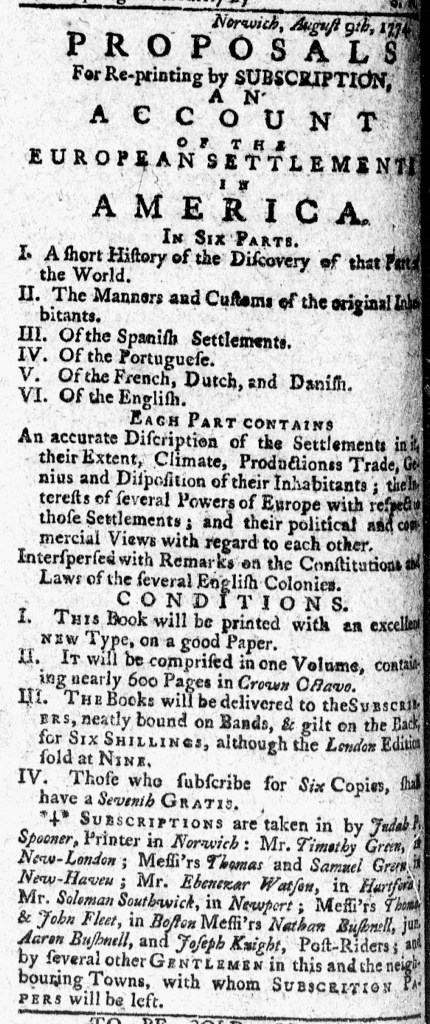
“SUBSCRIPTIONS are taken in by … Post-Riders.”
When Judah P. Spooner, a printer in Norwich, Connecticut, distributed a subscription proposal for reprinting An Account of the European Settlement in America in August 1774, he described the network of local agents in various towns who aided in collecting the names of subscribers and how many copies they wished to order. (Customers who reserved six copies “shall have a Seventh GRATIS.) Those local agents included newspaper printers in Hartford, New Haven, New London, Boston, and Newport, making their printing offices even busier hubs for conducting business and disseminating information. Such partnerships were customary; printers made a regular practice of displaying “SUBSCRIPTION PAPERS” for works proposed by their counterparts in other towns and sometimes even their competitors in their own towns. Spooner also indicated that “several other GENTLEMEN in [Norwich] and the neighbouring Towns” accepted orders.
In addition to the usual sorts of local agents, Spooner stated that “Nathan Bushnell, jun. Aaron Bushnell, and Joseph Knight, Post-Riders,” all accepted subscriptions for the proposed book. The printer entrusted those men with responsibilities beyond delivering letters and newspapers, yet this was not the only instance of them acting as local agents for printers and booksellers. Earlier in the summer of 1774, Solomon Southwick, one of the printers in Spooner’s network of local agents, advertised his edition of The Judgment of Whole Kingdoms and Nations. Readers could acquire copies from him in Newport or from Timothy Green in New London as well as from eight “CONSTITUTIONAL Post-Riders” in several towns in Connecticut. The Bushnells and Knight all appeared in that list of local agents. Presumably the men did not carry copies of the book with them but instead accepted orders, just as they recorded subscriptions to Spooner’s proposed book. A year earlier, Green advertised An Oration, Upon the Beauties of Liberty, offering it for sale in New London and “also at the Printing-Office in Norwich, and by Nathan Bushnell, jun. and Joseph Knight, Post Riders.” Knight not only sold and delivered the pamphlet but was also identified as the publisher on the title page: “Printed by T. Green, for Joseph Knight, Post-Rider.” Throughout the eighteenth century, printers established networks for advertising proposed works and collecting subscriptions. Their efforts depended, in part, on the assistance of post riders, yet it was not until the 1770s that post riders in New England appeared among the lists of local agents in subscription proposals. Previously, such lists had been populated by printers and booksellers along with merchants, lawyers, and other “GENTLEMEN,” but not humble post riders. Recruiting them represented an innovation in the book trades.