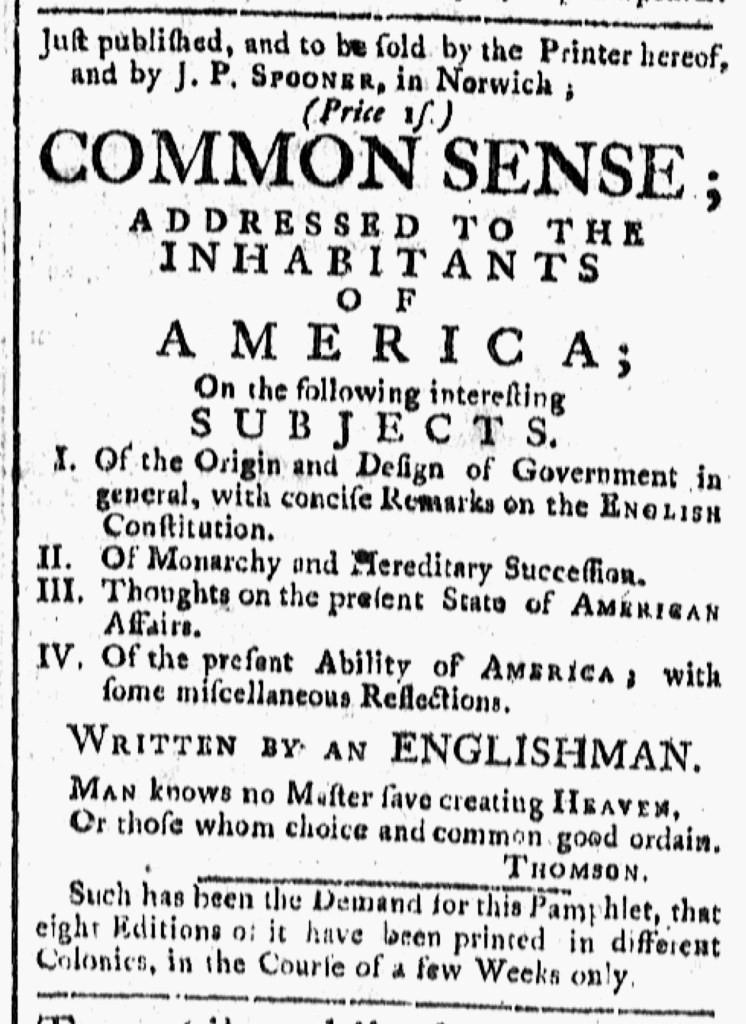
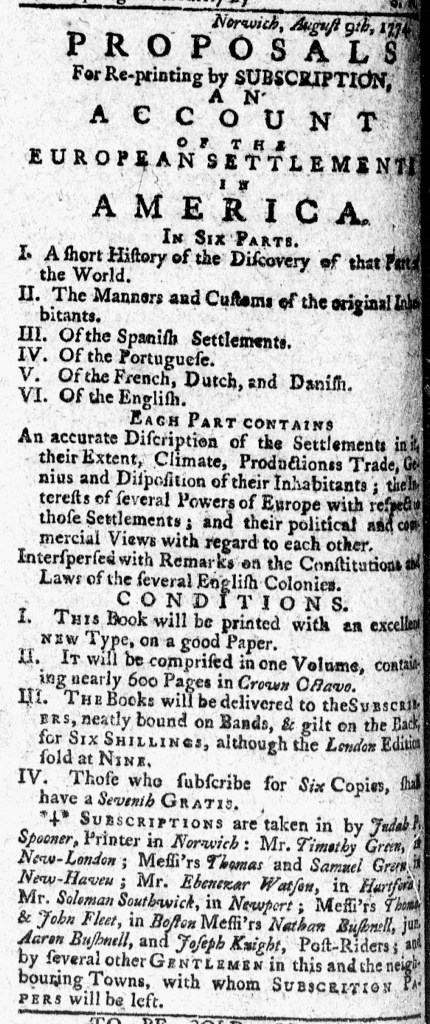
What was advertised in a revolutionary American newspaper 250 years ago today?
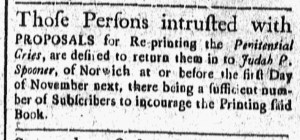
“Persons intrusted with PROPOSALS for Re-printing the Penitential Cries, are desired to return them in to Judah P. Spooner.”
Among the various advertisements in the October 11, 1776, edition of the Connecticut Gazette, one notice instructed “Those Persons intrusted with PROPOSALS for Re-printing the Penitential Cries … to turn them in to Judah P. Spooner, of Norwich at or before the first Day of November next.” This followed a common practice for publishing books in the eighteenth century. Before taking a book to press, printers distributed subscription proposals that promoted the work and gave details about publication (such as price and the quality of the paper and type). They asked consumers to reserve copies by subscribing for them. Printers or local agents acting on their behalf, compiled lists of subscribers. Subscription proposals simultaneously drummed up demand for books and let printers know how many copies to print so they did not end up with surplus copies that resulted in taking a loss on the project. Sometimes subscription proposals did not yield enough subscribers to make a project viable; in those cases, they were an important tool for conducting market research.
According to this advertisement, however, Spooner’s effort to publish Penitential Cries did attract “a sufficient number of Subscribers to incourage the Printing said Book.” Now he needed to add any subscribers not yet brought to his attention to his list so he could print copies for all of them and perhaps a small number of unclaimed copies in hopes of making additional sales. Spooner likely proposed publishing John Mason’s Spiritual Songs: Or, Songs of Praise with Penitential Cries to Almighty God, upon Several Occasions. At least five editions had been printed in the colonies, including a “fifteenth edition corrected” printed by Thomas Fleet for bookseller Daniel Henchman in Boston in 1742 and, most recently, a “sixteenth edition corrected” printed by Thomas Fleet and John Fleet in Boston in 1774. (References to the edition did not always align. For instance, Hugh Gaine printed a “seventeenth edition, corrected,” in New York in 1765, nearly a decade before the Fleets published their “sixteenth edition corrected.” Zachariah Fowle also published a “seventeenth edition, corrected,” in Boston in 1765.)
Seeking to publish a book was a bold venture in the fall of 1776. The war caused all sorts of disruptions; in particular, printers scrambled for paper to continue publishing their newspapers. They frequently ran advertisements calling for readers to provide rags to recycle into paper, sometimes warning that the fate of the newspaper itself depended on compliance with those requests. Spooner apparently thought that he had access to the paper he needed in addition to “a sufficient number of Subscribers.” If he did print the book, however, no copy survives. The next known American edition was indeed printed in Norwich, but not until 1783 when John Trumbull, the printer of the Norwich Packet, published his “fifteenth edition.” Spooner’s advertisement suggested that he was on the brink of successfully printing the book, but gathering attracting subscribers may not have been enough. Other circumstances likely prevented him from finishing the project.