
What was advertised in a colonial American newspaper 250 years ago today?
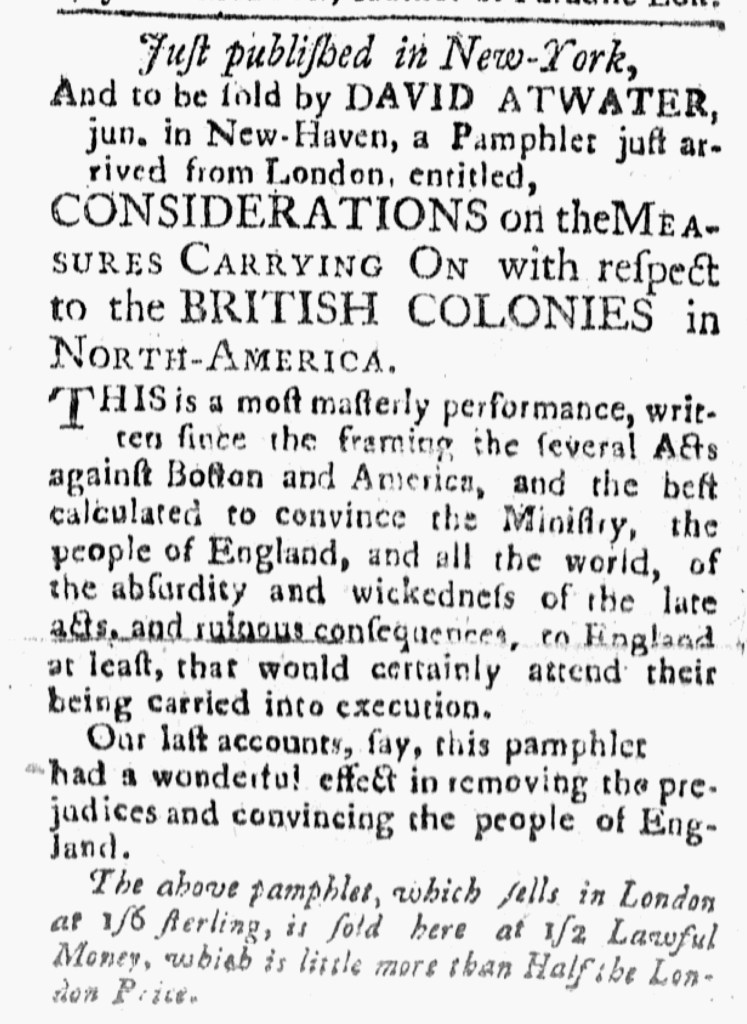
“Just published in New-York, And to be sold … in New-Haven, a Pamphlet just arrived from London.”
Printers in several cities published American editions of Considerations on the Measures Carrying On with Respect to the British Colonies in North-America in 1774, including Benjamin Edes and John Gill in Boston, John Holt in New York, Benjamin Towne in Philadelphia, and Ebenezer Watson in Hartford. The Adverts 250 Project has examined advertisements for this “Pamphlet just arrived from London” that Edes and Gill ran in their own Boston-Gazette and Holt ran in his own New-York Journal. Both newspapers had reputations for ardently supporting the patriot cause, making it no surprise that their printers would publish and sell a tract outlining the “absurdity and wickedness” of the Coercive Acts that Parliament passed in retaliation for the Boston Tea Party.
Other colonizers joined those printers in their efforts to disseminate the pamphlet. At the end of August, for instance, the Connecticut Journal carried an advertisement that promoted the edition “Just published in New-York” by Holt. Readers could purchase it from David Atwater, Jr., in New Haven. In addition to supplying Atwater with copies of the pamphlet, Holt also provided the copy for the advertisement. After the introduction that listed Atwater as the local agent who sold the pamphlet, the main body of the advertisement featured copy identical to Holt’s advertisement. It was the same copy that Edes and Gill appropriated for their advertisement. Atwater made one small revision to the final note, adjusting the price to suit the currency in Connecticut.
That four printing offices published the pamphlet suggests that it circulated widely in New England, New York, and Pennsylvania. However, printing and advertising the tract did not necessarily result in sales. On the other hand, Edes and Gill produced multiple editions, suggesting that they did indeed find buyers for it. Even if readers did not choose to purchase the pamphlet, they encountered the same rhetoric about the “ruinous consequences” of the Coercive Acts when they perused newspaper advertisements. As short editorials, those notices buttressed the arguments made in news items and letters that were reprinted from newspaper to newspaper throughout the colonies.