September 9

What was advertised in a colonial American newspaper 250 years ago today?
Connecticut Gazette (September 9, 1774).

“CONSIDERATIONS on the Measures carrying on by GREAT BRITAIN, against the Colonies in North-America.”

As the number of American editions of Considerations on the Measures Carrying On with Respect to the British Colonies in North-America increased in 1774, so did the number of newspapers that carried advertisements for the political tract.  John Holt, the printer of the New-York Journal, advertised his edition.  Benjamin Edes and John Gill, the printers of the Boston-Gazette, did so as well for their edition.  Ebenezer Watson, printer of the Connecticut Courant, ran his own advertisement when he published a Hartford edition.  Yet it was not solely the printers of the various American editions who advertised or sold the popular pamphlet.  Watson listed local agents in eight towns and two post riders who sold his edition.  David Atwater advertised the New York edition for sale in New Haven in the Connecticut Journal.

Timothy Green, printer of the Connecticut Gazette, joined their ranks with an advertisement in the September 9, 1774, edition of his newspaper.  That made the pamphlet available for purchase in New London in addition to other towns in New England and New York.  Compared to the other advertisements, however, Green’s notice was quite brief, just three lines that completed the column following “THOMAS ALLEN’S Marine List,” a regular feature, on the third page.  “TO BE SOLD by T. GREEN, CONSIDERATIONS on the Measures carrying on by GREAT BRITAIN, against the Colonies in North-America.”  Green did not provide any of the elaborate description about how well the pamphlet had been received in London and how it had influenced residents there to support the American colonies against the abuses perpetrated by Parliament, nor did he encourage readers to review it for themselves so they could be better informed.  Perhaps he expected that the news he printed throughout the rest of his newspaper and the conversations about current events taking place everywhere anyone went those days provided enough reason for colonizers to acquire the pamphlet.  He also did not state which edition he sold, though the variant title in his advertisement suggests that he carried Watson’s Hartford edition.  In stocking and promoting the pamphlet, Green joined printers, post riders, and others in disseminating a political tract intended to influence colonizers and help them in articulating their grievances against Parliament.

September 6

What was advertised in a colonial American newspaper 250 years ago today?

Connecticut Courant (September 6, 1774).

This celebrated Performance … had a wonderful Operation on the Minds of that People.”

A popular political pamphlet originally printed in London and reprinted in four towns in the colonies made another appearance among the advertisements in the September 6, 1774, edition of the Connecticut Courant.  In this instance, Ebenezer Watson, the printer of that newspaper, promoted his own edition of Considerations on the Measures Carrying On with Respect to the British Colonies in North-America produced at his printing office in Hartford.  By that time, John Holt, printer of the New-York Journal, and Benjamin Edes and John Gill, printers of the Boston-Gazette, had already advertised their own editions of the tract.  In New Haven, David Atwater advertised and sold Holt’s New York edition.

Those advertisers replicated the copy from one notice to another.  For his part, however Watson devised his own copy, though he had likely seen at least some of the other advertisements as he scoured other newspapers for content to reprint in the Connecticut Courant.  Watson even offered a variant title in his advertisement, “CONSIDERATIONS On the Measures carrying on by GREAT-BRITAIN, Against the Colonies in NORTH-AMERICA,” though the title on the title page of the pamphlet itself was consistent with the original London edition and the others reprinted in the colonies.  Although Watson did not directly borrow copy from the other advertisements circulating at the time, he seems to have been inspired by them enough to paraphrase from them.  “This celebrated performance” (rather than a “most masterly performance”), he proclaimed, “was first published in England, and had a wonderful Operation on the Minds of that People, in eradicating their Prejudices against the Inhabitants of America.”  In comparison, the other advertisements declared that the tract “had a wonderful effect in removing the prejudices and convincing the people of England.”  Other advertisers commented on the price of American editions compared to the London edition.  Watson did so more elaborately, stating that a “Book so highly admired, and so wonderfully calculated to open blind Eyes, ought to be in the hands” of colonizers throughout America.  That convinced him “to sell it as cheap as he can possibly afford it” without losing money on it.

To disseminate the pamphlet widely, Watson enlisted the aid of local agents in several towns, including Canaan, Farmington, Great Barrington, Litchfield, Middletown, Norfolk, Sheffield, Simsbury, and Torringford.  In addition, readers could acquire copies from two post riders, Joseph Knight and Amos Alden.  As printers in New England marketed a variety of books and pamphlets related to the imperial crisis in the mid 1770s, some of them integrated post riders into their distribution networks in new ways.  They made a point of naming post riders as agents who sold these publications, entrusting them with responsibilities beyond delivering items that buyers ordered from a local dignitary or directly from the printer.  This made post riders’ role in keeping colonizers informed about arguments critiquing Parliament even more visible as they became active proponents rather than mere messengers.

August 26

What was advertised in a colonial American newspaper 250 years ago today?

Supplement to the Connecticut Journal (August 26, 1774).

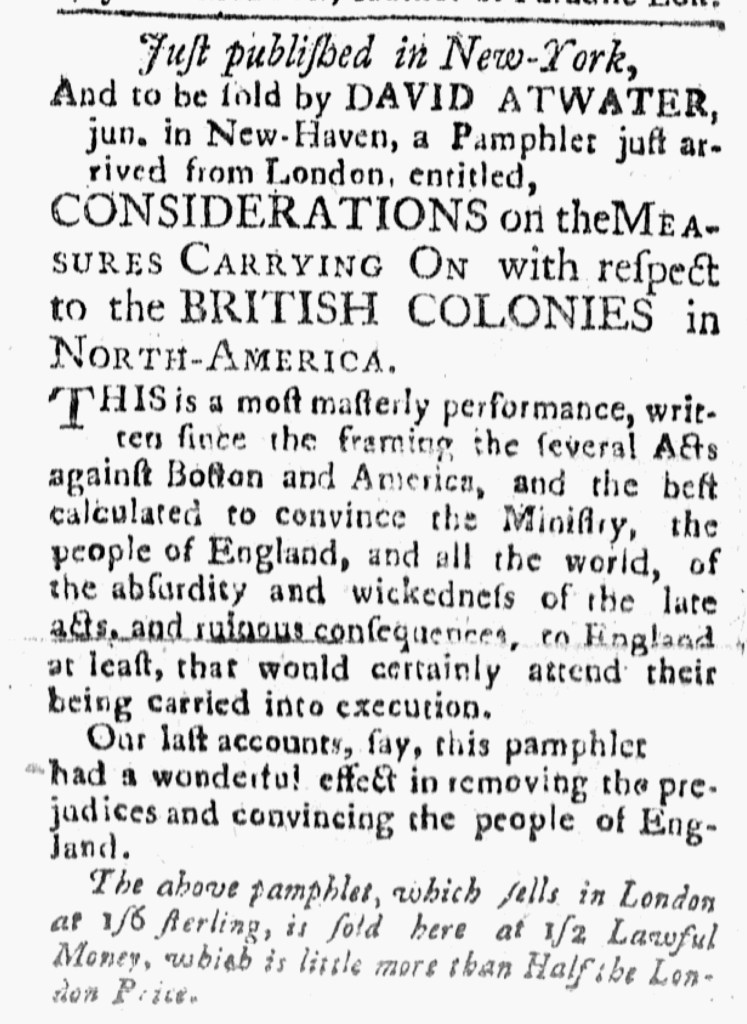
Just published in New-York, And to be sold … in New-Haven, a Pamphlet just arrived from London.”

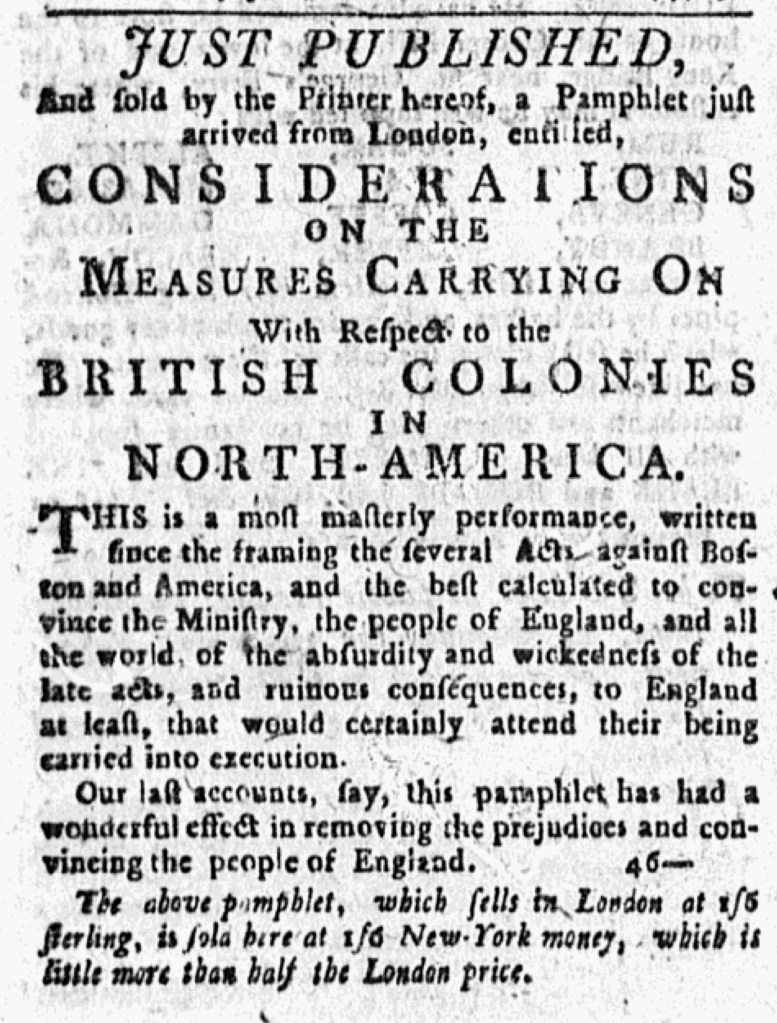
Printers in several cities published American editions of Considerations on the Measures Carrying On with Respect to the British Colonies in North-America in 1774, including Benjamin Edes and John Gill in Boston, John Holt in New York, Benjamin Towne in Philadelphia, and Ebenezer Watson in Hartford.  The Adverts 250 Project has examined advertisements for this “Pamphlet just arrived from London” that Edes and Gill ran in their own Boston-Gazette and Holt ran in his own New-York Journal.  Both newspapers had reputations for ardently supporting the patriot cause, making it no surprise that their printers would publish and sell a tract outlining the “absurdity and wickedness” of the Coercive Acts that Parliament passed in retaliation for the Boston Tea Party.

Other colonizers joined those printers in their efforts to disseminate the pamphlet.  At the end of August, for instance, the Connecticut Journal carried an advertisement that promoted the edition “Just published in New-York” by Holt.  Readers could purchase it from David Atwater, Jr., in New Haven.  In addition to supplying Atwater with copies of the pamphlet, Holt also provided the copy for the advertisement.  After the introduction that listed Atwater as the local agent who sold the pamphlet, the main body of the advertisement featured copy identical to Holt’s advertisement.  It was the same copy that Edes and Gill appropriated for their advertisement.  Atwater made one small revision to the final note, adjusting the price to suit the currency in Connecticut.

That four printing offices published the pamphlet suggests that it circulated widely in New England, New York, and Pennsylvania.  However, printing and advertising the tract did not necessarily result in sales.  On the other hand, Edes and Gill produced multiple editions, suggesting that they did indeed find buyers for it.  Even if readers did not choose to purchase the pamphlet, they encountered the same rhetoric about the “ruinous consequences” of the Coercive Acts when they perused newspaper advertisements.  As short editorials, those notices buttressed the arguments made in news items and letters that were reprinted from newspaper to newspaper throughout the colonies.

August 21

What was advertised in a colonial American newspaper 250 years ago this week?

Supplement to the New-York Journal (August 18, 1774).

Sold here at 1s6 New-York money, which is little more than half the London price.”

The Adverts 250 Project previously examined an advertisement for a political tract, Considerations on the Measures Carrying On with Respect to the British Colonies in North-America, that appeared in a prominent place in the August 1, 1774, edition of the Boston-Gazette, attributing the copy to Benjamin Edes and John Gill, the printers of that newspaper and the Boston edition of the pamphlet.  Yet Edes and Gill were not the only printers to produce an American edition of Considerations, nor were they the first to advertise it.  When they did, they borrowed advertising copy that previously appeared when John Holt marketed his edition in the New-York Journal.

Holt first announced publication of a New York edition of this “Pamphlet just arrived from London” on July 21.  When Edes and Gill advertised the same pamphlet eleven days later, they used copy identical to Holt’s advertisement, embellishing it with a quotation from Phillippe de Commines that appeared on the title page of the pamphlet.  As was often the case with advertisements for books and pamphlets, the printers did not devise any of the copy on their own, except for “THIS DAY PUBLISHED, (Price 9d.) And sold by EDES and GILL, in Queen-Street.”  Holt may have written the copy that lauded the pamphlet as a “most masterly performance” against the Coercive Acts and reported on its reception in England when he first advertised the pamphlet, though he could have borrowed that overview from someone else, just as Edes and Gill appropriated it from him.  Either way, Holt did eventually make an addition to his advertisement. After it ran twice, he added a note that the pamphlet “sells in London at 1s5 sterling” yet “is sold here at 1s6 New-York money, which is little more than half the London price.”  That suggests that the initial appeals might not have been enough to convince readers to buy the tract, no matter how much they may have been interested in the arguments it made about current events.  The printer found it necessary to add an appeal to price in hopes of selling the pamphlet.  Holt and other patriot printers sought to spread the rhetoric of the American Revolution (and generate revenues for themselves in the process), but doing so required more than merely announcing political pamphlets for sale.  Their advertisements aimed to convince colonizers, even those already sympathetic to their cause, to purchase the books and pamphlets about politics and political philosophy they printed and sold.

August 1

What was advertised in a colonial American newspaper 250 years ago today?

Boston-Gazette (August 1, 1774).

“This pamphlet has had a wonderful effect in removing the prejudices and convincing the people of England.”

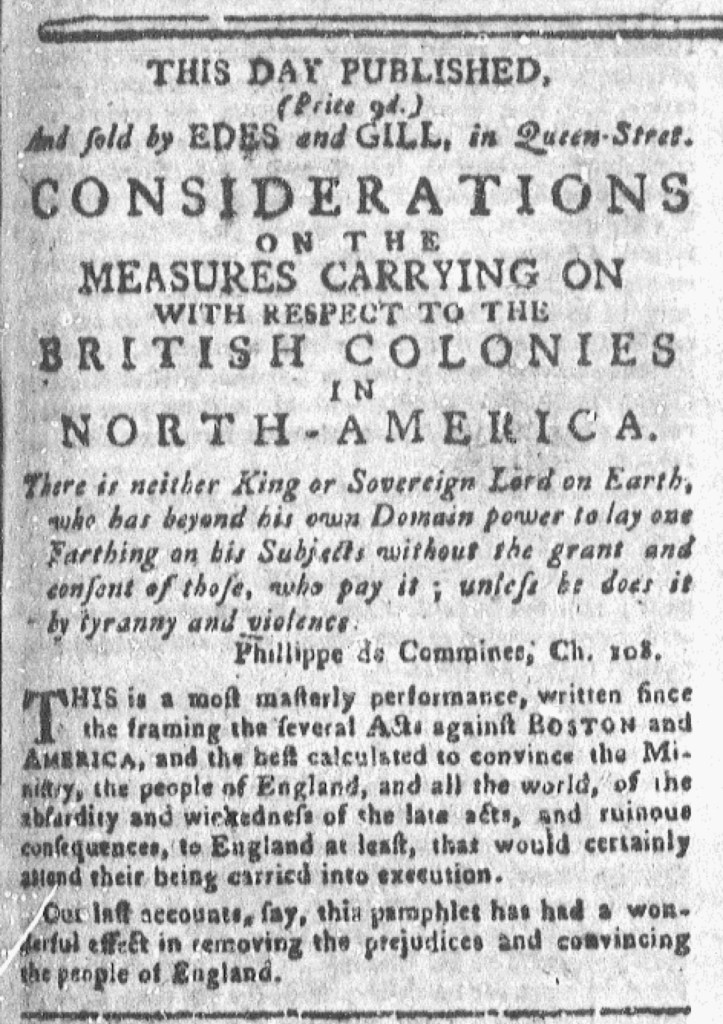
Benjamin Edes and John Gill, the printers of the Boston-Gazette, gave an advertisement for their American edition of Considerations on the Measures Carrying On with Respect to the British Colonies in North-America a prominent place in the August 1, 1774, edition of their newspaper.  It appeared as the first item in the first column on the first page, making it difficult for readers to miss.  The printers wished to call attention to the book, originally published in London, not only because they hoped to generate revenue from its sales but also as a means for colonizers to become even better informed about current events and the political challenges they faced as Parliament passed a series of laws, the Coercive Acts, following the Boston Tea Party.  As the imperial crisis intensified, patriot printers like Edes and Gill published newspapers, broadsides, pamphlets, books, and other items that documented the ongoing contest with Parliament, the king, and royal officials in the colonies.

To convince prospective customers of the necessity of purchasing and perusing this pamphlet, Edes and Gill explained that it was the “most masterly performance, written since the framing of the several Acts against BOSTON and AMERICA,” including the Boston Port Act and the Massachusetts Government Act, and “the best calculated to convince the Ministry, the people of England, and all the world, of the absurdity and wickedness of the late acts.”  Colonizers used newspapers and other publications in their efforts to shape opinion in the colonies, yet they were just as concerned with the information environment on the other side of the Atlantic.  In their publications and letters, they hoped to sway both officials and the general public in London and throughout Great Britain.  They also took note of the support they received for their plight.  In their advertisement for Considerations, Edes and Gill reported that their “last accounts” indicated “this pamphlet had had a wonderful effect in removing the prejudices and convincing the people of England” that Parliament had not been just in its treatment of the colonies.  Whether that was accurate or wishful thinking likely varied from person to person, but the printers wanted to believe that it was true.

Edes and Gill applauded how the pamphlet made a case about the “ruinous consequences, to England at least,” not just the colonies, “that would certainly attend” from the Coercive Acts “being carried into execution.”  Printers in Hartford, New York, and Philadelphia shared those sentiments, producing other American editions in each of those towns.  They hoped that the dissemination of the ideas expressed in Considerations would buttress the resolve of colonizers distressed by Parliament’s most recent legislation, especially upon learning how their allies in England made a case on their behalf.