
Who was the subject of an advertisement in a colonial American newspaper 250 years ago this week?
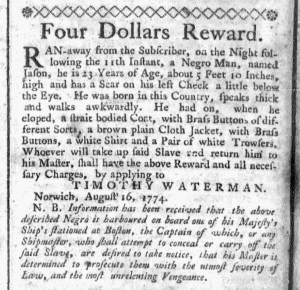
“RAN-away … a Negro Man named Jason.”
Like every other newspaper published in the colonies, from New England to Georgia, during the era of the American Revolution, the Norwich Packet carried advertisements that described enslaved men and women who liberated themselves by running away from their enslavers. Such advertisements encouraged all colonizers to engage in surveillance of Black bodies to determine whether the people they encountered matched descriptions in the newspapers, offering rewards to those who provided information or captured and returned fugitives seeking freedom.
One such advertisement appeared as summer turned to fall in 1774. Jason, an enslaved man “born in this Country,” departed sometime during the night of August 11. Timothy Waterman of Norwich spent a few days trying to find Jason on his before resorting to a newspaper advertisement dated August 16. It first ran in the August 18 edition of the Norwich Packet and appeared again on August 25. For its third iteration in the weekly newspaper, Waterman’s notice included a nota bene with an update: “Information has been received that the above described Negro is harboured on board one of his Majesty’s Ship’s stationed at Boston.” Waterman did not reveal the source of this information. Perhaps his advertisement and its dissemination far beyond Norwich yielded this lead. Waterman warned the captain of that vessel “or any Shipmaster” that should they “attempt to conceal or carry off said slave … that his Master is determined to prosecute them with the utmost severity of Law, and the most unrelenting Vengeance.” He sought to combine the power of the press and the power of the state in his effort to retrieve Jason and return him to enslavement.
Waterman also expected that the Norwich Packet and the Connecticut, Massachusetts, New-Hampshire, and Rhode-Island Weekly Advertiser circulated widely enough that ship captains in Boston would either see his advertisement or otherwise become aware of it. The information infrastructure worked in favor of enslavers and against enslaved men and women who made their own declarations of independence during the era of the American Revolution. That so many of these advertisements appeared in colonial newspapers, year after year, decade after decade, suggests that they must have been effective, at least to some degree, or else enslavers would not have continued investing in them.