What was advertised in a revolutionary American newspaper 250 years ago today?
Norwich Packet (September 23, 1776).
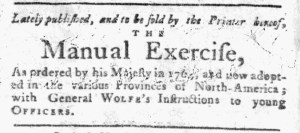
“Lately published … THE Manual Exercise.”
As fall arrived in 1776, John Trumbull inserted an advertisement for “THE Manual Exercise, As ordered by his Majesty in 1764, and now adopted in the various Provinces of North-America” in his newspaper, the Norwich Packet. He described the military manual as “Lately published, and to be sold by the Printer hereof.” Eighteenth-century readers understood that “Lately published” did not mean that it just came off the press. Instead, it meant that the book had been published and was available rather than being in the proposal or preparation stage. After all, advertisements proposing to publish many books ran in early American newspapers, but not all of them garnered enough demand that printers moved beyond merely gauging interest in them.
Local editions of this military manual, The Manual Exercise as Ordered by His Majesty in 1764: Together with Plans and Explanations of the Method Generally Practised at Reviews and Field-Days, had been published in at least ten towns from Massachusetts to Virginia in 1774 and 1775. It did so well that some printers issued second editions. Such had been the case with John Trumbull and his former partners, Alexander Robertson and James Roberston. They published their first Norwich edition in 1774 and a second Norwich edition in 1775. When Trumbull advertised the book in the fall of 1776, he did not promote a new edition but instead sought to sell remaining copies of the 1775 that he published with his former partners, Loyalists who had since moved to New York. His latest advertisement indicated that the manual included “General WOLFE’s Instructions to young OFFICERS.” The Robertsons and Trumbull previously added that content to the second Norwich edition, further evidence that Trumbull now hawked that book rather than a new edition. In asserting that it was “Lately published,” the printer did not claim that the military manual just hit the market but rather that production was complete and copies were available for sale immediately.
What was advertised in a revolutionary American newspaper 250 years ago today?
Norwich Packet (August 26, 1776).
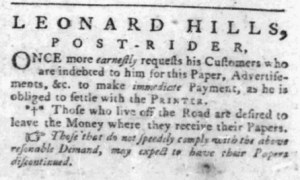
“Those who live off the Road are desired to leave the Money where they receive their Papers.”
During the era of the American Revolution, newspapers often featured advertisements from the post riders who delivered them to readers beyond the cities and towns where they were printed. Sometimes the post riders promoted their services, seeking new customers, but other times they called on current customers to pay for their services. Like newspaper printers, post riders extended credit to their patrons and, in turn, experienced similar difficulties in collecting from them.
Such was the case for Leonard Hills, a post rider who carried the Norwich Packet; and the Connecticut, Massachusetts, New-Hampshire & Rhode-Island Weekly Advertiser to subscribers in New England. With a hint of exasperation, he declared that he “ONCE more earnestly requests his Customers who are indebted to him … to make immediate payment” in an advertisement in the August 26, 1776, edition. Hills warned of the consequences, drawing attention with both a manicule and italics: “Those that do not speedily comply with the above reasonable Demand, may expect to have their Papers discontinued.”
Who would make that decision? The advertisement suggested that Hills made it rather than the printer, John Trumbull. The advertisement also revealed other aspects of how the service worked. “Those who live off the Road,” Hills instructed, “are desired to leave the Money where they receive their Papers.” The post rider did not deliver the Norwich Packet to every subscriber along his route. Instead, he left the right number of copies at a central location, such as a tavern, for subscribers to retrieve when they had a chance. Local agents thus assisted in distributing the newspapers once Hills dropped them off. Hills also stated that he was “obliged to settle with the PRINTER,” indicating that Trumbull did not directly handle subscriptions along Hills’s route. Instead, the post rider sold and managed those subscriptions. He also called on his customers to pay for “this Paper, Advertisements, &c.” That suggested that Hills served as an intermediary who handled advertisements that his customers placed in the Norwich Packet (and did so on credit rather than being required to pay for advertisements in advance) and that the post rider sold other items, perhaps almanacs or books. Hills’s notice revealed all sort of details about the services he provided. As a post rider, he assumed many responsibilities beyond merely deliver newspapers.
What was advertised in a revolutionary American newspaper 250 years ago today?
Norwich Packet (August 12, 1776).
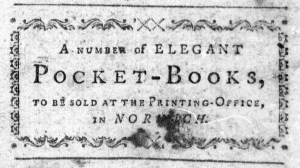
“A NUMBER OF ELEGANT POCKET-BOOKS, TO BE SOLD AT THE PRINTING-OFFICE.”
More than a dozen advertisements appeared in the August 12, 1776, edition of the Norwich Packet. Among them, Leonard Hills, a post rider, called on delinquent customers to pay for his services, William Mansfield sought to hire a journeyman shoemaker, and John Baker Brimmer solicited “Small Furrs, Bees-Wax, OLD COPPER AND PEWTER.” In separate advertisements, Peabody Clement and Peter Lanman each offered rewards for the return of lost pocketbooks, while Thomas Adams advertised that he had “TAKEN up … a bay Mare” and would return it to the owner upon “proving his Property” and paying for expenses.
Norwich Packet (August 12, 1776).
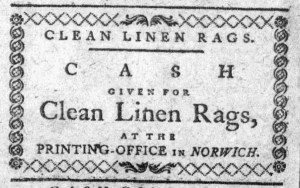
Even though the compositor used a variety of fonts to draw attention to each advertisement, only two of them featured borders made of decorative type. Both concerned business conducted “AT THE PRINTING-OFFICE IN NORWICH.” One announced, “A NUMBER of ELEGANT POCKET-BOOKS, TO BE SOLD AT THE PRINTING OFFICE.” If they checked the newspaper to confirm that their advertisements did indeed appear, Clement and Lanman likely spotted the notice that informed them where they could purchase replacements for their lost pocketbooks, though John Trumbull, the printer, certainly hoped to attract other customers as well. The other decorative border enclosed a call for “CLEAN LINEN RAGS” that the printer would recycle at the paper mill and, in turn, use to publish subsequent issues of theNorwich Packet. Trumbull promised “CASH … FOR Clean Linen Rags.” Similar notices appeared in newspapers throughout the new nation, though not usually spruced up with printing ornaments. In addition, the advertisements with borders did not run on the same page. That further distinguished each of them since readers would spot only one at a time. Neither border was especially sophisticated, but they did not need to be to serve their purpose. They only needed to create visual interest that enhanced their visibility compared to news and other advertisements. Trumbull exercised his discretion as printer to give his notices an advantage.
What was advertised in a revolutionary American newspaper 250 years ago today?
Norwich Packet (June 3, 1776).
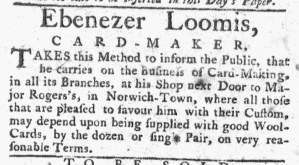
“Good Wool-Cards, by the dozen or single Pair, on very reasonable Terms.”
Readers who perused the June 3, 1776, edition of the Norwich Packet from the first page to the last page first encountered advertisements on the third page, starting with a notice from Ebenezer Loomis, “CARD-MAKER.” That Loomis’s advertisement appeared first was likely an accident rather than a deliberate decision made by the compositor or an arrangement made by the advertiser when he submitted the copy to the printing office. After all, Loomis’s notice did not have such a privileged place when it ran at the bottom of a column in the next issue of the Norwich Packet. The compositor placed it where it would fit.
No matter where his advertisement appeared in the newspaper, Loomis wanted readers to take note of the product he made and the service he performed in support of the American cause. Not every purveyor of goods and services used their occupation as a secondary headline to draw attention to their advertisements, but the “CARD-MAKER” did so and increased the visibility of his venture for readers who might not otherwise pause to read the paragraph that followed. Those who wanted to know more learned that Loomis “carries on the Business of Card-Making, in all its Branches … in Norwich-Town” when they read the short paragraph below the headlines that gave his name and occupation. Those “Wool-Cards” were small paddles with fine wire teeth used to separate and straighten the fibers, making wool easier to spin. They were essential tools for producing textiles, an endeavor that gained in economic and political significance due to nonimportation agreements adopted during the imperial crisis and the disruptions caused by the Revolutionary War. The eighth article of Continental Association, for instance, declared that “we will, in our several Stations, encourage Frugality, Economy, and Industry; and promote Agriculture, Arts, and the Manufactures of this Country, especially that of Wool.” That meant more than raising sheep. It also meant producing equipment, such as cards, spinning wheels, and looms, for processing wool and making textiles. Loomis did his part in that effort, making and selling “good Wool-Cards, by the dozen or single Pair, on very reasonable Terms.”
What was advertised in a revolutionary American newspaper 250 years ago today?
Norwich Packet (May 6, 1776).
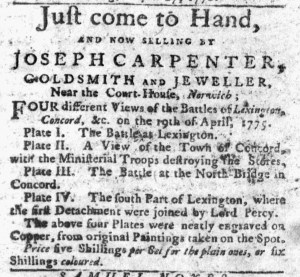
“FOUR different Views of the Battles of Lexington, Concord, &c. on the 19th of April, 1775.”
With the war now in its second year, Joseph Carpenter, a goldsmith and jeweler, marketed a series of commemorative prints depicting the battles of Lexington and Concord that he sold at his shop “Near the Court-House” in Norwich, Connecticut. Even though he stated that these “FOUR different Views” had “Just come to Hand,” other retailers had made them available months earlier. In fact, his advertisement in the May 6, 1776, edition of the Norwich Packet replicated large portions of the James Lockwood’s advertisement in the December 13, 1775, edition of the Connecticut Journal.
In addition to the description of the series of prints matching, the titles that Carpenter listed for the prints reflected Lockwood’s advertisement rather than the titles engraved at the top of each of them. Plate I was called “The Battle of Lexington” on both the print and in the advertisement, but Plate II was simply called “A View of the Town of Concord” on the print. In both advertisements, however, it had a more elaborate title, “A View of the Town of Concord, with the Ministerial Troops destroying the Stores.” The title engraved on Plate III named it “The Engagement at the North Bridge in Concord,” yet the advertisements called it “The Battle at the North-Bridge in Concord.” Finally, the tile on Plate IV declared that it presented a “View of the South Part of Lexington,” yet the advertisements said that it show “The south Part of Lexington, where the first Detachment were joined by Lord Percy.
Both advertisements informed prospective customers that “[t]he above four Plates were neatly engraved on Copper, from original Paintings take on the Spot.” Amos Doolittle engraved the images based on painting by Ralph Earl. How Carpenter acquired them, he did not say, only that they had “Just come to Hand.” When they did, it appears that whoever supplied them to the goldsmith and jeweler in Norwich also sent an advertisement clipped from a newspaper printed in New Haven or a letter that copied the notice in the Connecticut Journal. Lockwood’s original advertisement circulated in unintended ways before being disseminated in print once again for the benefit of another purveyor of the commemorative prints in another newspaper. Carpenter did not generate his own copy when he marketed the “FOUR different Views of the Battles of Lexington, Concord, &c. on the 19th of April, 1775,” but instead relied on an advertisement originally published months earlier.
What was advertised in a revolutionary American newspaper 250 years ago today?
Norwich Packet (March 4, 1776).
“All Sorts of Doe and Buck-Skin Breeches.”
This advertisement announced the arrival of John Saltmarsh, a “LEATHER BREECHES MAKER” from London. He offered to make breeches for anyone who needed them in Norwich, Connecticut. He uses both doe and buckskin and made them fit properly. He also promised they would fit well, offering to “make them fit properly, or demand nothing for his trouble.” This sounds confusing, but it was the equivalent of modern lawyers only asking for a payment if they win. Saltmarsh was that confident in his ability to make new breeches or alterations that pleased his customers.
I was not sure what “breeches” were when I first read this advertisement. From an interview with historian Kate Haulman in Vox, I learned that breeches are a kind of pants made distinctive through the wrappings that tighten them just below the knees. Some had buttons or buckles, but for a cheaper option some just had simple ties to hold them in place. They were fashionable, which was one reason Saltmarsh said that he was “from London,” but that was not the only way he tried to convince customers to buy breeches from him. He also focused on service, promising the work to be done with “one Day’s Notice” or else he will compensate the customer for the inconvenience. He even said, “he will pay for their trouble of coming after them.” Overall, Saltmarsh ran an honest business. He focused on not only making a good product that fits the needs of each customer, but also on a timetable that works for them.
**********
ADDITIONAL COMMENTARY: Carl Robert Keyes
One of my favorite parts of having students in my upper-level early American history courses serve as guest curators for the Adverts 250 Project is observing their sense of wonder and discovery as they encounter everyday life in the eighteenth century for the first time. That starts with each student compiling an archive that consists of one week of newspapers published during the era of the American Revolution. Those newspapers look familiar, but they also have significant difference compared to modern newspapers … and not just the long “s” that looks so strange to novice researchers. The purposes of some advertisements surprise them, such as what are today known as “runaway wife” advertisements in which husbands made public proclamations that they would not pay any expenses incurred by the unruly women who abandoned their household responsibilities (and that gives us a chance to discuss both coverture and the perspectives of the wives who did not have ready access to the public prints). Students also encounter consumer goods commonly advertised in early America that are not familiar to them, such as andirons and “AMERICAN CAKE-INK.” Breeches also fall in that category. Ethan was not the only student enrolled in my senior seminar in Fall 2025 who included an entry on breeches in the advertising portfolio he created throughout the semester.
In addition to seeing fresh perspectives on consumer goods, I am always interested to see which advertisements draw the attention of my students because they usually select different advertisements to examine as guest curators than I would if I produced that entry of the Adverts 250 Project on my own. I would have skipped over “JOHN SALTMARSH, LEATHER BREECHES MAKER, FROM LONDON,” in favor of the two advertisements for Thomas Paine’s Common Sense that appeared in the March 4, 1776, edition of the Norwich Packet, advertisements even more notable because the printers also included “EXTRACTS FROM A PAMPHLET ENTITLED, COMMON SENSE.” Perhaps they previewed the pamphlet for the edification of their readers, though they likely also hoped to incite greater demand for sales of the pamphlet at their printing office. This helps make a point that I underscore in all my courses: the stories that historians tell about the past depend on the sources they consult and, among those, which they choose to examine in greater detail. Ethan and I both chose advertisements that illuminate the past, though different advertisements engaged our curiosity. Elsewhere in his advertising portfolio, Ethan examined other advertisements from other newspapers. Considered together, his advertisements looked at many aspects of consumer culture, commerce, politics, and everyday life during the first year of the Revolutionary War. They included an advertisement for a riding manual “for gentlemen of every rank and profession,” an advertisement for pig iron, an advertisement for an assortment of books and pamphlets for supporters of the American cause, … and an advertisement for a local edition of Common Sense that appeared in the March 1 edition of the Connecticut Gazette. When we perused that newspaper, Ethan and I selected the same advertisement!
What was advertised in a revolutionary American newspaper 250 years ago today?
Norwich Packet (February 26, 1776).
“A few Copies of a Pamphlet ENTITLED, Common Sense.”
As February 1776 came to a close, more printers and booksellers made copies of Thomas Paine’s Common Sense available to local readers. Two advertisements for the popular political pamphlet appeared in the February 26 edition of the Norwich Packet. In one, the very first advertisement that appeared in that issue, Alexander Robertson, James Robertson, and John Trumbull announced that “A few Copies of a Pamphlet ENTITLED, Common Sense; ADDRESSED TO THE INHABITANTS OF NORTH AMERICA, May be had of the Printers hereof.” They did not provide any other details. In contract, Nathaniel Patten, a bookbinder and stationer, inserted a notice that resembled many others that appeared in newspapers in other towns, including the advertisements for the first edition published by Robert Bell in Philadelphia. It gave the title, previewed the contents with a list of the section headings, and concluded with an epigraph from “Liberty,” a poem by James Thomson.
Norwich Packet (February 26, 1776).
Which editions of Common Sense did the printers and Patten sell? Three days earlier, Timothy Green, the printer of the Connecticut Gazette in New London, announced the imminent publication of a local edition jointly undertaken with Judah P. Spooner in Norwich. Curiously, Spooner did not place his own advertisement in the Norwich Packet. The “few Copies” that the Robertsons and Trumbull stocked may have been sent to them by the industrious Bell who had previously supplied William Green, a bookbinder in New York, with copies of the first edition and an unauthorized second edition. The printers could have also received copies of a New York edition published by John Anderson, the printer of the Constitutional Gazette, or a Providence edition, published by John Carter, the printer of the Providence Gazette, that went to press even more recently. By the time the Robertsons and Trumbull ran their advertisement, the paths of circulation for the various editions crisscrossed each other. Similarly, Patten could have sold any of those editions. His advertisement declared, “Just published and sold by Nathaneil Patten,” yet eighteenth-century readers knew to separate the phrases “Just published” and “sold by.” The latter referred to Patten, but not necessarily the former. Instead, “Just published” meant “Now available.” Patten very well have promoted the local edition produced by Spooner. According to Richard Gimbel, Spooner and Green produced the only editions of Common Sense published in Norwich in 1776.[1] Whatever the origins of the copies advertised in the Norwich Packet, the printers and Patten participated in the widespread dissemination of the most influential political pamphlet published during the era of the American Revolution.
**********
[1] Richard Gimbel, Thomas Paine: A Bibliographical Check List of Common Sense with an Account of Its Publication (New Haven: Yale University Press, 1956), 90.
What was advertised in a revolutionary American newspaper 250 years ago today?
Norwich Packet (January 29, 1776).
“CASH GIVEN FOR Clean Linen Rags.”
Nathaniel Patten’s advertisement in the January 29, 1776, edition of the Norwich Packet was neither as lengthy nor as visually stimulating as some of his previous advertisements, but that may have been because he had a different purpose in running it. The “BOOKBINDER and STATIONER, at the East End of the Green,” did not provide a list of titles that he sold in this notice. Instead, he announced, “CASH GIVEN FOR Clean Linen Rags, Of any Kind, Old Sail Cloth,” and other remnants of textiles that could be recycled into paper. Similar calls for rags appeared frequently in early American newspapers, most often placed by the printers of those newspapers. Such advertisements often consisted of only one or two lines. Printers offered cash for rags without further explanation because readers knew exactly why they wanted the rags and how they would be used.
The proprietors of paper mills sometimes ran more elaborate advertisements requesting rags. Especially when colonizers enacted nonimportation agreements that disrupted the supply of paper coming from England, those advertisements depicted saving rags to produce paper as a patriotic duty and a means for all colonizers, including women, to support the American cause. Patten did not go into as much detail as John Keating did when promoting ‘THE FIRST Paper Manufactory Established in the city of New-York,” but he did say more than most printers. “As Paper is one of the most necessary Articles now wanted,” the bookbinder and stationer asserted, “it is hoped that all true Friends to America, will exert their utmost Endeavours to promote and encourage such Manufactory” in Connecticut. A lack of paper had indeed caused some printers to sometimes reduce the size of their weekly newspapers to half sheets (two pages) instead of full sheets (four pages) or miss publishing for a week or two. That was the situation in New England and beyond. Two days before Patten issued his call for rags in the Norwich Packet, for instance, John Pinkney, the printer of one Virginia Gazette, ran a notice in another Virginia Gazette to explain that he could not print his newspaper that week because he could not acquire paper.
What was advertised in a revolutionary American newspaper 250 years ago today?
Norwich Packet (November 13, 1775).
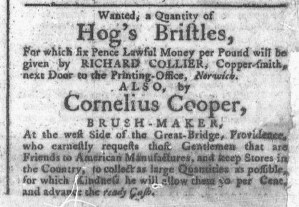
“Wanted, a Quantity of Hog’s Bristles [from] Friends to American Manufactures.”
Cornelius Cooper, a brushmaker who had relocated from Philadelphia to Providence, needed materials to continue operating his business in the fall of 1775. He ran an advertisement to that effect in the Providence Gazette, but his efforts did not end there. He also enlisted the help of Richard Collier, a coppersmith, in Norwich, Connecticut. An advertisement in the November 13, 1775, edition of the Norwich Packet proclaimed, “Wanted, a Quantity of Hog’s Bristles, For which six Pence Lawful Money per Pound will be given.” The notice listed Collier as the local agent who collected the bristles and paid the premium, yet it did not end there.
Instead, it also advised that “Cornelius Cooper,” his name in a font as large as “Hog’s Bristles,” offered the same price. After giving directions to his shop on “the west Side of the Great-Bridge, Providence,” the “BRUSH-MAKER” declared that he “earnestly requests those Gentlemen that are Friends to American Manufactures, and keep Stores in the Country, to collect as large Quantities as possible.” In his advertisement that simultaneously ran in the Providence Gazette, he indicated that he wished to acquire “Five Thousand Weight of Hog’s Bristles,” a considerable quantity. In making an appeal to “Friends to American Manufactures,” he invoked the Continental Association and efforts to replace goods imported from England with items produced in the colonies. That became more important than ever after the battles at Lexington and Concord. Decisions in the marketplace, including collecting hog’s bristles and purchasing brushes made from them, had political implications. Collier supported the cause by serving as a local agent for Cooper; the brushmaker presented an opportunity for others to do the same, especially shopkeepers in the countryside who collected bristles from their patrons. In return for that “Kindness,” Cooper not only paid “ready Cash” but also “allow[ed] them 30 per Cent.” It seems that he offered a discount to retailers who collected bristles if they purchased his brushes to stock in their stores. That strategy meant acquiring supplies and making sales at the same time, a neat arrangement for a brushmaker seeking to establish himself in New England.
Who was the subject of an advertisement in a revolutionary American newspaper 250 years ago today?
Norwich Packet (June 1, 1775).
“One Dollar Reward [for] a Negro Man, named Jack.”
Among its other contents, the June 1, 1775, edition of the Norwich Packet carried an advertisement that offered a “One Dollar Reward” for the capture and return of “a Negro Man, named Jack” who had liberated himself by running away from his enslaver, Joseph Farnham, Jr. of Canterbury, Connecticut, on the morning of April 8. Farnham provided a description that included Jack’s age, height, other physical characteristics, and clothing. He also stated that Jack “speaks broken English,” hoping that would assist readers in identifying the fugitive seeking freedom. In addition, Jack “has formerly been at Sea.” He had experience as a sailor, making it even more important to include the standard warning that “All Masters of Vessels and others are forbid to harbour or carry off said Negro, or they may depend on being prosecuted.” Farnham suspected that Jack was headed to Boston. He departed before the battles of Lexington and Concord and the siege of Boston. Those events may have worked to Jack’s advantage, distracting colonizers from taking too much notice of him.
What they certainly did notice was that the imperial crisis had entered a new stage. “HOSTILITIES are at length commenced in this colony,” Massachusetts, “by the troops under command of General Gage,” Joseph Warren, president pro tem of the Massachusetts Provincial Congress declared in an address to “the INHABITANTS of GREAT-BRITAIN.” He considered it vital that “an early, true, and authentic account of this inhuman proceeding should be known to you.” He then outlined the recent battles, especially the “ravages of the troops” in “General Gage’s army.” Farnham’s advertisement about Jack appeared immediately below Warren’s address in the June 1 edition of the Norwich Packet, though most readers likely did not grapple with the contradictions. On behalf of the Massachusetts Provincial Congress, Warren lamented that “ministerial vengeance against this colony, for refusing, with her sister colonies, a submission to slavery.” He meant figurative slavery, yet Farnham’s advertisement concerned the literal enslavement of a Black man, prompted by Jack’s quest for his own liberty. Time and time again, advertisements about enslaved men, women, and children appeared alongside news and editorials about the dangers that Parliament posed to the freedoms of colonizers. The revenue from Farnham’s advertisement about Jack, for instance, helped in making it possible for the printers to publish an editorial from the president pro tem of the Massachusetts Provincial Congress.