
What was advertised in a colonial American newspaper 250 years ago today?
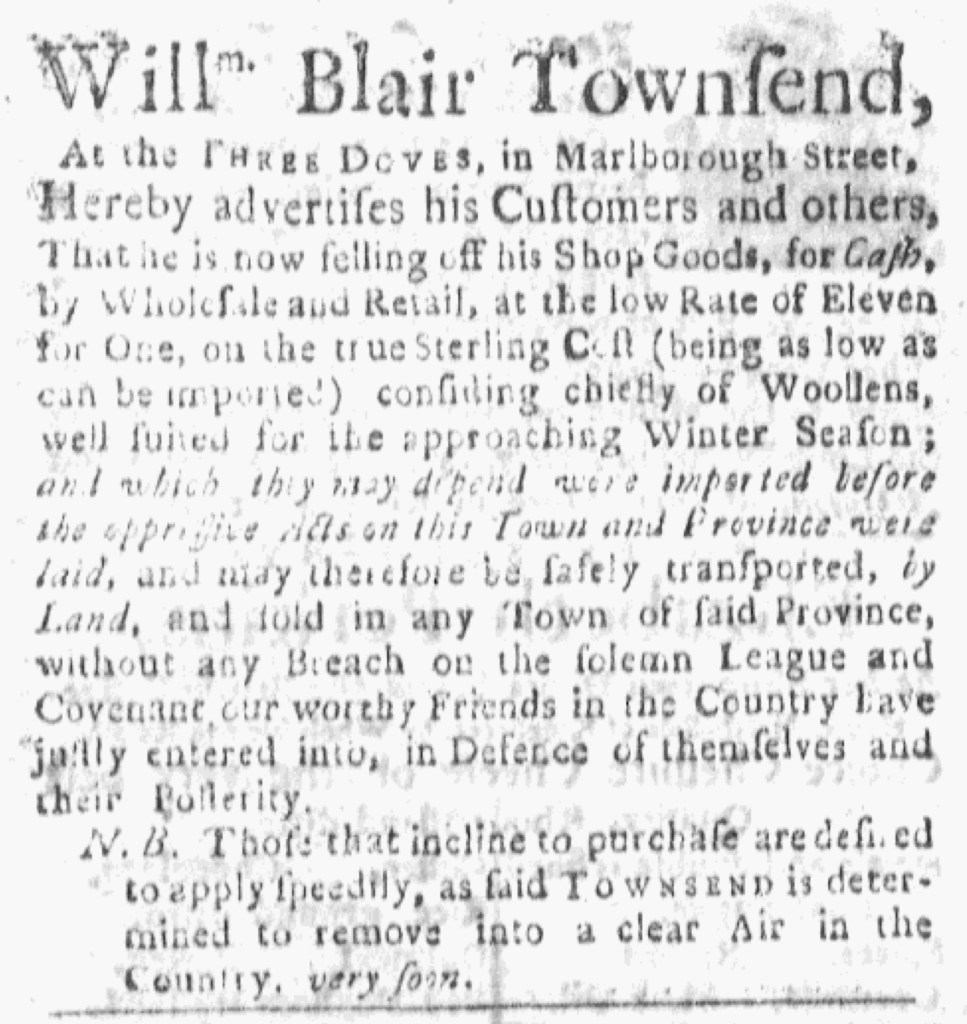
“May therefore be … sold … without any Breach on the solemn League and Covenant.”
Politics took center stage in William Blair Townsend’s advertisements for “Shop Goods … consisting chiefly of Woollens, well suited for the approaching Season” in the October 17, 1774, edition of the Boston Evening-Post. He looked to sell his entire inventory “by Wholesale and Retail” and close his shop, a casualty of the blockade of Boston that went into effect with the Boston Port Act that Parliament passed to punish the town for tossing tea into the harbor the previous December. To that end, he assured prospective customers that “they may depend [the goods] were imported before the oppressive Acts on this Town and Province were laid.” In addition to the Boston Port Act, Townsend invoked the Massachusetts Government Act and the other Coercive Acts.
Furthermore, he asserted that his wares “may therefore be safely transported, by Land, and sold in any Town of said Province, without any Breach on the solemn League and Covenant our worthy Friends in the Country have justly entered into, in Defence of themselves and their Posterity.” Townsend referred to a plan outlined in a letter that the Boston Committee of Correspondence circulated on June 8. After outlining the abuses perpetrated by Parliament, the letter encouraged resistance in the form of “affecting the trade and interest of Great Britain, so deeply as shall induce her to withdraw her oppressive hand.” The Committee of Correspondence sought to revive nonimportation agreements enacted twice in the past decade, first in response to the Stamp Act and, later, the Townshend duties. The letter proposed that colonizers “come into a solemn league, not to import goods from Great Britain, and not to buy any goods that shall hereafter be imported from thence, until our grievances shall be redressed.” Some merchants advocated waiting for more comprehensive measures that enlisted cooperation of other colonies, like the Continental Association that the First Continental Congress was in the process of drawing up in Philadelphia at the time Townsend published his advertisement, yet colonizers in towns throughout Massachusetts supported the Solemn League and Covenant.
Knowing that was the case, Townsend acknowledged the politics of the moment in his advertisement. He endorsed the pact while also making clear that neither he nor his prospective customers violated it. They could buy and sell with clear consciences … and without attracting the ire of the public. Beyond that, Townsend wished to clear out of Boston. In a nota bene, he encouraged “Those that incline to purchase … to apply speedily” since he “is determined to remove into a clear Air in the Country, very soon.” The situation had grown so bleak that that he did not intend to remain in Boston much longer.
[…] it. In the Boston Evening-Post, Frazier’s advertisement happened to appear immediately below William Blair Townsend’s notice that he sold goods “imported before the oppressive Acts on this Town and Province were laid” […]