
What was advertised in a colonial American newspaper 250 years ago today?
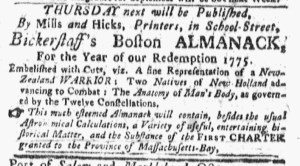
“This much esteemed Almanack will contain … the FIRST CHARTER granted to the Province of Massachusetts-Bay.”
On October 24, 1774, Nathaniel Mills and John Hicks, the printers of the Massachusetts Gazette and Boston Post-Boy, took to the pages of their own newspaper as well as the Boston Evening-Post to announce that they would publish “Bickerstaff’s Boston ALMANACK, For the Year of our Redemption 1775” later in the week. A few weeks earlier, “Isaac Bickerstaff” ran a notice promoting the almanac and requesting that proprietors of “new Houses of Entertainment” submit their names to the printing office “immediately” for inclusion in the list of taverns in the forthcoming almanac. Although the imaginary Bickerstaff was the purported author, Benjamin West provided the astronomical calculations and the printers compiled the rest of the contents.
Once Mills and Hicks were tavernkeepers a few weeks to submit updates before they moved forward with printing the almanac. As they prepared for publication, they promoted the images that accompanied the pamphlet. Three woodcuts “Embellished” it: “A fine Representation of a New-Zealand WARRIOR: Two Natives of New Holland advancing to Combat: [and] The Anatomy of Man’s Body, as governed by the Twelve Constellations.” The anatomy was a standard image incorporated into many almanacs, while the depictions of indigenous warriors from Australia (known at the time as New Holland) and New Zealand reflected the fascination with James Cook’s voyage aboard the Endeavour from 1768 through 1771. Accounts of that mission to the Pacific Ocean to observe the transit of Venus across the sun in 1769 had been advertised widely in American newspapers in recent years. Whether or not they purchased books that documented Cook’s endeavor, readers were likely familiar with it from newspaper accounts and conversation.
Yet Mills and Hicks did not focus solely on images depicting people in faraway places to market their almanac. They also referenced current events and local politics. “This much esteemed Almanack,” the printers declared, “will contain … a Variety of useful, entertaining historical Matter, and the Substance of the FIRST CHARTER granted to the Province of Massachusetts-Bay.” That charter, granted by Charles I in 1669, had particular importance in the fall of 1774 because Parliament recently revoked the more recent charter, granted by William and Mary in 1691, via the Massachusetts Government Act, one of the Coercive Acts passed in retaliation for the Boston Tea Party. That legislation gave more authority to a governor appointed by the king, significantly reducing the role that colonizers formerly played in governing themselves under both charters. In publishing the “FIRST CHARTER” and disseminating it widely in a pamphlet that readers would consult throughout the coming year, Mills and Hicks gave colonizers ready access to an important historical document and provided a ready reminder of the ideals of government that had been long practiced in the colony and recently overturned by a spiteful Parliament. The printers practiced politics in choosing to include the charter among the contents of the almanac.
[…] Advertised on 24 October 1774: “This much esteemed Almanack” What was advertised in a colonial American newspaper 250 years ago today? October 24 “This much esteemed Almanack will contain … the FIRST CHARTER granted to the Province of Massachusetts-Bay.” On October 24, 1774, Nathaniel Mills and John Hicks, the printers of the Massachusetts Gazette and Boston Post-Boy, took to the pages of their own newspaper as well as the Boston Evening-Post to announce that they would publish “Bickerstaff’s Boston ALMANACK, For the Year of our Redemption 1775″ later in the week. A few weeks earlier, “Isaac Bickerstaff” ran a notice promoting the almanac and requesting that proprietors of “new Houses of Entertainment” submit their names to the printing office “immediately” for inclusion in the list of taverns in the forthcoming almanac. Although the imaginary Bickerstaff was the purported author, Benjamin West provided the astronomical calculations and the printers compiled the rest of the contents. Mills and Hicks gave tavernkeepers a few weeks to submit updates before they moved forward with printing the almanac. As they prepared for publication, they promoted the images that accompanied the pamphlet. Three woodcuts “Embellished” it: “A fine Representation of a New-Zealand WARRIOR: Two Natives of New Holland (Autrailia) advancing to Combat: [and] The Anatomy of Man’s Body, as governed by the Twelve Constellations.”… …Yet Mills and Hicks did not focus solely on images depicting people in faraway places to market their almanac. They also referenced current events and local politics. “This much esteemed Almanack,” the printers declared, “will contain … a Variety of useful, entertaining historical Matter, and the Substance of the FIRST CHARTER granted to the Province of Massachusetts-Bay.” That charter, granted by Charles I in 1669, had particular importance in the fall of 1774 because Parliament recently revoked the more recent charter, granted by William and Mary in 1691, via the Massachusetts Government Act, one of the Coercive Acts passed in retaliation for the Boston Tea Party. Read more… […]