May 3

What was advertised in a revolutionary American newspaper 250 years ago today?
Virginia Gazette [Purdie] (May 3, 1776).

“Thirteen months Gazette due mrs. Rind’s estate, 13s. 6d.”

Most early American printers extended generous credit to newspaper subscribers, sometimes allowing them to fall years behind in making payment.  They frequently placed notices calling on subscribers to settle accounts in their own newspapers.  A notice in Alexander Purdie’s Virginia Gazette in the spring of 1776, however, requested that subscribers to a newspaper that ceased publication submit what they owed.

That newspaper had also been known as the Virginia Gazette.  William Rind commenced publishing Rind’s Virginia Gazette in Williamsburg on May 16, 1766.  He changed the name to Virginia Gazette in the fall of 1766.  Following his death in August 1773, his widow, Clementina Rind, published the newspaper for just over a year until her own death in September 1774.  John Pinkney then printed the newspaper, according to the colophon, “for the benefit of Clementina Rind’s estate” or, later, “for the benefit of Clementina Rind’s children.”  He became the sole publisher in April 1775.  Pinkney’s Virginia Gazette folded in the winter of 1776.  The issue for February 3, 1776, is the last known edition.  At the time, it was one of three newspapers named Virginia Gazette printed in Williamsburg.

The notice that ran in Purdie’s Virginia Gazette called on the “gentlemen who are still indebted to the estate of mrs. Clementina Rind, deceased, and mr. John Pinkney, for Gazettes … to send their respective balances” to “the administrator.”  For their convenience, they could dispatch them via “those gentlemen who are chosen delegates for their respective counties” who planned to travel to Williamsburg for meetings in May 1776.  A note at the end of the advertisements reminded subscribers that “Thirteen months Gazette due mrs. Rind’s estate” amounted to thirteen shillings and six pence and “Sixteen [months of the Virginia Gazette] due mr. John Pinkney” amounted to sixteen shillings and eight pence.  Those periods matched the amount of time that Clementina Rind printed the Virginia Gazette and then John Pinkney printed it, indicating that some subscribers had not paid for years, even when asked to settle with Rind’s estate.  Other newspaper printers experienced similar difficulties in collecting subscription fees, prompting some to threaten legal action in their notices.  In this instance, the administrator instead noted the “large debts still due from the said estate.”

Slavery Advertisements Published May 3, 1776

The Slavery Adverts 250 Project chronicles the role of newspaper advertising in perpetuating slavery in the era of the American Revolution. The project seeks to reveal the ubiquity of slavery in eighteenth-century life from New England to Georgia by republishing advertisements about enslaved people – for sale as individuals or in groups, wanted to purchase or for hire for short periods, runaways who liberated themselves, and those who were subsequently captured and confined in jails and workhouses – in daily digests on this site as well as in real time via the @SlaveAdverts250 Twitter feed, utilizing twenty-first-century media to stand in for the print media of the eighteenth century.

The project aims to provide modern audiences with a sense of just how often colonizers encountered these advertisements in their daily lives. Enslaved men, women, and children appeared in print somewhere in the colonies almost every single day. Those advertisements served as a constant backdrop for social, cultural, economic, and political life in colonial and revolutionary America. Colonizers who did not purport to own enslaved people were still confronted with slavery as well as invited to maintain the system by purchasing enslaved men, women, and children or assisting in the capture of so-called “runaways” who sought to free themselves from bondage. The frequency of these newspaper advertisements suggests just how embedded slavery was in colonial and revolutionary American culture in everyday interactions beyond the printed page.

These advertisements also testify to the experiences of enslaved men, women, and children, though readers must consider that those experiences have been remediated through descriptions offered by enslavers rather than enslaved people themselves. Often unnamed in the advertisements, enslaved men, women, and children were not invisible or unimportant in early America.

These advertisements appeared in revolutionary American newspapers 250 years ago today.

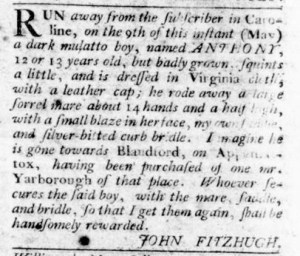
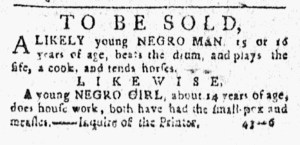
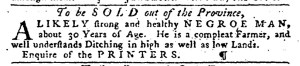
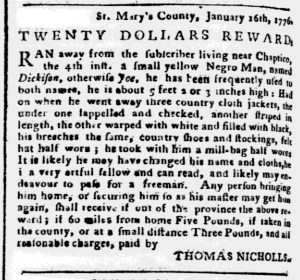
Connecticut Gazette (May 3, 1776).

**********

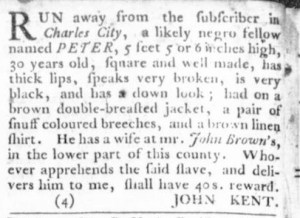
Connecticut Gazette (May 3, 1776).

**********

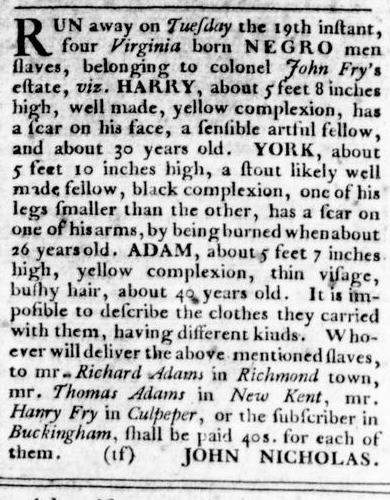
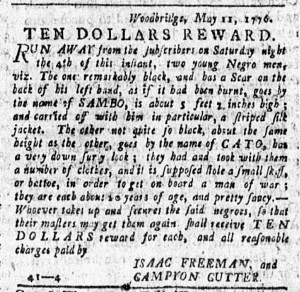
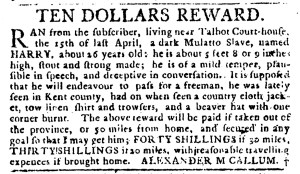
Virginia Gazette [Purdie] (May 3, 1776).

**********

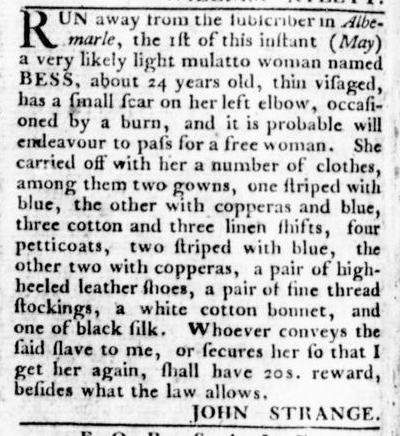
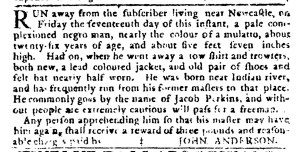
Virginia Gazette [Purdie] (May 3, 1776).

Advertisements for Common Sense Published May 3, 1776

Historians consider Thomas Paine’s Common Sense, published anonymously on January 9, 1776, the most influential political pamphlet that circulated in the colonies during the era of the American Revolution.  Written in plain language accessible to readers of all backgrounds, the pamphlet made a bold case for declaring independence at a time that many colonizers still sought a redress their grievances by George III and Parliament.  Paine’s pamphlet played a vital role in swaying public opinion in favor of declaring independence.

Common Sense was an eighteenth-century bestseller, though Paine wildly overestimated how many copies were published, claiming 150,000 circulated in 1776, and historians later made even more dubious claims that American printing presses produced as many as 500,000 copies.  Contrary to those exaggerations, American printers most likely published between 35,000 and 50,000 copies in 1776.  Scholars have identified twenty-five American editions, more than twice as many as any other American book or pamphlet published in the eighteenth century.

Colonizers certainly discussed Paine’s pamphlet … and printers, booksellers, and others advertised it widely.  As a special feature, the Adverts 250 Project chronicles those advertisements, starting with newspaper notices for Robert Bell’s first edition published in Philadelphia and then subsequent advertisements for that and other editions published and sold throughout the colonies.

These advertisements for Common Sense appeared in American newspapers 250 years ago today.

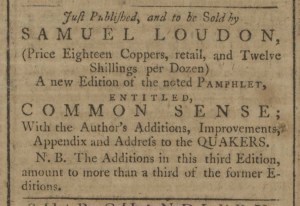
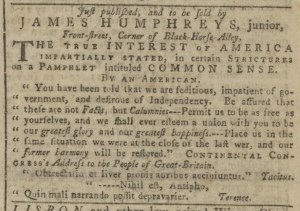
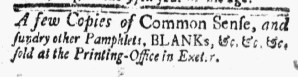
Connecticut Gazette (May 3, 1776).

May 2

What was advertised in a revolutionary American newspaper 250 years ago today?

New-England Chronicle (May 2, 1776).

American Coffee-House.”

Not long after British forces departed from Boston on March 17, 1776, and the siege of the city ended, Daniel Jones opened the “American Coffee-House.”  At about the same time, Samuel Hall, the printer of the New-England Chronicle, moved his printing office from “Stoughton-Hall, HARVARD-COLLEGE,” in Cambridge into Boston “next to the OLIVER CROMWELL TAVERN, in SCHOOL-STREET.”  He printed the first issue in the formerly occupied city on April 25.  A week later, Jones ran a notice in which he “respectfully acquaints the Gentlemen of the UNITED COLONIES, that the AMERICAN COFFEE HOUSE, at the sign of the Golden Eagle, King Street, BOSTON, is now opened for those Gentlemen who please to favour him with their commands.”

As much as Jones hoped to offer a place of respite for patrons who joined him for coffee and dining, that opening sentence testified to the uncertainty of the times.  The war had entered its second year.  When it began, most colonizers sought a redress of their grievances within the imperial system, but over time more and more of them advocated for declaring independence, especially following the publication of Thomas Paine’s Common Sense in Philadelphia in January 1776 and the widespread dissemination of local editions in the following months.  In the past, establishments like the one that Jones advertised were often known as the London Coffee House, a nod to the largest and most cosmopolitan city in the empire and, especially, to the transatlantic and even global networks of commerce that converged there.  Yet Jones named his establishment the “American Coffee-House” and addressed the “Gentlemen of the UNITED COLONIES,” privileging their American identity and acknowledging that the diverse colonies had banded together.  A Continental Congress organized resistance.  A Continental Army defended American liberties.  Even though Jones associated his new establishment with the American cause, it happened to be located on King Street (which would be renamed State Street shortly after the Treaty of Paris officially ended the Revolutionary War).  The “sign of the Golden Eagle,” a familiar device in several towns, one that did not have revolutionary significance, marked the coffeehouse’s location.  That the “Gentlemen of the UNITED COLONIES” gathered at the “AMERICAN COFFEE HOUSE” on King Street exemplified the transition taking place as colonizers moved from engaging in resistance to embracing revolution in 1776.

Slavery Advertisements Published May 2, 1776

The Slavery Adverts 250 Project chronicles the role of newspaper advertising in perpetuating slavery in the era of the American Revolution. The project seeks to reveal the ubiquity of slavery in eighteenth-century life from New England to Georgia by republishing advertisements about enslaved people – for sale as individuals or in groups, wanted to purchase or for hire for short periods, runaways who liberated themselves, and those who were subsequently captured and confined in jails and workhouses – in daily digests on this site as well as in real time via the @SlaveAdverts250 Twitter feed, utilizing twenty-first-century media to stand in for the print media of the eighteenth century.

The project aims to provide modern audiences with a sense of just how often colonizers encountered these advertisements in their daily lives. Enslaved men, women, and children appeared in print somewhere in the colonies almost every single day. Those advertisements served as a constant backdrop for social, cultural, economic, and political life in colonial and revolutionary America. Colonizers who did not purport to own enslaved people were still confronted with slavery as well as invited to maintain the system by purchasing enslaved men, women, and children or assisting in the capture of so-called “runaways” who sought to free themselves from bondage. The frequency of these newspaper advertisements suggests just how embedded slavery was in colonial and revolutionary American culture in everyday interactions beyond the printed page.

These advertisements also testify to the experiences of enslaved men, women, and children, though readers must consider that those experiences have been remediated through descriptions offered by enslavers rather than enslaved people themselves. Often unnamed in the advertisements, enslaved men, women, and children were not invisible or unimportant in early America.

These advertisements appeared in revolutionary American newspapers 250 years ago today.

Maryland Gazette (May 2, 1776).

**********

New-England Chronicle (May 2, 1776).

**********

New York Packet (May 2, 1776).

**********

Pennsylvania Evening Post (May 2, 1776).

Advertisements for Common Sense Published May 2, 1776

Historians consider Thomas Paine’s Common Sense, published anonymously on January 9, 1776, the most influential political pamphlet that circulated in the colonies during the era of the American Revolution.  Written in plain language accessible to readers of all backgrounds, the pamphlet made a bold case for declaring independence at a time that many colonizers still sought a redress their grievances by George III and Parliament.  Paine’s pamphlet played a vital role in swaying public opinion in favor of declaring independence.

Common Sense was an eighteenth-century bestseller, though Paine wildly overestimated how many copies were published, claiming 150,000 circulated in 1776, and historians later made even more dubious claims that American printing presses produced as many as 500,000 copies.  Contrary to those exaggerations, American printers most likely published between 35,000 and 50,000 copies in 1776.  Scholars have identified twenty-five American editions, more than twice as many as any other American book or pamphlet published in the eighteenth century.

Colonizers certainly discussed Paine’s pamphlet … and printers, booksellers, and others advertised it widely.  As a special feature, the Adverts 250 Project chronicles those advertisements, starting with newspaper notices for Robert Bell’s first edition published in Philadelphia and then subsequent advertisements for that and other editions published and sold throughout the colonies.

These advertisements for Common Sense appeared in American newspapers 250 years ago today.

New York Packet (May 2, 1776).

May 1

What was advertised in a revolutionary American newspaper 250 years ago today?

Maryland Journal (May 1, 1776).

“The Continental Spring Garden, nigh Baltimore town.”

Adam Lindsay, a fencing master in Baltimore, advertised lessons in the “Art of Defence (now so necessary for every Gentleman” in the May 1, 1776, edition of the Maryland Journal, yet that was not the primary purpose of his notice.  Instead, he informed readers that he “NOW lives at the Continental Spring Garden” near the town and “proposes to entertain LADIES and GENTLEMENT, who may think proper to view his Garden and refresh themselves, after a pleasing walk.”  That sort of activity was part of what Vaughn Scribner has described as “a news sort of commercial leisure sector” that developed in the colonies during the second half of the eighteenth century.[1]  Lindsay described his Continental Spring Garden as “large and genteelly laid out.”  Furthermore, he believed that “those who choose to recreate themselves with a view thereof, will not be displeased with their entertainment.”  An excursion to the Continental Spring Garden may have included light refreshments in a comfortable parlor since Lindsay invited guests to “his House and Garden.”

Scribner notes that the “fascination with commercial pleasure gardens coincided with Enlightenment notions of health, exercise, and natural romanticism,” some of the factors that contributed to the popularity of baths, spas, and mineral waters like the “COLD BATH” advertised in the Pennsylvania Evening Post the day before Lindsay’s notice ran in the Maryland Journal.[2]  He documents the founding and operation of pleasure gardens in or near the largest urban ports – Boston, Charleston, New York, and Philadelphia – as well as Baltimore and Providence.  The Adverts 250 Project has featured advertisements for some of those sites, including Ranelagh Garden and Vauxhall Garden (both named after famous attractions in London) in New York.  At the time that Lindsay established the Continental Spring Garden and advertised it, Baltimore was growing and becoming a more important port.  It was becoming a rival to Annapolis and would eventually overshadow the colonial capitol.  Just three years earlier, William Goddard commenced publication of the city’s first newspaper, the Maryland Journal.  The city quickly became a more significant center for commerce, prompting John Dunlap to introduce a second newspaper in 1775, which meant that Baltimore now had more newspapers than the sole Maryland Gazette published in Annapolis.  With such growth, Lindasy joined in an effort, as Scribner puts it, “to harness the verdant nature of their surroundings to make their cities more urbane, and healthy, spaces.”[3]  The Continental Spring Garden was part of a larger project undertaken in and near major ports along the Atlantic coast.

**********

[1] Vaughn Scribner, “The World of Nature,” in A Cultural History of Leisure in the Enlightenment, ed. Peter Borsay and Jan Hein Furnee (London: Bloomsbury Press, 2024), 183.

[2] Scribner, “World of Nature,” 184.

[3] Scribner, “World of Nature,” 183.

Slavery Advertisements Published May 1, 1776

The Slavery Adverts 250 Project chronicles the role of newspaper advertising in perpetuating slavery in the era of the American Revolution. The project seeks to reveal the ubiquity of slavery in eighteenth-century life from New England to Georgia by republishing advertisements about enslaved people – for sale as individuals or in groups, wanted to purchase or for hire for short periods, runaways who liberated themselves, and those who were subsequently captured and confined in jails and workhouses – in daily digests on this site as well as in real time via the @SlaveAdverts250 Twitter feed, utilizing twenty-first-century media to stand in for the print media of the eighteenth century.

The project aims to provide modern audiences with a sense of just how often colonizers encountered these advertisements in their daily lives. Enslaved men, women, and children appeared in print somewhere in the colonies almost every single day. Those advertisements served as a constant backdrop for social, cultural, economic, and political life in colonial and revolutionary America. Colonizers who did not purport to own enslaved people were still confronted with slavery as well as invited to maintain the system by purchasing enslaved men, women, and children or assisting in the capture of so-called “runaways” who sought to free themselves from bondage. The frequency of these newspaper advertisements suggests just how embedded slavery was in colonial and revolutionary American culture in everyday interactions beyond the printed page.

These advertisements also testify to the experiences of enslaved men, women, and children, though readers must consider that those experiences have been remediated through descriptions offered by enslavers rather than enslaved people themselves. Often unnamed in the advertisements, enslaved men, women, and children were not invisible or unimportant in early America.

These advertisements appeared in revolutionary American newspapers 250 years ago today.

Constitutional Gazette (May 1, 1776).

**********

Pennsylvania Gazette (May 1, 1776).

**********

Pennsylvania Gazette (May 1, 1776).

**********

Pennsylvania Journal (May 1, 1776).

**********

Pennsylvania Journal (May 1, 1776).

**********

Pennsylvania Journal (May 1, 1776).

**********

Pennsylvania Journal (May 1, 1776).