
What was advertised in a colonial American newspaper 250 years ago today?
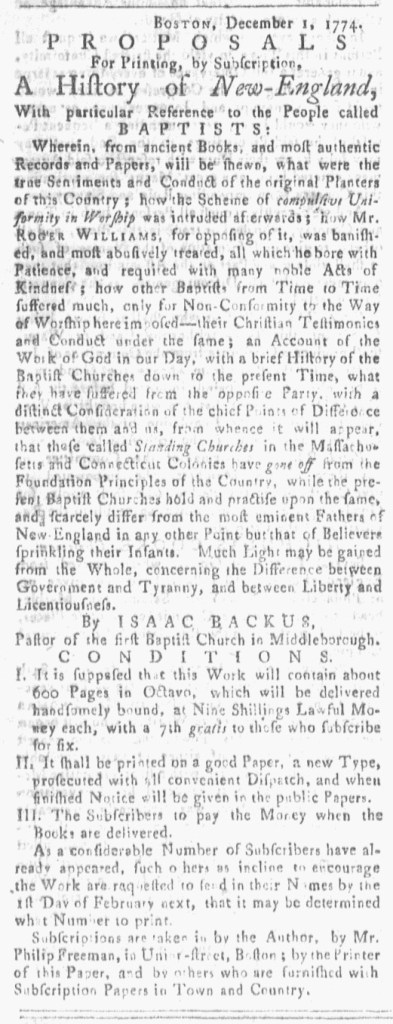
“A History of New-England, With particular Reference to the People called BAPTISTS.”
A subscription proposal for “A History of New-England, With particular Reference to the People called BAPTISTS” appeared among the various advertisements in the December 24, 1774, edition of the Providence Gazette. Dated “BOSTON, December 1,” it described a work in which Isaac Backus, “Pastor of the first Baptist Church in Middleborough,” consulted “ancient Books, and most authentic Records and Papers” to demonstrate the “true Sentiments and Conduct of the original Planters of this Country” and how the “Scheme of compulsive Uniformity in Worship was intruded afterwards.” The book included a “brief History of the Baptist Churches down to the present time” and “what they have suffered from the opposite Party, with a distinct Consideration of the chief Points of Difference between them and us, from whence it will appear, that those called Standing Churches in Massachusetts and Connecticut Colonies have gone off from the Foundation Principles of the Country.” As the imperial crisis intensified, Backus offered his own interpretation of the “Difference between Government and Tyranny, and between Liberty and Licentiousness” when it came to how Baptists had comported themselves and been treated in New England. Positioning Roger Williams as a protagonist in his narrative, the minister expected to attract subscribers in Rhode Island.
Beyond the contents of the volume, Backus promoted the “CONDITIONS” for publication that subscribers could expect. He anticipated that the book “will contain about 600 Pages in Octavo, which will be delivered handsomely bound.” Furthermore, they “shall be printed on good Paper” with a “new Type” to enhance legibility. Each copy cost nine shillings, though Backus offered a free seventh copy “to those who subscribe for six,” whether to gift to friends or retail in shops and bookstores. Subscribers did not need to make any payments in advance; sometimes subscription proposals called for deposits to help defray the initial costs of printing, but Backus stated that subscribers would “pay the Money when the Books are delivered.” Rather than raising funds, he intended for the proposals to gauge interest in the project and incite demand. To that end, he confided that a “considerable Number of Subscribers have already appeared.” Given the popularity of the book, Backus suggested, prospective subscribers did not want to miss an opportunity to reserve their own copies. They could submit their names to Backus or an associate in Boston or the printer of the Providence Gazette. In addition, the minister disseminated “Subscription Papers in Town and Country,” enlisting the aid of local agents in displaying his marketing materials.
Backus called for subscribers “to send in their Names by the 1st Day of February next, that it may be determined what Number to print.” Distributing subscription proposals did not always result in books going to press. In this case, Backus apparently found a sufficient number of subscribers to make the project viable, yet he did not publish the book as quickly as intended. Given the circumstances, an imperial crisis that became a war between the colonies and Britain in the spring of 1775, Backus published the first of three volumes in 1777 and the other two over the course of two decades. That first volume covered the period through 1690. The second, published in 1784, extended from 1690 to 1784, including “a concise view of the American war, and of the conduct of the Baptists therein, with the present state of their churches.” In 1796, Backus published the final volume, a church history that covered the period from 1783 through 1796 that featured a “particular history of the Baptist churches in the five states of New-England.” The project extended far beyond what he described in the subscription proposals the minister circulated in December 1774.
[…] for religious liberty, and one of the founders of Rhode Island College (now Brown University), previously announced this project in an advertisement in the Providence Gazette ten months earlier in December 1774. At that time, […]