
What was advertised in a colonial American newspaper 250 years ago today?
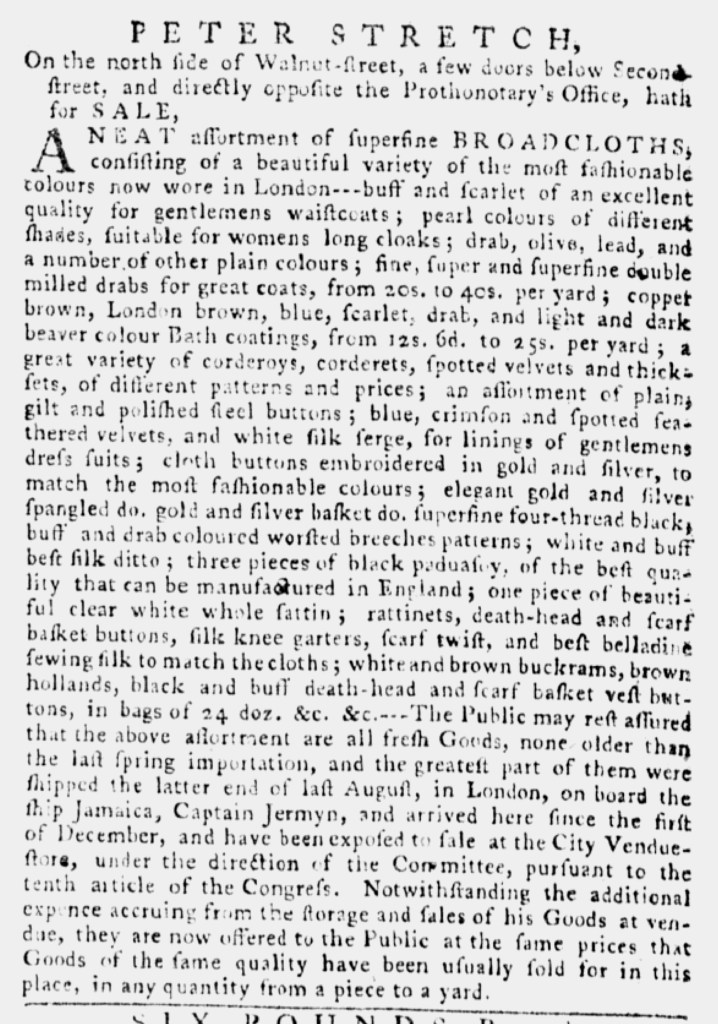
“Goods … have been exposed to sale … under the direction of the Committee, pursuant to the tenth article of the Congress.”
Even as the imperial crisis intensified in February 1775, Peter Stretch expected that consumers in and near Philadelphia would respond to marketing appeals that connected the textiles and accessories that he imported and sold to current fashions in London. Such had been the case for quite some time before the political situation became so troubled. A transatlantic consumer revolution bound together England and the colonies in the eighteenth century, helping to fuel a process of Anglicization among subjects of the empire in British mainland North America. When it came to advertising, it made sense to Stretch to open his notice in the February 22 edition of the Pennsylvania Gazette with a “NEAT assortment of superfine BROADCLOTHS, consisting of a beautiful variety of the most fashionable colours now wore in London.”
He anticipated such an appeal would resonate with prospective customers even with the Continental Association in effect. The First Continental Congress enacted that nonimportation agreement in response to the Coercive Acts. Yet Stretch acknowledged those circumstances as well. He wanted consumers to know that he sold new merchandise rather than items that had lingered on the shelves or in the warehouse for years, so he assured readers that “the above assortment are all fresh Goods, one older than the last spring importation.” He went into more detail, explaining that “the greatest part of them were shipped the latter end of last August, in London, on board the ship Jamaica, Captain Jermyn.” That meant that his wares had been ordered and shipped before the First Continental Congress began its meetings in September and October 1774 and certainly before delegates devised the Continental Association.
However, the Jamaica “arrived here since the first of December,” the day the nonimportation agreement went into effect. The tenth article made provisions for imports that arrived in December 1774 and January 1775, allowing merchants to refuse and return the goods, turn them over to a local committee to store while the pact remained in force, or entrust them to the committee to sell with the original costs returned to the importer and any profits designated to the relief of Boston where the harbor had been closed and blockaded since June 1774. Stretch reported that he adhered to the Continental Association. His wares “have been exposed to sale at the City Vendue-store, under the direction of the Committee, pursuant to the tenth article of the Congress.” Having done its due diligence, the committee apparently returned items not sold at auction to Stretch, provided that he also observe the ninth article that prohibited price gouging or “tak[ing] Advantage of the Scarcity of Goods that may be occasioned by this Association.” Stretch pledged that he offered his merchandise “at the same prices that Goods of the same quality have been usually sold for in this place.” The merchant demonstrated to consumers that they could still acquire textiles “of the most fashionable colours now wore in London” without violating the Continental Association.
[…] Even as the imperial crisis intensified in February 1775, Peter Stretch expected that consumers in and near Philadelphia would respond to marketing appeals that connected the textiles and accessories that he imported and sold to current fashions in London. Such had been the case for quite some time before the political situation became so troubled. A transatlantic consumer revolution bound together England and the colonies in the eighteenth century, helping to fuel a process of Anglicization among subjects of the empire in British mainland North America. When it came to advertising, it made sense to Stretch to open his notice in the February 22 edition of the Pennsylvania Gazette with a “NEAT assortment of superfine BROADCLOTHS, consisting of a beautiful variety of the most fashionable colours now wore in London.” He anticipated such an appeal would resonate with prospective customers even with the Continental Association in effect. Read more… […]
[…] the Continental Association went into effect on December 1, 1774, though he had on another occasion detailed his compliance with that […]