March 27

What was advertised in a revolutionary American newspaper 250 years ago today?
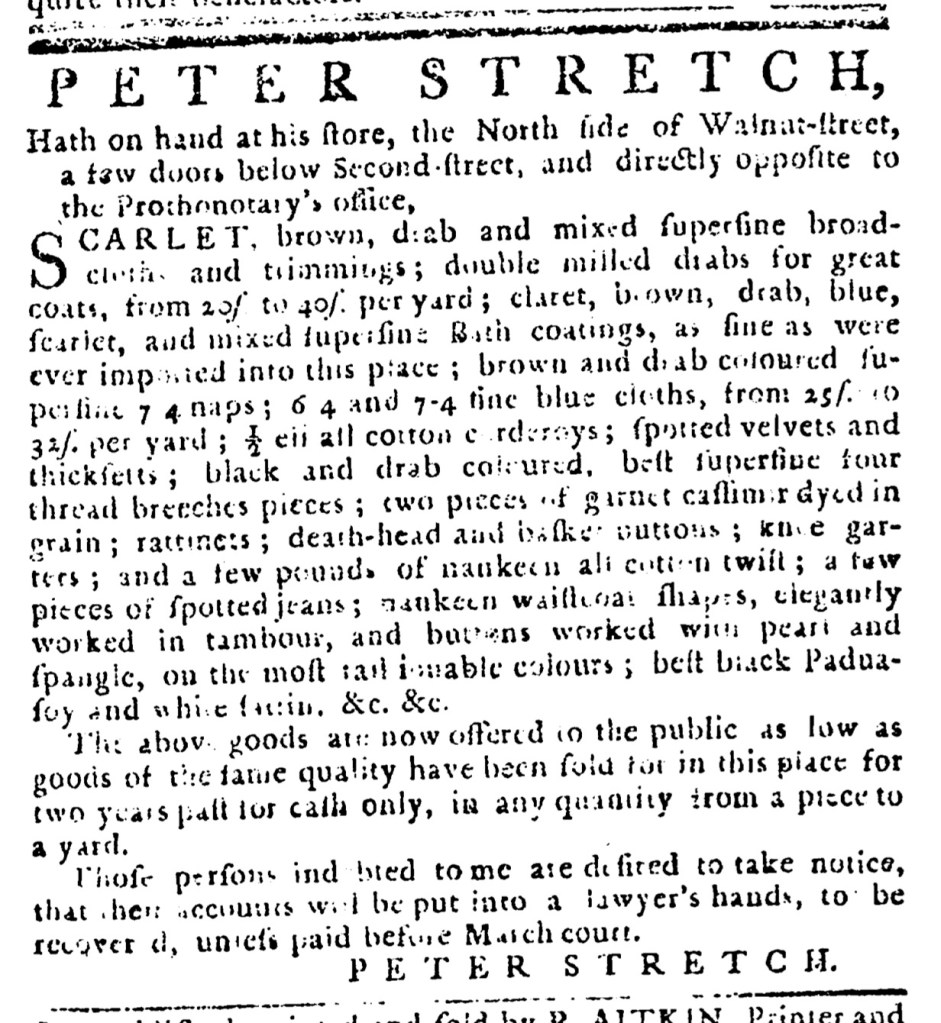
Pennsylvania Journal (March 27, 1776).

“The above goods are now offered … as low as goods of the same quality have been sold … for two years past.”

As spring arrived in 1776, Peter Stretch advertised an assortment of textiles and accessories available at his store on Walnut Street in Philadelphia.  In a notice in the March 27 edition of the Pennsylvania Journal, he listed many kinds of fabrics, including “SCARLET, brown, drab and mixed superfine broadcloaths and trimmings,” “spotted velvets and thicksetts,” and “best black Paduasoy and white sattin.”  Among the accessories, he stocked “death-head and basket buttons,” “knee garters,” and “buttons worked with pearl and spangle, on the most fashionable colours.”  Stretch’s inventory also included “claret, brown, drab, blue, scarlet, and mixed superfine Bath coatings, as fine as were ever imported into this place.”  He conveniently did not mention when he had received shipment of any of his wares, sidestepping whether they arrived before the Continental Association went into effect on December 1, 1774, though he had on another occasion detailed his compliance with that pact.

In this instance, Stretch did assert that his goods “are now offered to the public as low as goods of the same quality have been sold for in this place for two years past.”  In that regard, he did acknowledge the nonimportation agreement devised by the Second Continental Congress in response to the Coercive Acts that Parliament passed to punish Boston for destroying tea by throwing it into the harbor in December 1773.  The ninth article required that “Venders of Goods or Merchandise will not take Advantage of the Scarcity of Goods that may be occasioned by this Associacion, but will sell the same at the Rates we have been respectively accustomed to do for twelve Months past.”  It also specified that merchants and shopkeepers who did engage in price gouging then “no Person ought, nor will any of us deal with any such Person … at any Time thereafter, for any Commodity whatever.”  Stretch certainly wanted to avoid such consequences!  In stating that his prices matched those charged two years earlier, he assured prospective customers that they were in line with prices from before the Continental Association went into effect.  He did not promise great bargains, but at least his customers did not have to worry that he took advantage of the disruptions to trade caused by the imperial crisis and a war that started the previous April.
February 22

What was advertised in a colonial American newspaper 250 years ago today?

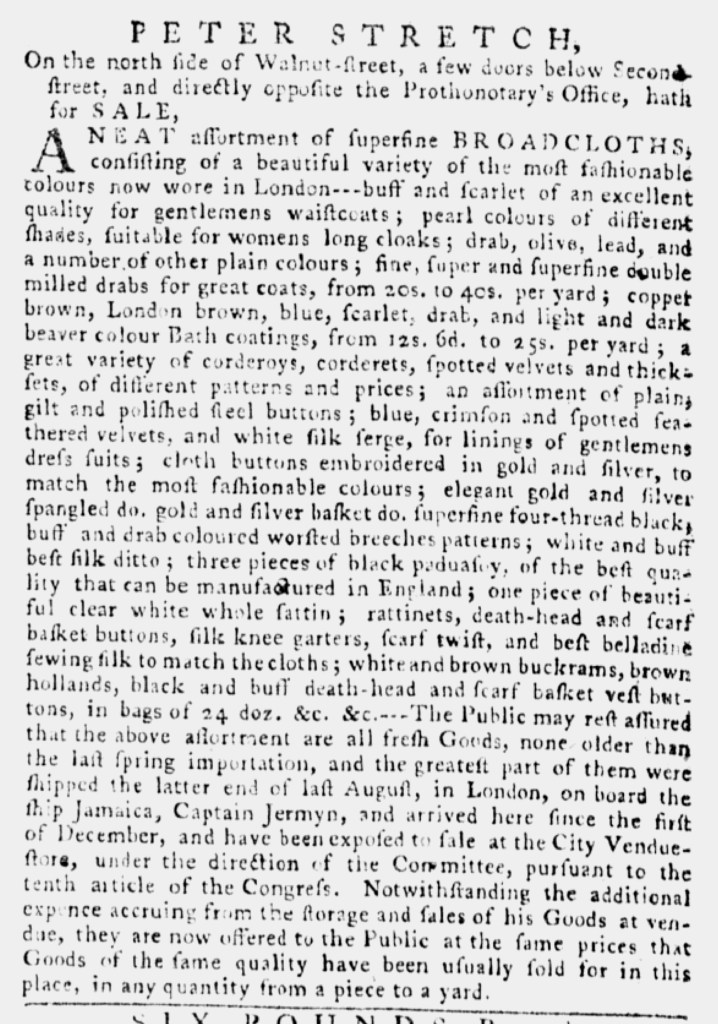
Pennsylvania Gazette (February 22, 1775).

“Goods … have been exposed to sale … under the direction of the Committee, pursuant to the tenth article of the Congress.”

Even as the imperial crisis intensified in February 1775, Peter Stretch expected that consumers in and near Philadelphia would respond to marketing appeals that connected the textiles and accessories that he imported and sold to current fashions in London.  Such had been the case for quite some time before the political situation became so troubled.  A transatlantic consumer revolution bound together England and the colonies in the eighteenth century, helping to fuel a process of Anglicization among subjects of the empire in British mainland North America.  When it came to advertising, it made sense to Stretch to open his notice in the February 22 edition of the Pennsylvania Gazette with a “NEAT assortment of superfine BROADCLOTHS, consisting of a beautiful variety of the most fashionable colours now wore in London.”

He anticipated such an appeal would resonate with prospective customers even with the Continental Association in effect.  The First Continental Congress enacted that nonimportation agreement in response to the Coercive Acts.  Yet Stretch acknowledged those circumstances as well.  He wanted consumers to know that he sold new merchandise rather than items that had lingered on the shelves or in the warehouse for years, so he assured readers that “the above assortment are all fresh Goods, one older than the last spring importation.”  He went into more detail, explaining that “the greatest part of them were shipped the latter end of last August, in London, on board the ship Jamaica, Captain Jermyn.”  That meant that his wares had been ordered and shipped before the First Continental Congress began its meetings in September and October 1774 and certainly before delegates devised the Continental Association.

However, the Jamaica “arrived here since the first of December,” the day the nonimportation agreement went into effect.  The tenth article made provisions for imports that arrived in December 1774 and January 1775, allowing merchants to refuse and return the goods, turn them over to a local committee to store while the pact remained in force, or entrust them to the committee to sell with the original costs returned to the importer and any profits designated to the relief of Boston where the harbor had been closed and blockaded since June 1774.  Stretch reported that he adhered to the Continental Association.  His wares “have been exposed to sale at the City Vendue-store, under the direction of the Committee, pursuant to the tenth article of the Congress.”  Having done its due diligence, the committee apparently returned items not sold at auction to Stretch, provided that he also observe the ninth article that prohibited price gouging or “tak[ing] Advantage of the Scarcity of Goods that may be occasioned by this Association.”  Stretch pledged that he offered his merchandise “at the same prices that Goods of the same quality have been usually sold for in this place.”  The merchant demonstrated to consumers that they could still acquire textiles “of the most fashionable colours now wore in London” without violating the Continental Association.

October 12

What was advertised in a colonial American newspaper 250 years ago today?

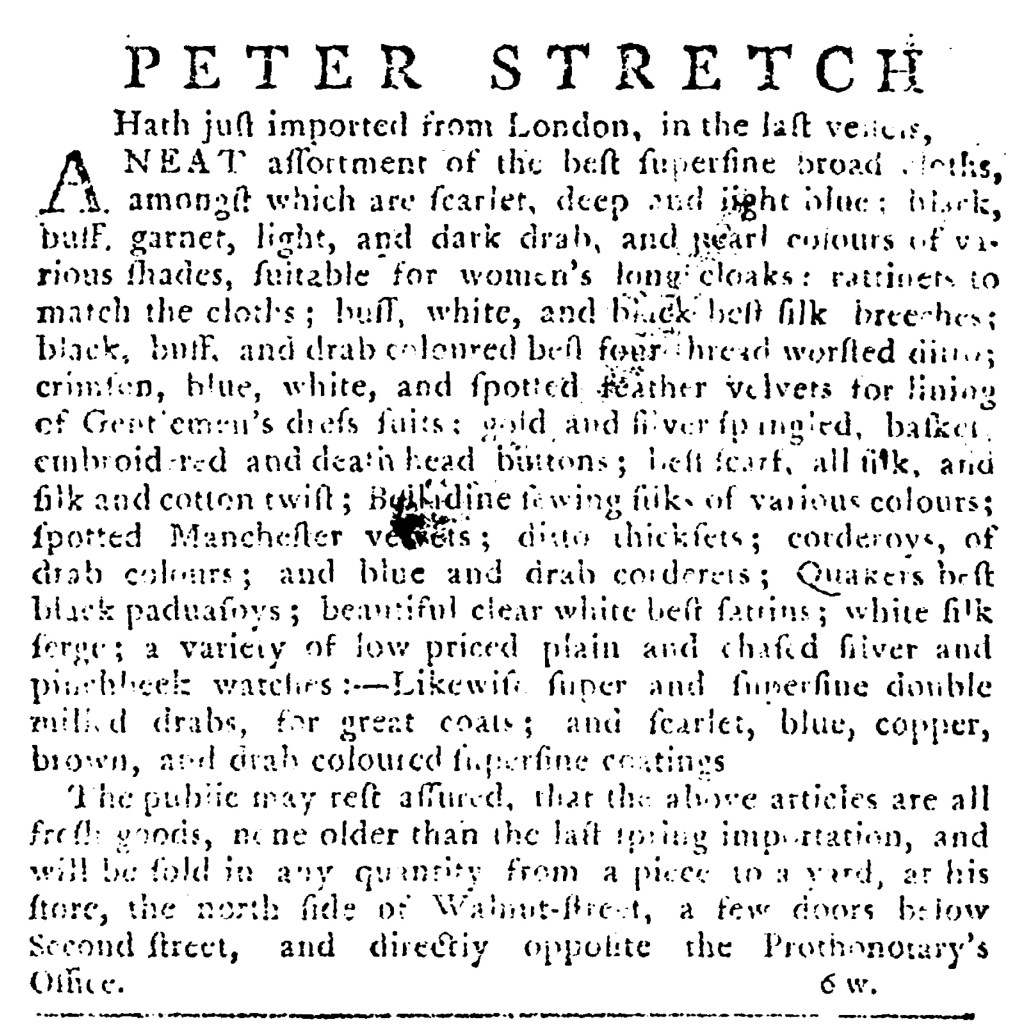
Pennsylvania Journal (October 12, 1774).

“The above articles are all fresh goods, none older than the last spring importation.”

In the fall of 1774, Peter Stretch advertised a “NEAT assortment” of textiles and accessories that he “Hath just imported from London, in the last vessels.”  In an advertisement in the October 12 edition of the Pennsylvania Journal, he listed many of those items, including “the best superfine broad cloths, amongst which are scarlet, deep and light blue, black, buff, garnet, light, and dark drab and pearl colours of various shades, suitable for women’s long cloaks,” “crimson, blue, white, and spotted feather velvets for lining of Gentlemen’s dress suits,” and “gold and silver spangled, basket, embroidered and death head buttons.”

In stating that he had recently imported his wares “in the last vessels,” Stretch deployed language commonly used by merchants and shopkeepers in their marketing efforts.  Elsewhere on the same page, for instance, Barclay and Mitchell declared that they stocked merchandise “Imported in the last vessels from England.”  Yet Stretch decided to provide further details about when he received his inventory at the end of his advertisement.  “The public may rest assured,” he confided, “that the above articles are all fresh goods, none older than the last spring importation.”  Stretch was in a bit of an awkward position.  He wanted the public to think of his goods as new rather than as leftovers that had been lingering on the shelves or in the storeroom, yet not too new.  As the First Continental Congress continued to meet in Philadelphia, just a short distance from Stretch’s store, the colonies prepared to adopt a nonimportation agreement in protest of the Coercive Acts imposed by Parliament following the Boston Tea Party.  Stretch seemingly did not want the public to get the impression that he had imported surplus goods with the intention of sidestepping any nonimportation agreement when it went into effect.  That would have meant allegations that he technically lived up to the letter of the pact but not the spirit.  Rather than hoarding goods in recent months to sell once a nonimportation made imported wares scarce, Stretch “assured” the public that he acquired much of his inventory during “the last spring importation” before the colonies knew about the Boston Port Act, the Massachusetts Government Act, and other legislation passed by Parliament.  He hoped that made it acceptable for patriots to make purchases at his store even as they became wary of the goods carried by his competitors.