
What was advertised in a colonial American newspaper 250 years ago today?
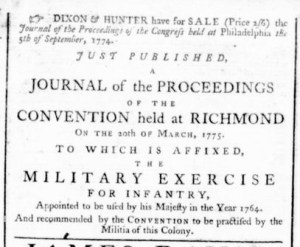
“JOURNAL of the PROCEEDINGS OF THE CONVENTION held at RICHMOND.”
John Carter once again advertised that “A few Copies of The Proceedings of the late Continental CONGRESS May be had at the Printing-Office” in the April 8, 1775, edition of the Providence Gazette. That same day, John Dixon and William Hunter advertised that they “have for SALE … the Journal of the Proceedings of the Congress held at Philadelphia” in the Virginia Gazette. When the First Continental Congress concluded its meetings near the end of October 1774, printers in many towns rushed to publish local editions of the Extracts from the Votes and Proceedings of the American Continental Congress. Dixon and his partner at the time, Alexander Purdie, printed the Extracts. So did Carter. Advertisements for the Extracts quickly appeared in newspapers. Not nearly as many printers published the Journal. William and Thomas Bradford produced a Philadelphia edition about a month after they published the Extracts. In New York, Hugh Gaine published the only other edition. In contrast to marketing for the Extracts, advertisements for the Journal did not immediately pepper newspapers throughout the colonies.
Yet over time printers and booksellers acquired copies of the Journal from the Bradfords or from Gaine and informed prospective customers that they stocked that volume. Dixon and Hunter did so when they advertised a publication that came off their own press, “A JOURNAL of the PROCEEDINGS OF THE CONVENTION held at RICHMOND ON THE 20th OF MARCH, 1775.” Although listed first in the advertisement, the Journal for the First Continental Congress received secondary attention. Dixon and Hunter used larger type for the title of their new publication and created greater visual interest by breaking the title into several lines and centering each line. Dixon and Hunter did not diminish the significance of the Journal for the First Continental Congress; instead, they treated the Journal for the convention at Richmond as breaking news, an important local update, and a continuation of coverage of proceedings that commenced with delegates in Philadelphia and then moved to meetings held throughout the colonies. They also had an interest in selling the volume that they produced, yet they recognized an opportunity to package it with the Journal for the First Continental Congress and increase revenue. Both publications kept the public informed while simultaneously commodifying American responses to the imperial crisis that ultimately became a revolution.