April 13

What was advertised in a colonial American newspaper 250 years ago today?
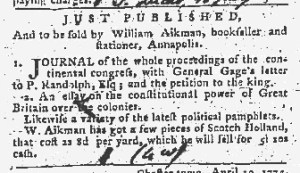
Maryland Gazette (April 13, 1775).

“JOURNAL of the whole proceedings of the continental congress.”

An advertisement by William Aikman, a bookseller and stationer in Annapolis, in the April 13, 1775, edition of the Maryland Gazette proclaimed, “JUST PUBLISHED, And to be sold … JOURNAL of the whole proceedings of the continental congress” and “An essay on the constitutional power of Great Britain over the colonies.”  While Aikman no doubt sold those items, they had not been “JUST PUBLISHED,” nor had he published them.

Readers understood that “JUST PUBLISHED” did not always mean that an item was hot off the presses; sometimes that phrase was a vestige of an advertisement originally composed and disseminated weeks or months earlier and printed once again without revisions.  Readers also understood that “JUST PUBLISHED, and to be sold by” did not necessarily mean that the retailer was also the publisher, merely that the retailer sold an item that had been published by someone, somewhere.  Keeping that in mind yields a better understanding of the production and dissemination of the items that Aikman advertised.

Although printers in many towns, including Anne Catharine Green and Son in Annapolis, produced and advertised local editions of the Extracts from the Votes and Proceedings of the American Continental Congress in the weeks after the First Continental Congress concluded its meetings in Philadelphia near the end of October 1774, only two printing offices published the complete Journal of the Proceedings of the Congress in the following months.  William Bradford and Thomas Bradford printed an edition in Philadelphia, as did Hugh Gaine in New York.  Aikman most likely stocked and advertised the Bradfords’ edition, especially considering that they also printed John Dickinson’s Essay on the Constitutional Power of Great-Britain over the Colonies in America in 1774.  Gaine did not publish a New York edition of that volume.

Aikman’s advertisement also stated that he carried “a variety of the latest political pamphlets,” but he did not list additional titles.  Perhaps he followed the lead of James Rivington in New York and tried to profit from selling pamphlets “on both sides, in the unhappy dispute with Great-Britain.”  As the imperial crisis reached its boiling point in April 1775, Aikman took to the pages of the Maryland Gazette to hawk two items published by the Bradfords in 1774 that became more timely and relevant as well as the “latest political pamphlets” that provided even more for colonizers to consider as they learned about and participated in current events.
April 8

What was advertised in a colonial American newspaper 250 years ago today?

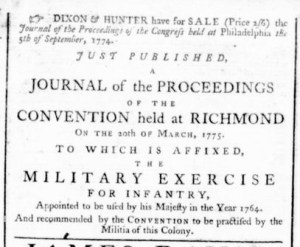
Virginia Gazette [Dixon and Hunter] (April 8, 1775).

“JOURNAL of the PROCEEDINGS OF THE CONVENTION held at RICHMOND.”

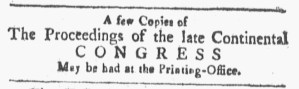
John Carter once again advertised that “A few Copies of The Proceedings of the late Continental CONGRESS May be had at the Printing-Office” in the April 8, 1775, edition of the Providence Gazette.  That same day, John Dixon and William Hunter advertised that they “have for SALE … the Journal of the Proceedings of the Congress held at Philadelphia” in the Virginia Gazette.  When the First Continental Congress concluded its meetings near the end of October 1774, printers in many towns rushed to publish local editions of the Extracts from the Votes and Proceedings of the American Continental Congress.  Dixon and his partner at the time, Alexander Purdie, printed the Extracts.  So did Carter.  Advertisements for the Extracts quickly appeared in newspapers.  Not nearly as many printers published the Journal.  William and Thomas Bradford produced a Philadelphia edition about a month after they published the Extracts.  In New York, Hugh Gaine published the only other edition.  In contrast to marketing for the Extracts, advertisements for the Journal did not immediately pepper newspapers throughout the colonies.

Yet over time printers and booksellers acquired copies of the Journal from the Bradfords or from Gaine and informed prospective customers that they stocked that volume.  Dixon and Hunter did so when they advertised a publication that came off their own press, “A JOURNAL of the PROCEEDINGS OF THE CONVENTION held at RICHMOND ON THE 20th OF MARCH, 1775.”  Although listed first in the advertisement, the Journal for the First Continental Congress received secondary attention.  Dixon and Hunter used larger type for the title of their new publication and created greater visual interest by breaking the title into several lines and centering each line.  Dixon and Hunter did not diminish the significance of the Journal for the First Continental Congress; instead, they treated the Journal for the convention at Richmond as breaking news, an important local update, and a continuation of coverage of proceedings that commenced with delegates in Philadelphia and then moved to meetings held throughout the colonies.  They also had an interest in selling the volume that they produced, yet they recognized an opportunity to package it with the Journal for the First Continental Congress and increase revenue.  Both publications kept the public informed while simultaneously commodifying American responses to the imperial crisis that ultimately became a revolution.

March 18

What was advertised in a colonial American newspaper 250 years ago today?

Providence Gazette (March 18, 1775).

“The Proceedings of the late Continental CONGRESS.”

It was a brief yet important notice: “A few Copies of the Proceedings of the late Continental CONGRESS May be had at the Printing-Office.”  It was the first advertisement that appeared in the March 18, 1775, edition of the Providence Gazette, immediately following the local news.  During the era of the American Revolution, printers often gave advertisements they considered significant, often advertisements for political pamphlets and other publications, that privileged place.  Such notices marked a transition between news selected by the printer and other content submitted by advertisers.  Printers may have expected that readers were more likely to give their attention to notices that followed (or even appeared to continue) the news than if they had been interspersed among other advertisements.

John Carter, the printer of the Providence Gazette, stocked a variety of political publications at his printing office “at Shakespear’s Head, in Meeting-Street, near the Court-House.”  He previously advertised “EXTRACTS From the VOTES and PROCEEDINGS of the AMERICAN CONTINENTAL CONGRESS.”  Once the First Continental Congress concluded its meetings in Philadelphia at the end of October 1774, printers in many towns, including Carter, published and advertised local editions of the Extracts to supplement coverage provided in their newspapers.  Not nearly as many printers, however, published the “JOURNAL OF THE PROCEEDINGS OF THE CONGRESS.”  William Bradford and Thomas Bradford, the printers of the Pennsylvania Journal, published a Philadelphia edition.  Hugh Gaine, the printer of the New-York Gazette and Weekly Mercury, published another edition.  Printers and booksellers in other cities and towns apparently acquired copies of the Journal from the Bradfords or from Gaine rather than devoting resources to producing local editions.  They believed that a market existed for that publication, even if local customers demanded only “A few Copies” to read along with the Extracts that provided so much information about the work of the First Continental Congress.  As the imperial crisis intensified in the first months of 1775, Carter suspected that readers of the Providence Gazette might desire their own copies of the Journal.

December 15

What was advertised in a colonial American newspaper 250 years ago today?

New-York Journal (December 15, 1774).

“JOURNAL OF THE PROCEEDINGS OF THE CONGRESS.”

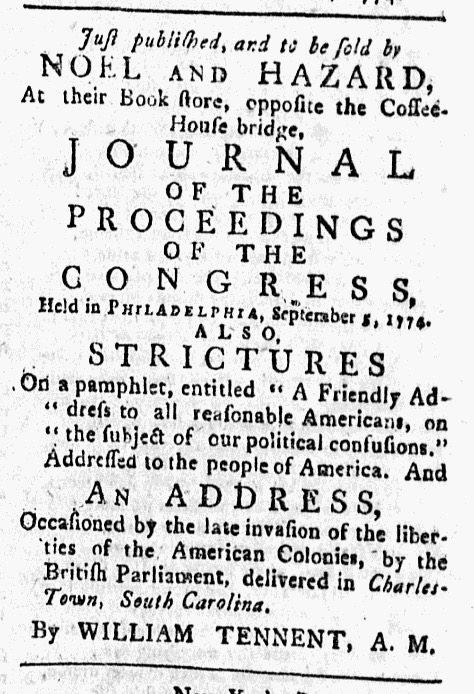
According to their advertisement in the December 15, 1775, edition of the New-York Journal, Garrat Noel and Ebenezer Hazard stocked the “JOURNAL OF THE PROCEEDINGS OF THE CONGRESS, Held in PHILADELPHIA” at their bookstore.  They also marketed “STRICTURES On a pamphlet, entitled ‘A Friendly Address to all reasonable Americans, on the subject of our political confusions’” by Charles Lee and “AN ADDRESS, Occasioned by the late invasion of the liberties of the American Colonies, by the British Parliament, delivered in Charles-Town, South Carolina” by William Tennent.  The booksellers provided the public access to news and commentary about current events beyond what appeared in the public prints, though they privileged perspectives expressed by Patriots rather than Loyalists.

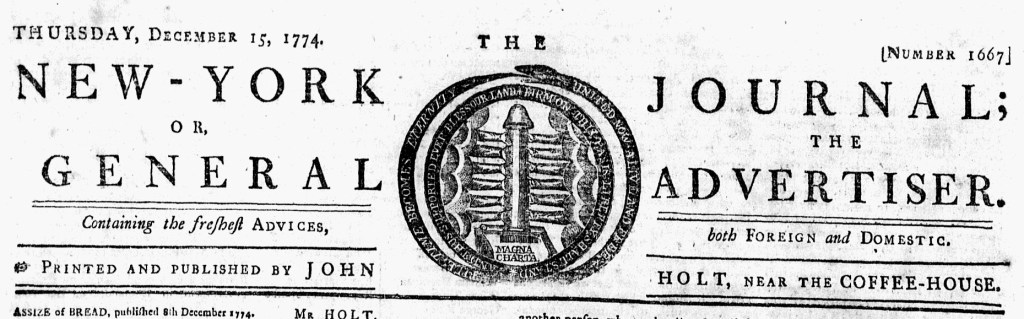
Noel and Hazard may have sold Hugh Gaine’s New York edition of the Proceedings of the First Continental Congress, though the other titles in their advertisement suggest that they could have sold the Philadelphia edition printed by William Bradford and Thomas Bradford.  The Bradfords also published Lee’s Strictures and Tennent’s Address, possibly sending copies of all three titles to Noel and Hazard.  Either  way, the masthead of the newspaper that featured the booksellers’ advertisement suggested that the Bradfords’ edition of the Proceedings made their way to New York.  Six months earlier, John Holt, the printer of the New-York Journal, incorporated a political cartoon depicting a severed snake, each segment representing one of the colonies, with the motto “UNITE OR DIE” into the masthead.  On December 15, he replaced it with a woodcut depicting twelve hands, one for each colony represented at the First Continental Congress, grasping a liberty pole with a liberty cap perched atop it on a pedestal inscribed “MAGNA CHARTA.”  A similar image appeared on the title page of the Bradfords’ edition of the Proceedings, described in Princeton University Library’s online catalog as “the first wood-cut device of the 12 colonies intended to symbolize the need for the true political unity of the colonies.”  Holt enhanced that image, having an ouroboros twice encircle the hands and pillar.  A message on the ouroboros proclaimed, “UNITED NOW – ALIVE AND FREE – AND THUS SUPPORTED EVER – BLESS OUR LAND – FIRM ON THIS BASIS LIBERTY SHALL STAND – TILL TIME BECOMES ETERNITY.”  This addition to his newspaper set the tone for readers to peruse Noel and Hazard’s advertisement, other paid notices, and the news and editorials selected by Holt.

New-York Journal (December 15, 1774).

December 2

What was advertised in a colonial American newspaper 250 years ago today?

Connecticut Gazette (December 2, 1774).

“All the Proceedings of the AMERICAN CONGRESS.”

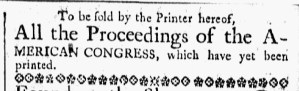
Among the several advertisements that ran in the December 2, 1774, edition of the Connecticut Gazette, a brief notice announced that “All the Proceedings of the AMERICAN CONGRESS, which have yet been printed” were “sold by the Printer hereof.”  That expanded the options that readers had for learning more about the meetings held by the First Continental Congress in Philadelphia from September 5 through October 26.  The Connecticut Gazette and other newspapers provided coverage.  In addition, printers throughout the colonies began publishing, advertising, and selling Extracts from the Votes and Proceedings of the American Continental Congress shortly after delegates concluded their business.  Within a month, William Bradford and Thomas Bradford advertised a “JOURNAL OF THE PROCEEDINGS OF THE CONGRESS,” an even more complete account to keep colonizers informed about current events.

Timothy Green, the printer of the Connecticut Gazette, was among the printers who produced a local edition of the Extracts, yet when he advertised “All the Proceedings … which have yet been printed” he did not refer to a volume from his own press.  Although printers far and wide quickly created and marketed local editions of the Extracts, only a couple opted to print the more extensive Journal.  The Bradfords advertised their Philadelphia edition.  Hugh Gaine, the printer of the New-York Gazette and Weekly Mercury, printed the only other edition.  Green likely sold Gaine’s edition at his printing office in New Haven, given the proximity of that town to New York, though the Bradfords could have dispatched copies via a ship bound from Philadelphia to New England.  No matter which printer supplied Green with copies of the Proceedings, he advertised the journal of the meetings of the First Continental Congress to readers in Connecticut a little over a week after the Bradfords first promoted their edition in the Pennsylvania Journal.  He did so the day after the Continental Association, a nonimportation pact intended to unite the colonies in resisting the Coercive Acts, went into effect.  As readers made decisions about what they would buy and sell, Green presented them with another option for learning about the political principles behind the Continental Association and the other actions taken by the First Continental Congress.

November 23

What was advertised in a colonial American newspaper 250 years ago today?

Pennsylvania Journal (November 23, 1774).

“JOURNAL OF THE PROCEEDINGS OF THE CONGRESS, Held at PHILADELPHIA.”

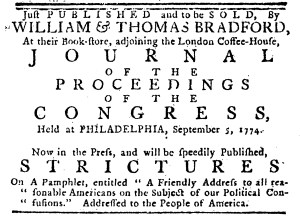
Just three weeks after they first advertised a pamphlet containing “EXTRACTS FROM THE VOTES AND PROCEEDINGS OF THE AMERICAN CONTINENTAL CONGRESS,” William Bradford and Thomas Bradford announced that they “Just PUBLISHED” a more extensive “JOURNAL OF THE PROCEEDINGS OF THE CONGRESS, Held at PHILADELPHIA, September 5, 1774.”  Although printers in towns throughout the colonies produced, marketed, and sold local editions of the Extracts to keep the public informed about what occurred at the First Continental Congress, the Bradfords were nearly alone in printing the Journal.  Hugh Gaine, the printer of the New-York Gazette and Weekly Mercury, joined them in that endeavor.

The Bradfords gave their advertisement for the Journal a privileged place in the November 23, 1774, edition of their newspaper, the Pennsylvania Journal.  It appeared on the third page, immediately following the list of prices current in Philadelphia.  While that may not seem like a spot of any significance in modern newspapers, consider the production of newspapers in eighteenth-century America.  Printers created each four-page issue by first printing the first and fourth pages on one side of a broadsheet, letting the ink dry, and then printing the second and third pages on the other side.  That meant that the most current news often appeared on the interior pages of an issue since printers set type and printed those pages last.  In most newspapers, the shipping news from the customs house or the prices current were the last news items before the advertisements, a familiar visual cue for readers that one type of content came to an end and another began.  For readers examining the news more carefully than the advertisements, an advertisement’s placement immediately following the shipping news and prices current likely increased its visibility.

That their advertisement for the Journal occupied that privileged place was not unique to the Bradfords marketing it in their own newspaper.  On the same day, they placed a notice in the Pennsylvania Gazette.  It ran on the third page, immediately following the shipping news and the prices current.  Among more than fifty paid notices in that issue, the printers of that newspaper apparently believed that the Journal deserved special treatment.  Marketing and selling both the Extracts and the Journal became an extension of keeping the public informed via coverage of the First Continental Congress that appeared in newspapers.