
What was advertised in colonial American newspaper 250 years ago today?
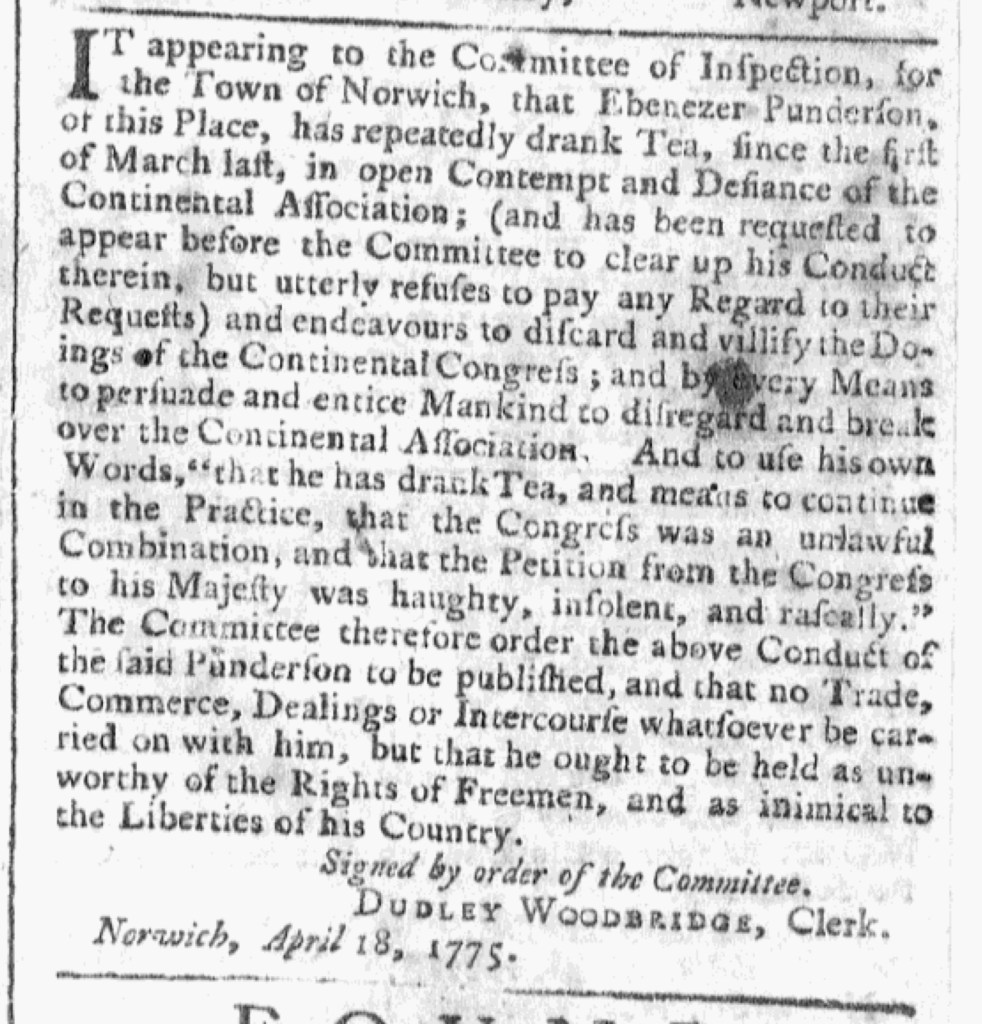
“Ebenezer Punderson … has repeatedly drank Tea … in open Contempt and Defiance of the Continental Association.”
Ebenezer Punderson went too far and now it was time for consequences. He brazenly and repeatedly violated the Continental Association, the nonimportation and nonconsumption agreement enacted by the Continental Congress in response to the Coercive Acts. As a result of his actions, the Committee of Inspection in Norwich, Connecticut, placed an advertisement in the April 20, 1775, edition of the Norwich Packet to document his behavior and advise the community to shun Punderson.
The committee reported that Punderson “has repeatedly drank Tea … in open Contempt and Defiance of the Continental Association.” When the committee sought to investigate the matter, he “utterly refuse[d] to pay any Regard to their Requests” to appear before it. Even worse, he “endeavours to discard and vilify the Doings of the Continental Congress; and by every Means to persuade and entice Mankind to disregard and break over the Continental Association.” His refusal to abide by the Continental Association damaged the movement and had the potential to do even more harm by inspiring others to ignore it as well. In addition, he stridently declared that he had no intention of adhering to the agreement, insulting the Continental Congress in the process: “to use his own words, ‘that he has drank Tea, and means to continue in that Practice, that the Congress was an unlawful Combination, and that the Petition from the Congress to his Majesty was haughty, insolent, and rascally.’”
The Committee of Inspection, in turn, determined that it was Punderson who was haughty, insolent, and rascally. It ordered that the “Conduct of the said Punderson be published, and that no Trade, Commerce, Dealings or Intercourse whatsoever be carried on with him.” Furthermore, the committee declared that “he ought to be held as unworthy of the Rights of Freemen, and as inimical to the Liberties of his Country.” Punderson acted in opposition to the patriot cause. The Committee of Inspection intended to see him pay for his transgressions.
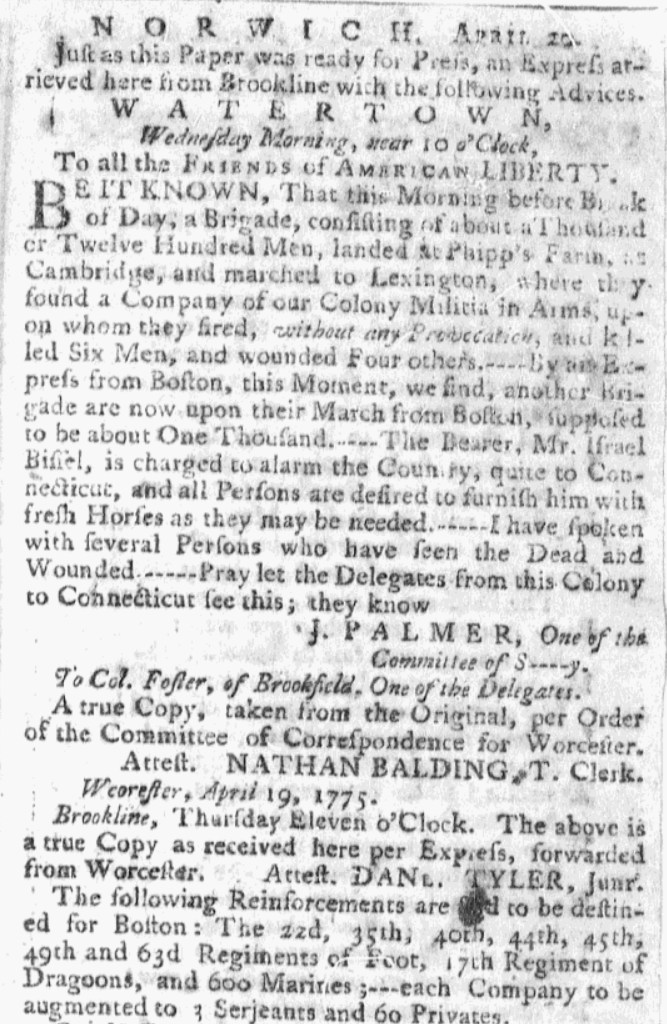
Punderson chose the wrong time to draw attention to himself. Some of the first coverage of the battle at Lexington to appear in American newspapers ran at the top of the column that featured the advertisement about his offenses. “Just as this Paper was ready for Press,” the printers declared, “an Express arrived here from Brookline with the following Advices” from J. Palmer, “One of the Committee of S[afet]y,” and dispatched to “Col. Foster, of Brookfield.” The missive reported that before dawn on the morning of April 19 “a Brigade [of British troops] … marched to Lexington, where they found a Company of our Colony Militia in Arms, upon whom they fired, without any Provocation, and killed Six Men, and wounded Four others.” Palmer stated that he had “spoken with several Persons who have seen the Dead and Wounded.” He also relayed news that another Brigade “are now on their March from Boston.” Israel Bissell carried the message, “charged to alarm the Country” in western Massachusetts all the way to Connecticut. The printers published this account from a “true Copy, taken from the Original, per Order of the Committee of Correspondence for Worcester.” The details were sparse, yet the “FRIENDS of AMERICAN LIBERTY” reading the Norwich Packet now knew that fighting had commenced near Boston. That news quite likely had an impact on their attitude when they read about Punderson’s offenses further down the column.
[…] Punderson had the misfortune of appearing in an advertisement placed in the Norwich Packet by the local Committee of Inspection in the issue that carried the first newspaper coverage of the battles of Lexington and Concord. […]