
What was advertised in a revolutionary American newspaper 250 years ago today?
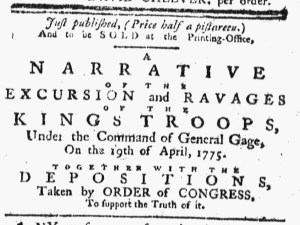
“A NARRATIVE OF THE EXCURSION and RAVAGES OF THE KINGS TROOPS, Under the Command of General Gage.”
I am fortunate to live just a few miles from the American Antiquarian Society in Worcester, Massachusetts. I pass the AAS on my way to campus, take students there to examine primary sources from the era of the American Revolution, and use its collections in my own research. Over the years that I have been in Worcester, I have become familiar with the stories that scholars and staff affiliated with the AAS most often tell about its founder, Isaiah Thomas. In recent months, I have used newspaper advertisements to retell some of those stories … and today I want to draw attention to an important detail that I have not heard highlighted nearly as often as the most treasured and repeated parts of the Thomas narrative.
This is a brief version of the story most often told: Thomas was an ardent Patriot whose editorial perspective in the Massachusetts Spy, the newspaper he printed in Boston so angered British officials that for his own safety he left Boston in April 1775, getting out just before the battles at Lexington and Concord and the siege of the city that followed. Thomas headed to Worcester, taking his press there and continuing to print the Massachusetts Spy in that town. It took a few weeks for him to acquire the paper necessary to print his newspaper, but when the first Worcester edition appeared on May 3, 1775, it included an account of the events at Lexington and Concord. Thomas famously signed the bottom of one copy: “This News-paper is the first Thing ever printed in Worcester – Isaiah Thomas.” (This story does not mention that Thomas previously announced plans to establish a printing office in Worcester and install a junior partner to print the town’s first newspaper or that when he left Boston he advertised that he would publish the next issue of the Massachusetts Spy in Worcester on May 3.) Thomas settled in Worcester. He collected as many books, pamphlets, newspapers, broadsides, and other items printed in America as he could to research and publish his History of Printing in America in 1810. Those items became the initial collections of the American Antiquarian Society, founded in Worcester in 1812. Thomas did not establish the library and learned society in Boston because he felt Worcester provided greater security as the new nation went to war with Great Britain for a second time.
That’s a great story, one that engages students, scholars, and visitors to the American Antiquarian Society … but there’s even more that, from my perspective, makes it an even better story about this Patriot printer and his contributions to the American cause. Two months after Thomas printed the first issue of the Massachusetts Spy in Worcester, the newspaper carried an advertisement for “A NARRATIVE OF THE EXCURSION and RAVAGES OF THE KINGS TROOPS, Under the Command of General Gage, On the 19th of April, 1775.” The book also included “DEPOSITIONS, Taken by ORDER of CONGRESS, To support the Truth of it.” Just as the first newspaper printed in the town featured an account of Lexington and Concord, so did the first book published there. Once again, Thomas made a notation on the product of his press: “First Book printed in Worcester.”[1] The imprint at the bottom of the title page stated, “WORCESTER, Printed by ISAIAH THOMAS, by order of the PROVINCIAL CONGRESS.” To underscore the point, Thomas printed the corresponding resolution on the verso of that page.[2] Thomas served as printer, even though other printers had offices closer to where the Massachusetts Provincial Congress met in Watertown. For instance, Samuel Hall and Ebenezer Hall relocated the Essex Gazette from Salem to Cambridge and renamed it the New-England Chronicle. Benjamin Edes, another prominent Patriot printer, moved to Watertown and printed the Boston-Gazette there.
When Thomas printed A Narrative of the Excursion and Ravages of the King’s Troops and marketed it in the Massachusetts Spy, Patriots fought a war on many fronts. In addition to the battles at Lexington, Concord, and Bunker Hill, they waged a war of information. Thomas worked to establish and expand a communications infrastructure to collect and disseminate news from Boston and its environs, the Continental Congress meeting in Philadelphia, and throughout the colonies and beyond. Yet he competed with misinformation and British officials and Tories who had different perspectives and relayed different versions of recent events and their causes. That made it even more important to supplement newspaper coverage of the outbreak of hostilities at Lexington and Concord, sometimes confused and contradictory, with “the Truth of it,” not just as presented by a Patriot printer but supported by “DEPOSITIONS, Taken by ORDER of CONGRESS.” Thomas played an important role in establishing the narrative of what occurred on April 19, 1775.
**********
[1] See the first image on the page linked here.
[2] Advance to the fifth image on the page linked here.