July 5

What was advertised in a revolutionary American newspaper 250 years ago today?
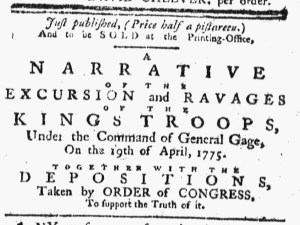
Massachusetts Spy (July 5, 1775).

“A NARRATIVE OF THE EXCURSION and RAVAGES OF THE KINGS TROOPS, Under the Command of General Gage.”

I am fortunate to live just a few miles from the American Antiquarian Society in Worcester, Massachusetts.  I pass the AAS on my way to campus, take students there to examine primary sources from the era of the American Revolution, and use its collections in my own research.  Over the years that I have been in Worcester, I have become familiar with the stories that scholars and staff affiliated with the AAS most often tell about its founder, Isaiah Thomas.  In recent months, I have used newspaper advertisements to retell some of those stories … and today I want to draw attention to an important detail that I have not heard highlighted nearly as often as the most treasured and repeated parts of the Thomas narrative.

This is a brief version of the story most often told: Thomas was an ardent Patriot whose editorial perspective in the Massachusetts Spy, the newspaper he printed in Boston so angered British officials that for his own safety he left Boston in April 1775, getting out just before the battles at Lexington and Concord and the siege of the city that followed.  Thomas headed to Worcester, taking his press there and continuing to print the Massachusetts Spy in that town.  It took a few weeks for him to acquire the paper necessary to print his newspaper, but when the first Worcester edition appeared on May 3, 1775, it included an account of the events at Lexington and Concord.  Thomas famously signed the bottom of one copy: “This News-paper is the first Thing ever printed in Worcester – Isaiah Thomas.”  (This story does not mention that Thomas previously announced plans to establish a printing office in Worcester and install a junior partner to print the town’s first newspaper or that when he left Boston he advertised that he would publish the next issue of the Massachusetts Spy in Worcester on May 3.)  Thomas settled in Worcester.  He collected as many books, pamphlets, newspapers, broadsides, and other items printed in America as he could to research and publish his History of Printing in America in 1810.  Those items became the initial collections of the American Antiquarian Society, founded in Worcester in 1812.  Thomas did not establish the library and learned society in Boston because he felt Worcester provided greater security as the new nation went to war with Great Britain for a second time.

That’s a great story, one that engages students, scholars, and visitors to the American Antiquarian Society … but there’s even more that, from my perspective, makes it an even better story about this Patriot printer and his contributions to the American cause.  Two months after Thomas printed the first issue of the Massachusetts Spy in Worcester, the newspaper carried an advertisement for “A NARRATIVE OF THE EXCURSION and RAVAGES OF THE KINGS TROOPS, Under the Command of General Gage, On the 19th of April, 1775.”  The book also included “DEPOSITIONS, Taken by ORDER of CONGRESS, To support the Truth of it.”  Just as the first newspaper printed in the town featured an account of Lexington and Concord, so did the first book published there.  Once again, Thomas made a notation on the product of his press: “First Book printed in Worcester.”[1]  The imprint at the bottom of the title page stated, “WORCESTER, Printed by ISAIAH THOMAS, by order of the PROVINCIAL CONGRESS.”  To underscore the point, Thomas printed the corresponding resolution on the verso of that page.[2]  Thomas served as printer, even though other printers had offices closer to where the Massachusetts Provincial Congress met in Watertown.  For instance, Samuel Hall and Ebenezer Hall relocated the Essex Gazette from Salem to Cambridge and renamed it the New-England Chronicle.  Benjamin Edes, another prominent Patriot printer, moved to Watertown and printed the Boston-Gazette there.

When Thomas printed A Narrative of the Excursion and Ravages of the King’s Troops and marketed it in the Massachusetts Spy, Patriots fought a war on many fronts.  In addition to the battles at Lexington, Concord, and Bunker Hill, they waged a war of information.  Thomas worked to establish and expand a communications infrastructure to collect and disseminate news from Boston and its environs, the Continental Congress meeting in Philadelphia, and throughout the colonies and beyond.  Yet he competed with misinformation and British officials and Tories who had different perspectives and relayed different versions of recent events and their causes.  That made it even more important to supplement newspaper coverage of the outbreak of hostilities at Lexington and Concord, sometimes confused and contradictory, with “the Truth of it,” not just as presented by a Patriot printer but supported by “DEPOSITIONS, Taken by ORDER of CONGRESS.”  Thomas played an important role in establishing the narrative of what occurred on April 19, 1775.

**********

[1] See the first image on the page linked here.

[2] Advance to the fifth image on the page linked here.
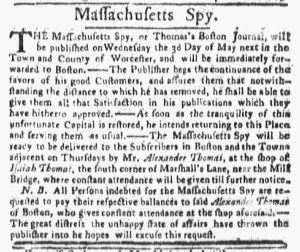
April 17

What was advertised in a colonial American newspaper 250 years ago today?

Boston Evening-Post (April 17, 1775).

“THE Massachusetts Spy … will be published … in the Town and County of Worcester.”

Isaiah Thomas published the last issue of the Massachusetts Spy in Boston on April 6, 1775.  Eleven days later, advertisements in the Boston Evening-Post and the Massachusetts Gazette and Boston Post-Boy informed readers that the “Massachusetts Spy, or Thomas’s Boston Journal, will be published on Wednesday the 3d Day of May next in the Town and County of Worcester, and will be immediately forwarded to Boston.”  Why did Thomas suddenly suspend publishing the Massachusetts Spy, founded in 1770, and relocate to Worcester with plans to revive the newspaper there?

In his History of Printing in America, published in 1810, Thomas declared, “It became at length apparent to all reflecting men that hostilities must soon take place between Great Britain and her American colonies.”  Through the editorial stance he took in the Massachusetts Spy, the patriot printer “had rendered himself very obnoxious to the friends of the British administration; and, in consequence, the tories, and some of the British soldiery in the town, openly threatened him with the effects of their resentment.”  Along with other residents of Boston, Thomas had endured all sorts of “Distresses,” as he called them, following the closure of the harbor in retaliation for the destruction of the tea, but now his own safety was at stake.  “For these and other reasons, he was induced to pack up, privately, a press and types, and to send them in the night over the Charles river to Charlestown, whence they were conveyed to Worcester.”  Thomas was smart with his timing for getting out of Boston: “This was only a few days before the affair at Lexington.”[1]  The printer smuggled a press out of Boston just before the Revolutionary War began with the skirmishes at Lexington and Concord followed by the siege of Boston.

Near the end of February, the Massachusetts Spy carried subscription proposals for a “New Weekly NEWS-PAPER … To be entitled, The WORCESTER GAZETTE.”  Thomas had made arrangements with “a number of gentlemen in the county of Worcester, zealously engaged in the cause of the country … to open a printing house, and to publish a newspaper there, in the course of the ensuing spring.”  It would be the town’s first printing office and first newspaper.  Thomas planned “to send a press, with a suitable person to manage the concerns of it,” having previously gained experience setting up Henry-Walter Tinges as a junior partner who oversaw their printing office in Newburyport and printed the Essex Journal.  “The war commencing sooner than expected,” however, Thomas “was obliged to leave Boston, and came himself to Worcester, opened a printing house, and on the 3d of May, 1775, executed the first printing done in the town.”[2]

As he prepared to open that printing office, his advertisement in newspapers still published in Boston advised the public that the “Publisher [of the Massachusetts Spy] begs the continuance of the favors of his good Customers, and assures then that notwithstanding the distance to which he has removed, he shall be able to give them all that Satisfaction in his publications which they have hitherto approved.”  Furthermore, he planned to return to Boston “[a]s soon as the tranquility of this unfortunate Capital is restored,” not knowing at the time that he would remain in Worcester after the war ended.  For the moment, he designated a local agent, Alexander Thomas, who oversaw his shop in Boston and saw to the delivery of new issues of the Massachusetts Spy on Thursdays, the day after the printer published them in Worcester.  He also requested that “All Persons indebted for the Massachusetts Spy … pay their respective balances.” Like other printers, Thomas extended credit to his customers, but the “great distress [of] the unhappy state of affairs” made it necessary to call on them to make payment.”  Thomas faced a new chapter, one that the Adverts 250 Projectwill chronicle as it examines advertisements placed in revolutionary American newspapers.

**********

[1] Isaiah Thomas, The History of Printing in America: With a Biography of Printers and an Account of Newspapers (1810; New York: Weathervane Press, 1970), 168.

[2] Thomas, History of Printing, 180-181.

February 23

What was advertised in a colonial American newspaper 250 years ago today?

Massachusetts Spy (February 23, 1775).

“A New Weekly NEWS-PAPER … The WORCESTER GAZETTE; OR, AMERICAN ORACLE of LIBERTY.”

Among the advertisements in the February 23, 1775, edition of the Massachusetts Spy appeared “PROPOSALS For … A New Weekly NEWS-PAPER … To be entitled, The WORCESTER GAZETTE; OR, AMERICAN ORACLE of LIBERTY.”  That newspaper would commence publication in Worcester, about forty miles west of Boston, “as soon as Seven Hundred Subscribers have entered their names.”  It would be the first newspaper published in that town, giving residents greater access to “the most early and authentic Intelligence, and such Political Essays, as are worthy of Public notice, with other matters interesting and entertaining.”

In his History of Printing in America (1810), Isaiah Thomas explained, “In 1774, a number of gentlemen in the county of Worcester, zealously engaged in the cause of the country, were from the then appearance of public affairs, desirous to have a press established in Worcester.”  In other words, supporters of the patriot cause wanted a local newspaper instead of relying on newspapers published in Boston, Salem, Newburyport, Providence, Portsmouth, Norwich, and Hartford.  Although newspapers from each of those towns served readers in larger, overlapping regions, Patriots in Worcester believed that a local newspaper would both serve their community and strengthen their position.  By the time they “applied to a printer in Boston” in December 1774, the “Worcester Revolution” had already closed the courts and removed British authority from that town.  Thomas, that printer in Boston, “engaged to open a printing house, and to publish a newspaper there, in the course of the ensuing spring.”  He initially intended to follow a model like the one for establishing the Essex Journal in partnership with Henry-Walter Tinges in Newburyport.  Tinges, the junior partner, managed the printing office there while Thomas remained in Boston.  As part of his preparations, Thomas published the proposals for the Worcester Gazette as he worked on recruiting “a suitable person to manage the concerns of it.” However, when the Revolutionary War began with the Battles of Lexington and Concord on April 19, Thomas “was obliged to leave Boston, and came himself to Worcester” and became the city’s first printer.[1]

When Thomas disseminated the first issue on May3, he combined the name of the newspaper he published in Boston for several years, the Massachusetts Spy, and the intended name for the new newspaper, calling it the Massachusetts Spy or American Oracle of Liberty.  As outlined in the proposals from February, he published the newspaper “every WEDNESDAY Morning, as early as possible” so it could be “delivered to the Subscribers in Worcester at their houses, and sent by the first opportunity to such as are at a greater distance.”  The annual subscription fee in the colophon matched the proposals, “Six Shillings and Eight Pence per annum, the same as the Boston news-papers.”  The colophon did not list rates for advertising, though the proposals stated that they would be “inserted in a neat and conspicuous [manner], at the same rates as they are in Boston.”  Little did Thomas know when he published the “PROPOSALS [for] The WORCESTER GAZETTE” in February 1775 that he would soon relocate to that town and become one of its most prominent residents, establishing the first printing office and, eventually, founding the American Antiquarian Society in 1812.

**********

[1] Isaiah Thomas, The History of Printing in America: With a Biography of Printers and an Account of Newspapers (1810; New York: Weathervane Books, 1970), 180-181.