
What was advertised in a revolutionary American newspaper 250 years ago today?
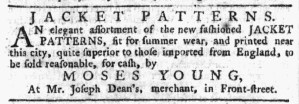
“JACKET PATTERNS … printed near this city, quite superior to those imported from England.”
Public discourse about the American Revolution resonated not only in the news and editorials that appeared in newspapers but also in the advertisements that ran in them. In the July 18, 1775, edition of the Pennsylvania Journal, for instance, John Dean, a bookbinder, once again advertised the Philadelphia edition of A Self Defensive War Lawful, a sermon recently “preached at Lancaster, before Captain Ross’s company of militia” by John Carmichael. The updated version of this advertisement indicated that four local printers and booksellers now stocked the sermon. It also listed prices for single copies, a dozen, or a hundred, suggesting that Dean anticipated that retailers would purchase copies to sell or other customers would buy the sermon to distribute in their communities.
The advertisement immediately above the one for the sermon was also tied to the events of the American Revolution. Moses Young announced that he sold “JACKET PATTERNS.” He had an “elegant assortment of the new fashioned JACKET PATTERNS, fit for summer wear, and printed near this city.” Young did not have to invoke the Continental Association, a nonimportation agreement devised by the First Continental Congress in response to the Coercive Acts, for readers to understand the implications of his assertion that the patterns were produced near Philadelphia. In addition to prohibiting imported goods, the Continental Association called on colonizers to “encourage Frugality, Economy, and Industry; and promote Agriculture, Arts, and the Manufactures of this Country.” Moses Young did just that … and he gave consumers a chance to do their part. They could keep up with current trends and they could do so without sacrificing quality. After all, Young described the patterns as both “new fashioned” and “quite superior to those imported from England.” In addition, he sold them for a “reasonable” price. As the siege of Boston continued in Massachusetts and the Second Continental Congress continued meeting in Philadelphia, Young’s marketing presented an opportunity for consumers to offer their support for the American cause through one of the decisions they made in the marketplace.