
Who was the subject of an advertisement in a revolutionary American newspaper 250 years ago today?
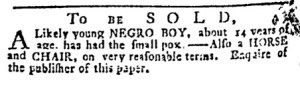
“TO BE SOLD, A Likely young NEGRO BOY, about 14 years of age.”
On September 5, 1775, Mary Katharine Goddard, the printer of the Maryland Journal, and the Baltimore Advertiser, published a two-page Postscript to the Baltimore Journal, &c. to supplement the news and other content that appeared in the standard edition. It appeared a day ahead of the weekly edition. Goddard apparently believed that she had news that could not wait as well as not enough space to print it all, making the Postscript necessary. The first page of the supplement featured news from New York and Watertown, Massachusetts, in a larger font, while the second page consisted almost entirely of news from the “PROVINCIAL CONVENTION” held in Annapolis in a smaller font. A note preceding the headline indicated that coverage was “Continued from our last.” Even devoting an entire page in smaller font to that news did not allow Goddard to print all of it. A note at the end promised, “To be continued.”
That left just enough space for Goddard to insert one advertisement. An advertisement about a “Likely young NEGRO BOY” and a “HORSE and CHAIR” (a kind of carriage) that ran in the previous issue was the right length to complete the final column on the second page of the Postscript. It did not provide much information about the enslaved young man, noting only that he was “about 14 years old” and “has had the small pox” so he would not contract that disease again. Interested parties should “Enquire of the publisher of this paper” the advertisement instructed. Like other printers who published newspapers from New England to Georgia, Goddard not only disseminated advertisements about enslaved people but also served as a broker who facilitated sales when those advertisements directed readers to learn more at the printing office. In this instance, publishing news from Maryland’s provincial convention meant greater circulation for an advertisement offering an enslaved youth for sale. That advertisement ran once again in the standard issue the next day, placing it before the eyes of readers with greater frequency than any other notices in that newspaper. Even as the provincial convention met to discuss how to defend the liberties of colonizers and the Maryland Journal carried the news, the newspaper also worked to constrain the freedom of enslaved people, including one “Likely young NEGRO BOY” in particular.