October 9

What was advertised in a revolutionary American newspaper 250 years ago today?

Maryland Journal (October 9, 1776).

“BLANKS AND HAND BILLS are done on the shortest NOTICE, in a NEAT and CORRECT MANNER.”

As was the case for many eighteenth-century newspapers, the Maryland Journal featured an array of advertisements and concluded with a colophon that served as a final advertisement, one that repeated from issue to issue every week.  Not every colophon advertised the goods and services available at the printing office where the newspaper was published.  Some merely gave the name of the printer and the town.  The Maryland Journal and many others, however, had lengthy colophons that hawked subscriptions and solicited job printing.

In the fall of 1776, the newspaper’s colophon stated, “BALTIMORE: Published by M.K. Goddard, at the PRINTING-OFFICE in MARKET-STREET, next Door above Dr. JOHN STEVENSON’s, where SUBSCRIPTIONS for this PAPER, at TEN SHILLINGS per Annum, ADVERTISEMENTS and INTERESTING ESSAYS, or LETTERS of USEFUL INTELLIGENCE, are gratefully received for this PAPER; and where all MANNER of PRINTING-WORK is performed with CARE, FIDELITY, and EXPEDITION.— BLANKS AND HAND BILLS are done on the shortest NOTICE, in a NEAT and CORRECT MANNER.”

Like many of her male counterparts, Mary Katharine Goddard used the colophon to promote both the newspaper and other aspects of the business she operated.  Her brother, William, established the Maryland Journal in August 1773, but Goddard had been the printer since May 1775.  She included extensive directions to the printing office in the colophon to aid customers seeking to purchase subscriptions, advertisements, or blanks or others with job printing orders for handbills and other items.  In addition, advertisements often instructed interested parties to “enquire of the printer” to learn more.  Goddard served as an information broker, supplying details that did not appear in print.  The directions in the colophon helped readers seeking to “enquire of the printer” to find her printing office.  That Goddard included blanks (or printed forms, which could be personalized for an entrepreneur) and handbills in the colophon suggests that she did brisk business in them.  Those forms of advertising media have not been saved and preserved to the extent of newspapers and the advertisements that appeared in them, though they circulated in Baltimore and other cities and towns in eighteenth-century America.  Goddard’s colophon hinted at marketing materials that readers encountered as they went about their daily lives.
June 19

What was advertised in a revolutionary American newspaper 250 years ago today?

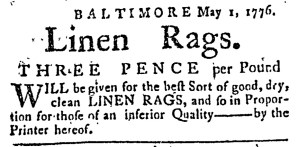
Maryland Journal (June 19, 1776).

“The Presses, the important vehicles of instruction and amusement, must soon be reduced to the same unhappy situation.”

During an ongoing shortage of paper, John Dixon and William Hunter, the printers of the Virginia Gazette in Williamsburg, were not the only printers in the Chesapeake who inserted a call for “CLEAN LINEN RAGS” to recycle into paper in their newspaper in June 1776.  Frederick Green, the printer of the Maryland Gazette in Annapolis, inserted such a notice in the June 20 edition: “THREE PENCE per pound is given for fine white LINEN RAGS, and one penny per pound for coarse, by the Printer hereof.”  On June 19, the printers of both newspapers published in Baltimore ran similar notices.  Mary Katharine Goddard, the printer of the Maryland Journal, ran (once again!) an advertisement similar to Green’s notice.  Since May 1, she had been informing readers that “THREE PENCE per Pound WILL be given for the best Sort of good, dry, clean LINEN RAGS, and so in Proportion for those of an inferior Quality.”  To draw attention, she used “Linen Rags” in a much larger font as a headline for the advertisement.

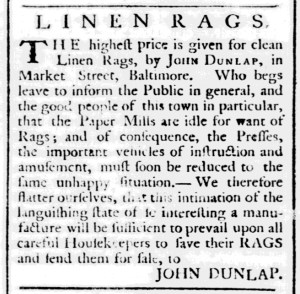
Dunlap’s Maryland Gazette (June 19, 1776).

John Dunlap composed a more elaborate notice for Dunlap’s Maryland Gazette.  Beneath a headline that proclaimed, “LINEN RAGS,” in capital letters, he informed readers that the “highest price is given for clean Linen Rags, by JOHN DUNLAP.”  He went on to explain to “the Public in general, and the good people of this town in particular” that “the Paper Mills are idle for want of Rags.”  As a result, “the Presses, the important vehicles of instruction and amusement” – and news about politics, commerce, and current events as the war continued and the Continental Congress moved closer and closer to declaring independence – “must soon be reduced to the same unhappy situation” of sitting idle.  “We therefore flatter ourselves,” Dunlap confidently asserted, “that this intimation of the languishing state of so interesting a manufacture will be sufficient to prevail upon all careful Housekeepers to save their RAGS and send them for sale.”  In other words, anyone who wanted to continue receiving the news via Dunlap’s Maryland Gazette or any other newspaper needed to do their part in supplying rags for the paper mills.  Women in particular, those “careful Housekeepers,” had an important role to play in making it possible for newspapers to disseminate the “FRESHEST ADVICES, both FOREIGN and DOMESTIC,” promised in the masthead of the Maryland Journal and other newspapers.

October 11

What was advertised in a revolutionary American newspaper 250 years ago today?

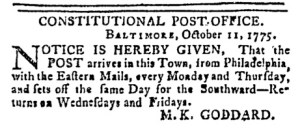
Maryland Journal (October 11, 1775).

“CONSTITUTIONAL POST-OFFICE.  BALTIMORE.”

The contents of the October 11, 1775, edition of the Maryland Journal were organized such that the first advertisement that readers encountered promoted the Baltimore branch of the “CONSTITUTIONAL POST-OFFICE” established by the Second Continental Congress as an alternative to the imperial postal system operated by the British government.  It completed the middle column on the third page, a column otherwise filled with news from Cambridge, Hartford, New York, and Philadelphia.  Two lines separated it from other content, indicating a transition from news to advertising, yet the notice seemed a continuation of updates about current events, including an inaccurate report that General Richard Montgomery had captured Montreal as part of the American invasion of Quebec.  Advertisements inserted for other purposes, such as fencing lessons and descriptions of runaway indentured servants, appeared in the next column and on the next page.

“NOTICE IS HEREBY GIVEN,” the advertisement proclaimed, “That the POST arrives in this Town, from Philadelphia, with the Eastern Mailes, every Monday and Thursday, and sets off the same Day for the Southward.”  It returned from that direction on Wednesdays and Fridays.  The notice was signed, “M.K. GODDARD.”  The colophon at the bottom of the final page also listed “M.K. GODDARD, at the PRINTING-OFFICE in MARKET-STREET” as the printer of the Maryland Journal.  Mary Katharine Goddard operated the printing office in Baltimore.  Like many other printers, she simultaneously served as postmaster.  Many of them, as Joseph M. Adelman explains, had been “associated with the old imperial system” and “shifted [their] service from the British post office to the American one.”  They included Solomon Southwick, the printer of the Newport Mercury, John Carter, the printer of the Providence Gazette, and Alexander Purdie, the printer of the Virginia Gazette.  Appointed to the position in 1775, Goddard served as postmaster in Baltimore for fourteen years “until she lost her position in 1789 to a new postmaster more closely connected to the new Federal Postmaster General.”[1]

Women participated in the American Revolution in many ways.  They signed nonimportation agreements and made decisions in the marketplace that reflected their political principles, they spun wool and made homespun garments as alternatives to British imports, and they raised funds to support the Continental Army.  Some served in more formal roles, including Mary Katharine Goddard as both the printer of the Maryland Journal and the postmaster at the “CONSTITUTIONAL POST-OFFICE” in Baltimore.

**********

[1] Joseph M. Adelman, “‘A Constitutional Conveyance of Intelligence, Public and Private’: The Post Office, the Business of Printing, and the American Revolution,” Enterprise and Society 11, no. 4 (December 2010): 742.

September 5

Who was the subject of an advertisement in a revolutionary American newspaper 250 years ago today?

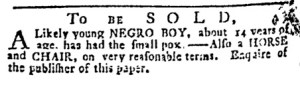
Postscript to the Baltimore Journal, &c. (September 5, 1775).

“TO BE SOLD, A Likely young NEGRO BOY, about 14 years of age.”

On September 5, 1775, Mary Katharine Goddard, the printer of the Maryland Journal, and the Baltimore Advertiser, published a two-page Postscript to the Baltimore Journal, &c. to supplement the news and other content that appeared in the standard edition.  It appeared a day ahead of the weekly edition.  Goddard apparently believed that she had news that could not wait as well as not enough space to print it all, making the Postscript necessary.  The first page of the supplement featured news from New York and Watertown, Massachusetts, in a larger font, while the second page consisted almost entirely of news from the “PROVINCIAL CONVENTION” held in Annapolis in a smaller font.  A note preceding the headline indicated that coverage was “Continued from our last.”  Even devoting an entire page in smaller font to that news did not allow Goddard to print all of it.  A note at the end promised, “To be continued.”

That left just enough space for Goddard to insert one advertisement.  An advertisement about a “Likely young NEGRO BOY” and a “HORSE and CHAIR” (a kind of carriage) that ran in the previous issue was the right length to complete the final column on the second page of the Postscript.  It did not provide much information about the enslaved young man, noting only that he was “about 14 years old” and “has had the small pox” so he would not contract that disease again.  Interested parties should “Enquire of the publisher of this paper” the advertisement instructed.  Like other printers who published newspapers from New England to Georgia, Goddard not only disseminated advertisements about enslaved people but also served as a broker who facilitated sales when those advertisements directed readers to learn more at the printing office.  In this instance, publishing news from Maryland’s provincial convention meant greater circulation for an advertisement offering an enslaved youth for sale.  That advertisement ran once again in the standard issue the next day, placing it before the eyes of readers with greater frequency than any other notices in that newspaper.  Even as the provincial convention met to discuss how to defend the liberties of colonizers and the Maryland Journal carried the news, the newspaper also worked to constrain the freedom of enslaved people, including one “Likely young NEGRO BOY” in particular.