
What was advertised in a revolutionary American newspaper 250 years ago today?
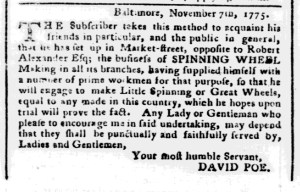
“He has set up … the business of SPINNING WHEEL Making.”
David Poe established a workshop for making spinning wheels in Baltimore in the fall of 1775. To attract the attention of prospective customers, he placed an advertisement in the November 14 edition of Dunlap’s Maryland Gazette, advising “his friends in particular, and the public in general, that he has set up … the business of SPINNING WHEEL Making in all its branches.” Rather than make one spinning wheel at a time, he could produce them in quantity, “having supplied himself with a number of prime workmen for that purpose.” Poe did not specify whether those “prime workmen” were free, indentured, or enslaved. He instead emphasized that he “will engage to make Little Spinning or Great Wheels, equal to any made in this country.” Furthermore, he invited readers to see for themselves, stating that he “hopes upon trial” spinning wheels made in his workshop “will prove the fact.”
Poe advertised spinning wheels at a time that they became political symbols. In response to the Coercive Acts that Parliament passed to punish Boston after the destruction of imported tea during a protest now known as the Boston Tea Party, the First Continental Congress devised the Continental Association, a nonimportation, nonconsumption, and nonexportation pact that called on colonizers to abstain from purchasing goods, including textiles, imported from England. The agreement also included a call for colonizers to “encourage Frugality, Economy, and Industry; and promote Agriculture, Arts, and the Manufactures of this Country, especially that of Wool.” Poe heeded that call as homespun cloth produced in the colonies became a fashionable political statement. Newspapers carried reports of women participating in politics by holding spinning bees in public spaces. Rather than a useful tool operated in domestic settings, the spinning wheel became a symbol of public commitment to the American cause, a visible demonstration to friends, neighbors, and the rest of the community that industrious women hoped would inspire others to follow their lead. Poe did his part, aiming to provide “Any Lady or Gentleman” with spinning wheels for their households. He did not make direct reference to the Continental Association or the events that had unfolded in the seven months since the battles at Lexington and Concord, but he did not need to do so. Readers certainly understood the connection between spinning wheels and current events.
[…] the same time that David Poe advertised that he “set up … the business of SPINNING WHEEL Making” in Baltimore in November 1775, Fergus McIllroy took to the pages of Dunlap’s Maryland Gazette to […]