June 27

What was advertised in a revolutionary American newspaper 250 years ago today?
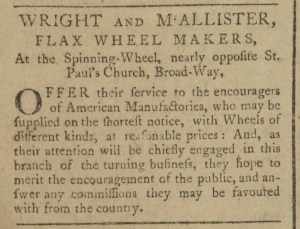
New York Packet (June 27, 1776).

“WRIGHT AND McALLISTER, FLAX WHEEL MAKERS, … OFFER their service to the encouragers of American Manufactories.”

Wright and McAllister, “FLAX WHEEL MAKERS,” marked their location “nearly opposite St. Paul’s Church, Broad-Way,” in New York with a sign depicting a spinning wheel.  The placed an advertisement in the June 27, 1776, edition of the New York Packet to “OFFER their service to the encouragers of American Manufactories.”  In so doing, they echoed the language that so often appeared in editorials about producing goods in the colonies rather than importing them from Great Britain, in advertisements that promoted such products, and in nonimportation agreements adopted as acts of resistance.  The eighth article of the Continental Association, the most significant of the nonimportation agreements, for instance, stated, “That we will, in our several Stations, encourage Frugality, Economy, and Industry; and promote Agriculture, Arts, and the Manufactures of this Country.”  That meant producing homespun textiles as alternatives to the array of imported fabrics that dominated newspaper advertisement for imported goods, yet colonizers could not focus solely on the final product.  Purchasing and wearing homespun depended on having the equipment necessary for producing it.

Wright and McAllister aimed to do their part in such a worthy endeavor.  They made “Wheels of different kinds” that they sold “at reasonable prices.”  Under other circumstances they might have described themselves as turners rather than “FLAX WHEEL MAKERS,” but they decided that “their attention will be chiefly engaged in this branch of the turning business” on the eve of the Second Continental Congress declaring independence.  They joined other entrepreneurs who marketed American-made equipment for producing textiles, including Robert White and David Poe, who both made spinning wheels, and Fergus McIllroy, who made looms.  Given the service that they undertook on behalf of the American cause, Wright and McAllister “hope[d] to merit the encouragement of the public” in New York as well as “answer any commissions they may be favoured with from the county.”  In turn, their work would enable others, especially women, to participate in politics through their activities in the marketplace, not only as consumers but also as producers of the thread necessary for producing homespun textiles.
December 19

What was advertised in a revolutionary American newspaper 250 years ago today?

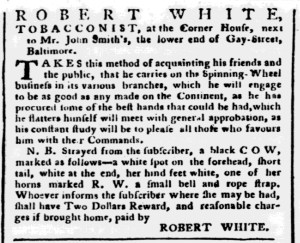
Dunlap’s Maryland Gazette (December 19, 1775).

“He carries on the Spinning-Wheel business in its various branches.”

In the final weeks of 1775, Robert White, a tobacconist in Baltimore, diversified his business.  He inserted an advertisement in the December 19 edition of Dunlap’s Maryland Gazette that announced that “he carries on the Spinning-Wheel business in its various branches.”  Why would a tobacconist decide to go into that line of business?  The Continental Association, a nonimportation and nonconsumption agreement devised by the Furst Continental Congress, remained in effect.  It called on colonizers to replace imported goods, including textiles, with alternatives produced in the colonies.  That meant more time spent spinning, a domestic chore that gained political significance.  Women styled Daughters of Liberty in newspaper accounts participated in public spinning bees to demonstrate their patriotism and inspire others to follow their example in their own homes.  To do so, they needed the right equipment.  White saw an expanding market for spinning wheels.

He was not alone in marketing equipment for producing homespun cloth.  His advertisement happened to appear immediately above Fergus McIllroy’s notice promoting “LOOMS made properly, for carrying on the Linen and Woolen Weaving-business.”  McIllroy, a “House Joiner,” also pursued a new line of work, though in his case doing so did not depart nearly as much from his primary occupation.  In addition, he reported that he had previously constructed more than two hundred looms in Ireland before migrating to the colonies.  White, the tobacconist, did not invoke such experience when it came to spinning wheels, yet he confidently proclaimed that he “will engage” his spinning wheels “to be as good as any made on the Continent” because “he has procured some of the best hands that could be had.”  In turn, White “flatters himself” that his workers and the spinning wheels they produced “will meet with general approbation” or approval from customers.  The tobacconist apparently served as a supervisor, an entrepreneur who established a business when he identified need for it during difficult time yet did not participate in making the spinning wheels.  Instead, in overseeing his new business, he pledged that “his constant study will be to please all those who favours him with their Commands.”  With no resolution in sight for the imperial crisis that became a war the previous April, White’s advertisement likely resonated with readers who understand the political implications of a tobacconist deciding to produce spinning wheels.

November 14

What was advertised in a revolutionary American newspaper 250 years ago today?

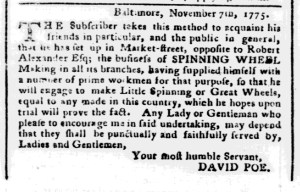
Dunlap’s Maryland Gazette (November 14, 1775).

“He has set up … the business of SPINNING WHEEL Making.”

David Poe established a workshop for making spinning wheels in Baltimore in the fall of 1775.  To attract the attention of prospective customers, he placed an advertisement in the November 14 edition of Dunlap’s Maryland Gazette, advising “his friends in particular, and the public in general, that he has set up … the business of SPINNING WHEEL Making in all its branches.”  Rather than make one spinning wheel at a time, he could produce them in quantity, “having supplied himself with a number of prime workmen for that purpose.”  Poe did not specify whether those “prime workmen” were free, indentured, or enslaved.  He instead emphasized that he “will engage to make Little Spinning or Great Wheels, equal to any made in this country.”  Furthermore, he invited readers to see for themselves, stating that he “hopes upon trial” spinning wheels made in his workshop “will prove the fact.”

Poe advertised spinning wheels at a time that they became political symbols.  In response to the Coercive Acts that Parliament passed to punish Boston after the destruction of imported tea during a protest now known as the Boston Tea Party, the First Continental Congress devised the Continental Association, a nonimportation, nonconsumption, and nonexportation pact that called on colonizers to abstain from purchasing goods, including textiles, imported from England.  The agreement also included a call for colonizers to “encourage Frugality, Economy, and Industry; and promote Agriculture, Arts, and the Manufactures of this Country, especially that of Wool.”  Poe heeded that call as homespun cloth produced in the colonies became a fashionable political statement.  Newspapers carried reports of women participating in politics by holding spinning bees in public spaces.  Rather than a useful tool operated in domestic settings, the spinning wheel became a symbol of public commitment to the American cause, a visible demonstration to friends, neighbors, and the rest of the community that industrious women hoped would inspire others to follow their lead.  Poe did his part, aiming to provide “Any Lady or Gentleman” with spinning wheels for their households.  He did not make direct reference to the Continental Association or the events that had unfolded in the seven months since the battles at Lexington and Concord, but he did not need to do so.  Readers certainly understood the connection between spinning wheels and current events.