
What was advertised in a revolutionary American newspaper 250 years ago today?
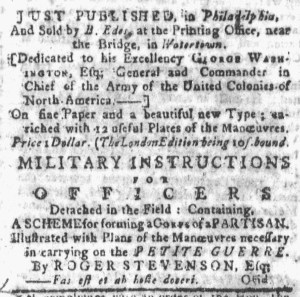
“MILITARY INSTRUCTIONS for officers Detached in the Field.”
On November 20, 1775, Benjamin Edes, the printer of the Boston-Gazette, ran an advertisement for a military manual “JUST PUBLISHED, in Philadelphia,” and available at his printing office in Watertown. The printer had relocated there shortly after the battles at Lexington and Concord, though he did not update the name of his newspaper. He advertised an edition of Roger Stevenson’s Military Instructions for Officers Detached in the Field published by Robert Aitken. Although the advertisement proclaimed that the book had been “JUST PUBLISHED,” another edition had been available in Philadelphia since June. At the time that Aitken advertised it, he noted that “A new Edition of this Book, with some Additions, is now in the Press and will soon be published.” That likely referred to the edition that Edes stocked, especially considering that the appeals in his advertisement paralleled the advertisement that Aitken published in the Pennsylvania Ledger in August.
Both advertisements opened with an announcement that the book had been published and where to acquire copies, followed by a note that this edition was “Dedicated to his Excellency GEORGE WASHINGTON, Esq; General and Commander in Chief of the Army of the United Colonies of North-America.” Next, both advertisements commented on the material aspects of the book, noting the “fine Paper and a beautiful new Type” as well as the “12 useful Plates [or illustrations] of the Manœuvres.” The price in the local currency followed, along with a comparison to the price of a bound London edition.” As was so often the case in advertisements for books, all that preamble appeared before the title of the book. Aitken’s much longer advertisement then presented an address “TO THE PUBLIC” drawn from the preface. Edes did not devote that much space to his advertisement in the Boston-Gazette. Instead, he inserted a quotation from Ovid: “Fas est et ab roste doceri” (It is right to be taught from the pulpit). That phrase invoked Stevenson’s experience as a British officer. Edes did not devise it on his own. Instead, he borrowed it from the title page. Overall, Edes did not generate original copy for his advertisement for a military manual printed in Philadelphia. Instead, he borrowed heavily from Aitken’s advertisement, revising the location where customers could purchase the book and the price in local currency. He also substituted the quotation on the title page for an excerpt from the preface but did not compose anything new for his advertisement. The marketing for the book in the Boston-Gazette thus replicated the strategies that Aitken introduced in the public prints in Philadelphia months earlier. He may even have dispatched a clipping of the advertisement with the copies he sent to Edes.