April 8

What was advertised in a revolutionary American newspaper 250 years ago today?
Boston-Gazette (April 8, 1776).

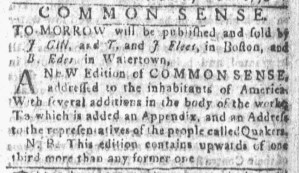
“TO-MORROW will be published … A NEW Edition of COMMON SENSE.”

The April 8, 1776, edition of the Boston-Gazette featured an update about the local edition of Thomas Paine’s Common Sense announced in the New-England Chronicle four days earlier.  On a Thursday, readers learned that “Next week will be PUBLISHED, and to be SOLD … in BOSTON, A New Edition of COMMON SENSE.”  The following Monday, an advertisement with a headline that proclaimed “COMMON SENSE” informed the public that “TO-MORROW will be published and sold … A NEW Edition of COMMON SENSE.”  In less than a week, the Boston edition went from in the press to in stock and for sale.

The new advertisement included a clarification about where readers could acquire copies: from “J. Gill, and T. and J. Fleet, in Boston, and B. Edes in Watertown.”  The previous version listed only Boston locations, though Benjamin Edes had relocated to Watertown to print the Boston-Gazette there throughout the siege of Boston.  Although the British departed on March 17, Edes and the Boston-Gazette remained in Watertown until the end of October.  Customers could purchase Common Sense from Edes in Watertown or from John Gill, his former partner in publishing the newspaper, in Boston.  In addition, Thomas Fleet and John Fleet, who had printed the Boston Evening-Post before it folded soon after the battles at Lexington and Concord, also sold Common Sense in Boston.

As the number of local editions of Common Sense proliferated in 1776, so did the number of advertisements promoting the popular political pamphlet and the number of newspapers disseminating advertisements about it.  The number of retailers who sold Common Sense also increased.  Although the printers in Boston and Watertown did not do so, others listed the price for a single copy and offered discounts for buying a dozen or more, encouraging booksellers, shopkeepers, and others to purchase copies to sell far and wide.  Counting the number of local editions of Common Sense demonstrates the popularity of the pamphlet compared to other political tracts published during the era of the American Revolution, yet that does not reveal the timing of their publication and sale to readers.  Advertisements for Common Sense, on the other hand, demonstrate when local editions became available to readers.

April 4

What was advertised in a revolutionary American newspaper 250 years ago today?

New-England Chronicle (April 4, 1776).

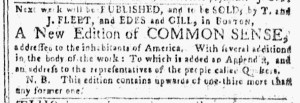
“Will be PUBLISHED … in BOSTON, A New Edition of COMMON SENSE.”

It did not take long after the siege of Boston ended with the evacuation of British troops on March 17, 1776, for printers in that town to set about publishing a local edition of Thomas Paine’s Common Sense.  An advertisement in the April 4 edition of the New-England Chronicle, published in Cambridge, announced that “Next week will be PUBLISHED, and to be SOLD, by T. and J. FLEET, and EDES and GILL, in BOSTON, A New Edition of COMMON SENSE.”  This edition would include “several additions in the body of the work: To which is added an Appendix, and an address to the representatives of the people called Quakers.”  That the printers described it as a “New Edition” suggested that they followed the second edition that Paine collaborated with William Bradford and Thomas Bradford in publishing rather than unauthorized editions that Robert Bell, the publisher of the first edition, marketed after having a falling out with the author.  The Bradfords described their edition as the “NEW EDITION” in their advertisements.  They also inserted a nota bene that declared, “This Edition contains upwards of one-third more than any former one.”  The Fleets and Edes and Gill replicated that nota bene in their own advertisement.

It likely came as no surprise to local readers that Benjamin Edes and John Gill got involved in publishing an edition of Common Sense.  For many years, they printed the Boston-Gazette, a newspaper known for its strident advocacy for the American cause.  After publishing the April 17, 1775, edition of the Boston-Gazette, they suspended the newspapers and dissolved their partnership following the battles at Lexington and Concord on April 19.  Edes removed to Watertown, where the Massachusetts Provincial Congress met, and resumed publication in early June 1775.  The Boston-Gazette remained there until the end of October 1776 and then returned to port city.  Thomas Fleet and John Fleet, the former printers of the Boston Evening-Post, had previously collaborated with Edes and Gill and other local printers on other projects, especially almanacs.  They published the final issue of the Boston Evening-Post on April 24, 1775, announcing that they “shall desist publishing their Papers … till Matters are in a more settled State.”  They never resumed publishing their newspaper, but they joined with Edes and Gill in publishing a Boston edition of Common Sense shortly after the British left the city.  Samuel Hall, the printer of the New-England Chronicle, may have attempted to give the enterprise a boost.  The news updates in the column to the left of the advertisement for the popular political pamphlet reported that a “favourite toast, in the best companies, is, ‘May the INDEPENDENT principles of COMMON SENSE be confirmed throughout the United Colonies.’”  The publication and dissemination of a Boston edition of Common Sense helped in spreading those “INDEPENDENT principles in New England.

April 1

What was advertised in a revolutionary American newspaper 250 years ago today?

Boston-Gazette (April 1, 1776).

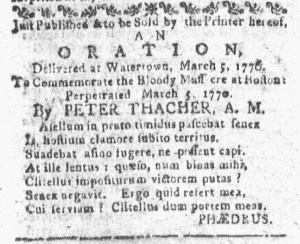
“AN ORATION … To Commemorate the Bloody Massacre at Boston: Perpetrated March 5, 1770.”

The annual tradition continued during the first year of the Revolutionary War.  Each year since the Boston Massacre, residents of the city gathered to mark the anniversary, honor the men who died when British regulars fired into a crowd of protestors, and hear an oration about the dangers of a standing army stationed in an urban port during times of peace.  James Lovell delivered the address in 1771, followed by Joseph Warren in 1772, Benjamin Church in 1773, and John Hancock in 1774.  In March 1775, Joseph Warren gave the last oration before the Revolutionary War commenced with the battles at Lexington and Concord on April 19.  Three months later, he was killed in action at the Battle of Bunker Hill.

Patriots made adjustments to the ritual in 1776.  The British occupation of Boston continued.  The Continental Army, commanded by George Washington, continued the siege of the city.  The Massachusetts Provincial Congress met at Watertown.  It was from there that William Cooper, the “Town Clerk of Boston” in exile, announced that according to a “vote in a town-meeting legally assembled” on March 5, 1775, “an ORATION will be delivered at the meeting-house, in Watertown, on the 5th of March next, … to commemorate the horrid Massacre perpetrated in Boston, on the evening of the 5th of March, 1770, by a party of Soldiers of the 29th Regiment, under the command of Capt. Thomas Preston.”  Refugees from Boston and the inhabitants of Watertown and other nearby towns gathered in Watertown for the annual oration about “the ruinous tendency of Standing armies being placed in large and populous cities, in time of peace.”  It was also a rally for asserting “the necessity of such exertions as the inhabitants of Boston then manifested, whereby the designs of the conspirators against the public safety, have been frustrated.”

Although circumstances forced those “who were inhabitants of Boston” to shift the location for the annual commemoration, other aspects remained constant, including the printing, marketing, and dissemination of the oration a few weeks after the gathering occurred.  This time, Peter Thacher delivered “AN ORATION … To Commemorate the Bloody Massacre at Boston: Perpetrated March 5, 1770.”  Benjamin Edes, who had relocated the Boston-Gazette from Boston to Watertown, printed the pamphlet and sold it at his printing office.  As had been the case with previous orations, this gave those who had been present an opportunity to experience Thacher’s address again and as many times as they wished to read it.  The pamphlet also gave those who had not attended a chance to read what Thacher said and imbibe the arguments made in support of the American cause.  Gathering for the oration was an important civic act, yet the circulation of the oration in print may have had an impact just as significant.

November 20

What was advertised in a revolutionary American newspaper 250 years ago today?

Boston-Gazette (November 20, 1775).

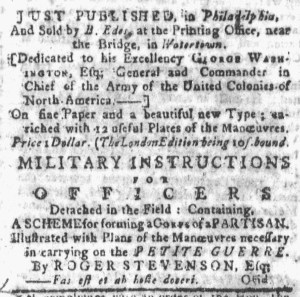
“MILITARY INSTRUCTIONS for officers Detached in the Field.”

On November 20, 1775, Benjamin Edes, the printer of the Boston-Gazette, ran an advertisement for a military manual “JUST PUBLISHED, in Philadelphia,” and available at his printing office in Watertown.  The printer had relocated there shortly after the battles at Lexington and Concord, though he did not update the name of his newspaper.  He advertised an edition of Roger Stevenson’s Military Instructions for Officers Detached in the Field published by Robert Aitken.  Although the advertisement proclaimed that the book had been “JUST PUBLISHED,” another edition had been available in Philadelphia since June.  At the time that Aitken advertised it, he noted that “A new Edition of this Book, with some Additions, is now in the Press and will soon be published.”  That likely referred to the edition that Edes stocked, especially considering that the appeals in his advertisement paralleled the advertisement that Aitken published in the Pennsylvania Ledger in August.

Both advertisements opened with an announcement that the book had been published and where to acquire copies, followed by a note that this edition was “Dedicated to his Excellency GEORGE WASHINGTON, Esq; General and Commander in Chief of the Army of the United Colonies of North-America.”  Next, both advertisements commented on the material aspects of the book, noting the “fine Paper and a beautiful new Type” as well as the “12 useful Plates [or illustrations] of the Manœuvres.”  The price in the local currency followed, along with a comparison to the price of a bound London edition.”  As was so often the case in advertisements for books, all that preamble appeared before the title of the book.  Aitken’s much longer advertisement then presented an address “TO THE PUBLIC” drawn from the preface.  Edes did not devote that much space to his advertisement in the Boston-Gazette.  Instead, he inserted a quotation from Ovid: “Fas est et ab roste doceri” (It is right to be taught from the pulpit).  That phrase invoked Stevenson’s experience as a British officer.  Edes did not devise it on his own.  Instead, he borrowed it from the title page.  Overall, Edes did not generate original copy for his advertisement for a military manual printed in Philadelphia.  Instead, he borrowed heavily from Aitken’s advertisement, revising the location where customers could purchase the book and the price in local currency.  He also substituted the quotation on the title page for an excerpt from the preface but did not compose anything new for his advertisement.  The marketing for the book in the Boston-Gazette thus replicated the strategies that Aitken introduced in the public prints in Philadelphia months earlier.  He may even have dispatched a clipping of the advertisement with the copies he sent to Edes.

June 5

What was advertised in a revolutionary American newspaper 250 years ago today?

Boston-Gazette (June 5, 1775).

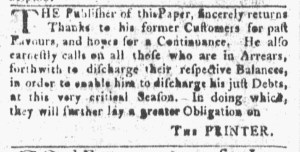
“THE Publisher of this Paper, sincerely returns Thanks to his former Customers for past Favours, and hopes for a Continuance.”

It was the first issue of the Boston-Gazette published in seven weeks.  It was also the first issue of the Boston-Gazette published in nearby Watertown rather than in Boston.  The newspaper underwent other changes following the battles at Lexington and Concord.  A notice placed by the printer (rather than by the printers) hinted at some of them.

Benjamin Edes and John Gill had been partners in publishing the Boston-Gazette since April 7, 1755.  Over the course of two decades, they developed a reputation as two of the printers who most ardently supported the Patriot cause.  In his diary entry for September 3, 1769, John Adams recorded that he joined Edes and Gill and other Sons of Liberty in spending the evening “preparing for the Next Days Newspaper – a curious Employment.  Cooking up Paragraphs, Articles, Occurences, &c. – working the political Engine!”  When the Revolutionary War began, all the newspapers in Boston either folded, relocated, or suspended publication.  Edes and Gill published their last issue on April 17, two days before the momentous events at Lexington and Concord.  They then dissolved their partnership.  Edes moved to Watertown and resumed publication with continuous numbering despite the change in location.  The Boston-Gazetteremained there more than a year with a new issue every Monday.  The last Watertown issue appeared on October 28, 1776.  On November 4, Edes once again published the Boston-Gazette in Boston.

The first issue in Watertown featured only four advertisements, two of them placed by the printer.  In one, Edes expressed his appreciation “to his former Customers for past Favours, and hope[d] for a Continuance” of their subscriptions.  He also needed “also those who are in Arrears, forthwith to discharge their respective Balances, in order to enable him to discharge his just Debts, at this very critical Season.”  In addition to cash, Edes needed other resources to continue publishing the Boston-Gazette.  Another advertisement announced, “CASH given for clean Cotton and Linnen RAGS, at the Printing Office in Watertown.”  Those rags would be made into paper.  Edes had limited access to that essential item; throughout most of the summer his newspaper consisted of only two pages (a half sheet) rather than the usual four pages (a full sheet).  The other two advertisements offered employment opportunities, one to “Journeymen Taylors” and the other to “Journeymen Saddlers.”  In addition, a notice at the top of the first column on the first page invited “THOSE Persons who are possessed of any of Governor Hutchinson’s Letters … to forward them to the Printer hereof, in order for Publication.”  Edes wished to embarrass the former governor and score political points, as he had done two years earlier.  The printer moved his press to Watertown, yet he continued the same political activism.

March 17

What was advertised in a colonial American newspaper 250 years ago today?

Massachusetts Gazette and Boston Weekly News-Letter (March 17, 1775).

“AN ORATION … to commemorate the bloody Tragedy of March 5th 1770.”

In the spring of 1771, patriots marked the first anniversary of the “BLOODY TRAGEDY” now known as the Boston Massacre with “AN ORATION Delivered … at the Request of the Inhabitants of the Town of Boston … By JAMES LOVELL.”  That started an annual tradition, with Joseph Warren giving the oration in 1772, Benjamin Church in 1773, and John Hancock in 1774.  Gathering for the oration became an annual ritual.  So did publishing and marketing it.

For the fifth anniversary, the “ORATION … to commemorate the bloody Tragedy of March 5th 1770” was once again “delivered by JOSEPH WARREN.”  Less than two weeks later, advertisements in the March 17 edition of the Massachusetts Gazette and Boston Weekly News-Letter informed readers where they could acquire copies.  One indicated that Benjamin Edes and John Gill, the printers of the Boston-Gazette, sold the oration, implying that they also published it.  According to the imprint, Edes and Gill printed the address in partnership with Joseph Greenleaf, the proprietor of the Royal American Magazine.

Another advertisement gave readers another option: “In the MASSACHUSETTS SPY, of this Day is published, the WHOLE of the ORATION, delivered by JOSEPH WARREN, Esq; on March 6th , 1775, to commemorate the bloody Tragedy of March 5th, 1770.”  Isaiah Thomas, the printer of the Massachusetts Spy, did indeed devote three of the four columns of the third page of his newspaper to Warren’s oration.  In an introduction, he reported that it was “this day published, in a pamphlet” and available for sale in addition to appearing in the newspaper.  The printer offered multiple ways for readers to engage with the oration.  He (and Edes and Gill and Greenleaf) also offered consumers an opportunity to purchase a commemorative item.  Readers who previously purchased the orations by Lovell, Warren, Church, and Hancock on previous anniversaries may have been motivated to add to their collections.

The printer of the Massachusetts Gazette and Boston Weekly News-Letter gave the advertisements a privileged place, likely intended to increase the chances that readers took note of them.  They appeared one after the other immediately after the weekly account of local marriages and deaths.  That meant that the advertisements served as a transition between news items and paid notices.  Readers who perused the news yet merely glanced through the advertisements may have been more likely to take note of these first notices as they realized that the remainder of the page featured advertising.  A manicule also helped call attention to them, signaling their importance in a town experiencing the distresses of the Boston Port Act and the other Coercive Acts.

January 2

What was advertised in a colonial American newspaper 250 years ago today?

Boston-Gazette (January 2, 1775).

The GRAND AMERICAN CONTINENTAL ASSOCIATION … to be pasted up in every Family.”

In the first issue of the Boston-Gazette published in 1775, Benjamin Edes and John Gill, the printers, opened with a notice concerning the Continental Association as the first item in the first column on the first page.  The First Continental Congress had devised that nonimportation, nonconsumption, and nonexportation pact when it met in Philadelphia in September and October 1774, intending for it to go into effect on December 1.  The Continental Association answered the Boston Port Act, the Massachusetts Government Act, and the other Coercive Acts that Parliament had passed in retaliation for the Boston Tea Party, perhaps not expecting a unified response from the colonies.  The First Continental Congress, however, devised a plan that allowed consumers from New England to Georgia to express their political principles through the decisions they made in the marketplace., drawing inspiration from the nonimportation agreements that went into effect to protest the Stamp Act and the duties on imported goods in the Townshend Acts.

Edes and Gill helped to raise awareness of the Continental Association not only through newspaper coverage but also by disseminating copies far and wide.  “ANY Town or District within this Province,” their notice advised, “may be supplied by Edes and Gill, on the shortest Notice, with the GRAND AMERICAN CONTINENTAL ASSOCIATION, printed on one Side of a Sheet of Paper.”  They offered the pact as a broadside “on purpose to be pasted up in every Family.”  The printers wished for local governments to purchase their edition of the Continental Association and distribute them to households for constant reference.  Putting the pact on display demonstrated support for the American cause against Parliament or at least signaled an intention to comply.  Posting it in homes as well as public spaces made it easy to consult, reminding everyone that they had a part to play in the protest.  The Continental Association made decisions about participating in the marketplace inherently political, making it impossible for any individual or household to take a neutral stance.  Edes and Gill recognized that was the case.  Although they stood to generate revenue from selling broadside copies of the Continental Association by the dozen or gross, the political stance they consistently advanced throughout the imperial crisis suggested that increasing awareness of the pact and encouraging compliance with it motivated them as much or even more.

April 11

What was advertised in a colonial American newspaper 250 years ago today?

Boston-Gazette (April 11, 1774).

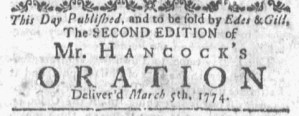
“The SECOND EDITION of Mr. HANCOCK’S ORATION.”

Benjamin Edes and John Gill, printers of the Boston-Gazette, gave their advertisement for the “SECOND EDITION of Mr. HANCOCK’S ORATION Deliver’d March 5th” a privileged place in their newspaper.  Readers did not need further explanation to understand that “March 5th” referred to the date of the Boston Massacre and that Hancock had been selected to give the annual address that memorialized the victims and raised an alarm about the danger of quartering an army in an urban center, like Boston, during times of peace.

Still, Edes and Gill, who printed the “ORATION” as well as the newspaper, did what they could to draw attention to the second edition.  The first time they announced it was “This Day Published,” in the April 4, 1774, edition of the Boston-Gazette, they ran the notice immediately below news and editorials.  Even if readers chose not to peruse other advertisements closely once they realized they had finished the news, they likely took note of the advertisement for the “ORATION” in its place of transition from one kind of content to another.  In the next issue of the weekly newspaper, the notice ran at the bottom of the last column on the first page, the only advertisement on that page.  Once again, the patriot printers increased the likelihood that readers would spot that advertisement and accept an invitation to demonstrate their own commitment to the patriot cause by purchasing copies for themselves.

That Edes and Gill published a “SECOND EDITION” testified to the demand for the first edition.  It sold well enough to justify another printing.  Edes and Gill took it to press just a few months after the Boston Tea Party and just a few weeks after another destruction of tea.  Although that second Boston Tea Party is not nearly as well known today, it was certainly among the current events that would have been on the minds of colonizers as they participated in commemorating the fourth anniversary of the Boston Massacre, discussed the politics of tea, and decried various abuses perpetrated by Parliament.  Purchasing and reading Hancock’s “ORATION” was part of the growing resistance to British rule in the colonies, a means for consumers to practice politics in the marketplace and imbibe the rhetoric of a noted patriot long after the Boston Massacre’s annual commemorative events concluded.

January 30

What was advertised in a colonial American newspaper 250 years ago this week?

Boston-Gazette (January 24, 1774).

Our Advertising Customers, are desired for the future to send their Advertisements by Saturday Sunset.”

Benjamin Edes and John Gill, printers of the Boston-Gazette, exercised their prerogative as proprietors of the newspaper to place some notices about its operation at the top of the first column on the first page of the January 24, 1774, edition.  Doing so, they hoped, increased the likelihood that the customers they addressed would see them and take note.  To that end, they enclosed their first notice within a decorative border.  The printers declared, “ALL Persons indebted for this Paper, whose Accounts have been above 12 Months standing, are requested to make immediate Payment.”  Printers often extended credit to subscribers.  Some of them remained delinquent for years.

In another notice, Edes and Gill instructed that “Our Advertising Customers, are desired for the future to send their Advertisements by Saturday Sunset.”  Rather than a decorative border, a manicule and italic font called attention to this notice.  Edes and Gill published the Boston-Gazette on Mondays, but ordinances in colonial Boston prohibited working on Sundays.  Sunset occurred at 4:52 in the afternoon on the day the printers published this announcement.  Though that time has been standardized for modern time zones, it was early enough in the day that those laboring in the printing office could set type and finish printing the newspaper in the evening.  John Adams suggests that Edes and Gill may not have always abided the prohibition on working on Sundays.  On Sunday, September 3, 1769, he wrote in his diary that he attended a “Charity Lecture” and then “Spent the Remainder of the Evening and supped with Mr. Otis, in Company with Mr. Adams, Mr. Wm. Davis, and Mr. Jno. Gill.  The Evening spent in preparing for the Next Days Newspaper – a curios Employment.  Cooking up Paragraphs, Articles, Occurences, &c. – Working the political Engine!”  Things were in motion at Edes and Gill’s printing office on Sundays, at least sometimes!  Yet in the early 1770s some colonizers even complained about work undertaken on Saturday evenings.  Announcing that they accepted advertisements until sunset on Saturdays may have been Edes and Gill’s way of indicating that they completed most of their work by that time while also holding firm that they could labor into the evening if they wished.  Although they would not have used the phrase, it gave them plausible deniability about any intentions of working on Sundays.

In a third notice, the printers teased an item that would appear in the next edition.  They acknowledged that they “receiv’d THE REMEMB’RANCER … intended for this Day’s Paper,” yet chose to delay publication for a week.  The piece “publickly reveals very marvellous Practices of his Excellency, at the last Session of the General Assembly.”  Edes and Gill chose to hold off on embarrassing the governor, Thomas Hutchinson, “till next Week, when the Members of both Houses will be more generally in Town.”  The printers may have hoped that the anticipation would yield more sales for the next issue of the Boston-Gazette, though their primary goal seemed to be that as many people as possible, especially those who served in the assembly, would read the piece when issues circulated the following week.  It appeared as the first item on the first page of the January 31 edition.

Rather than opening the January 24 edition with news, editorials, or advertisements submitted by customers, Edes and Gill instead tended to the business of operating their newspaper first and then published other content.  They called on delinquent subscribers to settle accounts, directed advertisers when to submit their notices, and previewed a juicy letter that would appear in the next issue, giving their own notices a prominent place on the page.

August 23

What was advertised in a colonial American newspaper 250 years ago today?

Boston-Gazette (August 23, 1773).

“It would greatly oblige us, if our advertising Customers would send their Advertisements Saturday Afternoon.”

Colonial printers only occasionally addressed the business of advertising in their newspapers.  Some did solicit advertisements in the colophon at the bottom of the final page, though they did not always specify rates or offer additional instructions.  In the colophon for the Massachusetts Gazette and Boston Post-Boy, for instance, Nathaniel Mills and John Hicks stated that “Subscriptions, Advertisements, and Letters of Intelligence for this Paper are taken in” at their printing office.  John Holt did provide more information in the colophon for the New-York Journal, noting that “Advertisements of no more Length than Breadth are inserted for Five Shillings, four Weeks, and One Shilling for each Week after, and larger Advertisements in the same Proportion.”  A few printers also promoted other forms of advertising.  Isaiah Thomas, for example, informed readers that he printed “Small HAND-BILLS at an Hour’s Notice” in the colophon for the Massachusetts Spy.  The printer of the Wöchentliche Pennsylvanische Staatsbote highlighted a particular service in the masthead of that newspaper: “All ADVERTISEMENTS to be inserted in this Paper, or printed single by HENRY MILLER, Publisher hereof, are by him translated gratis.”

Most printers, in contrast, did not regularly publish information about advertising in their newspapers.  Among those that did, few presented the sorts of specifics that Holt, Thomas, and Miller did in their colophons.  That makes the note that Benjamin Edes and John Gill, printers of the Boston-Gazette, inserted at the bottom of the third page of the August 23, 1773, edition all the more noteworthy.  “It would greatly oblige us,” they pleaded, “if our advertising Customers would send their Advertisements Saturday Afternoon.”  The printers presumably meant “no later than Saturday Afternoon.”  They distributed their weekly newspaper on Mondays.  That meant that production of the first and last pages, printed on the same side of a broadsheet, took place near the end of the week and production of the second and third pages, on the other side of the broadsheet, just prior to distribution.  Edes and Gill and others who worked in their printing office needed time to set type for the latest news and new advertisements, manually operate the press, and hang the newspapers for the ink to dry before folding and delivering them to subscribers.  If advertisers wanted their notices to appear in the Boston-Gazette on Monday then they needed to submit them to the printing office in a timely fashion.  Edes and Gill advised that meant Saturday afternoon.  To increase the likelihood that advertisers would take note of such instructions, they inserted this notice as a single line in the margin at the bottom of the page, a line that ran across all three columns of that page. That notice guided advertisers while also testifying to what the printers considered best practices in the business of advertising in their colonial newspaper.