
What was advertised in a revolutionary American newspaper 250 years ago today?
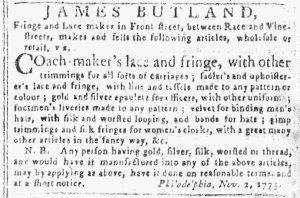
“Fringe and Lace maker in Front street, between Race and Vine-streets, … Philadelphia.”
James Butland, a “Fringe and Lace maker,” placed several newspaper advertisements in 1775. In February, he inserted an advertisement in the Pennsylvania Journal, advising prospective customers that he “Continues to make and sell” all sorts of fringes and laces equal in quality to any imported from England. He also assured the public that “no advantage shall be taken on account of the troubles between Britain and America,” signaling that he abided by the Continental Association and did not raise prices once that nonimportation agreement went into effect. In July, he placed a new advertisement in the Pennsylvania Evening Post, once again promoting his fringes and laces made in Philadelphia. He also requested “unfashionable” scraps “not fit for sale,” asserting that he could upcycle them into new pieces.
In December, he published another advertisement. Like the others, it included a list of the types of fringes and laces he made, including “Coach-maker’s lace and fringe, with other trimmings for all sorts of carriages; sadler’s and upholsterer’s lace and fringe, with line and tassels made to any pattern or colour; gold and silver epaulets for officers, with other uniforms, [and] footmen’s liveries made to any pattern.” In a nota bene, Butland invited “Any person having gold, silver, silk, worsted or thread” who would like it “manufactured into any of the above articles” to apply to his shop “between Race and Vine-streets” in Philadelphia. It was much like the advertisements he previously published … except for the newspaper that carried it. This notice appeared in the New-England Chronicle, printed in Cambridge as the siege of Boston continued. Other advertisements in the December 14 edition came from towns in the vicinity, including Beverly, Braintree, Brookline, Cambridge, Concord, Danvers, Gloucester, Medford, Menotomy, Newton, Plymouth, Roxbury, Salem, Topsfield, Waltham, and Woburn. One concerning a stray horse came from Epping, New Hampshire. Like other newspapers, the New-England Chronicle served an entire region, yet advertisements for artisans (or shopkeepers or merchants) in cities and towns beyond that region rarely appeared in any colonial newspapers. Printers and booksellers often distributed subscription proposals and other advertisements more widely in their efforts to incite enough demand and generate enough sales to make their projects viable. Other advertisers, however, focused on cultivating local clienteles. Even those who offered mail order goods and services lived and worked within the region served by the newspapers that carried their advertisements. That made Butland’s advertisement for fringe and lace made in Philadelphia in the New-England Chronicle quite unusual, raising questions without easy answers. Why did he choose to advertise in that newspaper? How did that fit into his overall marketing strategy? How effective did he anticipate his advertisement would be?