December 14

What was advertised in a revolutionary American newspaper 250 years ago today?
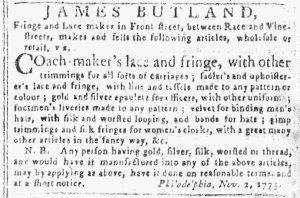
New-England Chronicle (December 14, 1775).

“Fringe and Lace maker in Front street, between Race and Vine-streets, … Philadelphia.”

James Butland, a “Fringe and Lace maker,” placed several newspaper advertisements in 1775.  In February, he inserted an advertisement in the Pennsylvania Journal, advising prospective customers that he “Continues to make and sell” all sorts of fringes and laces equal in quality to any imported from England.  He also assured the public that “no advantage shall be taken on account of the troubles between Britain and America,” signaling that he abided by the Continental Association and did not raise prices once that nonimportation agreement went into effect.  In July, he placed a new advertisement in the Pennsylvania Evening Post, once again promoting his fringes and laces made in Philadelphia.  He also requested “unfashionable” scraps “not fit for sale,” asserting that he could upcycle them into new pieces.

In December, he published another advertisement.  Like the others, it included a list of the types of fringes and laces he made, including “Coach-maker’s lace and fringe, with other trimmings for all sorts of carriages; sadler’s and upholsterer’s lace and fringe, with line and tassels made to any pattern or colour; gold and silver epaulets for officers, with other uniforms, [and] footmen’s liveries made to any pattern.”  In a nota bene, Butland invited “Any person having gold, silver, silk, worsted or thread” who would like it “manufactured into any of the above articles” to apply to his shop “between Race and Vine-streets” in Philadelphia.  It was much like the advertisements he previously published … except for the newspaper that carried it.  This notice appeared in the New-England Chronicle, printed in Cambridge as the siege of Boston continued.  Other advertisements in the December 14 edition came from towns in the vicinity, including Beverly, Braintree, Brookline, Cambridge, Concord, Danvers, Gloucester, Medford, Menotomy, Newton, Plymouth, Roxbury, Salem, Topsfield, Waltham, and Woburn.  One concerning a stray horse came from Epping, New Hampshire.  Like other newspapers, the New-England Chronicle served an entire region, yet advertisements for artisans (or shopkeepers or merchants) in cities and towns beyond that region rarely appeared in any colonial newspapers.  Printers and booksellers often distributed subscription proposals and other advertisements more widely in their efforts to incite enough demand and generate enough sales to make their projects viable.  Other advertisers, however, focused on cultivating local clienteles.  Even those who offered mail order goods and services lived and worked within the region served by the newspapers that carried their advertisements.  That made Butland’s advertisement for fringe and lace made in Philadelphia in the New-England Chronicle quite unusual, raising questions without easy answers.  Why did he choose to advertise in that newspaper?  How did that fit into his overall marketing strategy?  How effective did he anticipate his advertisement would be?

April 2

What was advertised in a colonial American newspaper 250 years ago today?

Providence Gazette (April 2, 1774).

“Genteel Boarding, FOR Gentlemen, Strangers and others.”

Thomas Russell provided “Genteel Boarding … at the House lately occupied by Mr. Benjamin Bagnall, deceased, near the State-House” in Boston.  He did not, however, place his advertisement in the Boston-Gazette or the Massachusetts Spyor any of the several other newspapers printed in that city.  Instead, he ran it in the Providence Gazette for six weeks in the spring of 1774.  For “Gentlemen, Strangers and others” who planned to visit Boston, Russell presented an option for accommodations and made planning their journey that much easier.

To convince prospective guests that his establishment was a good choice, he assured readers that the house was “a very noted Place for this Business” as well as “well known to be a large and commodious House.”  For anyone not familiar with its reputation, including those who lived any distance from Boston, they “have only to apply, to be convinced how agreeably they can be accommodated.”  Russell’s hospitality and the amenities he offered, he suggested, would become immediately apparent upon meeting.

Boston and other American towns had not yet adopted standardized street numbers, so Russell provided travelers with general directions to get them to the vicinity of the house and enough information to find it once they spoke with some locals.  Anyone who made their way to the “State-House” could then ask anyone they encountered about Russell’s boarding house, though they might more efficiently find it by invoking Benjamin Bagnall’s name since Russell apparently only recently acquired the property.  Describing the landmark according to local knowledge would get guests to Russell’s door.

In promoting his boarding house, Russell joined entrepreneurs who ran taverns and inns who advertised in newspapers published in other cities.  While they certainly welcomed local custom, they believed that marketing their establishments in publications in other towns would generate additional business.  Russell seemed certain enough of it that he invested in advertising in the Providence Gazette for six weeks rather than starting with the standard three-week run for his advertisement.  With the arrival of spring, he likely anticipated more travelers from Providence and its environs making their way to Boston.  Russell stood ready to provide them with lodgings.

September 7

What was advertised in a colonial American newspaper 250 years ago today?

Providence Gazette (September 7, 1771).

“Sell at least as low as they were ever sold on the Continent of America.”

Some merchants and shopkeepers named their businesses after the signs that marked their locations, but relatively few chose other sorts of names.  E. Bridgham of Boston was one of those exceptions, advertising that he operated the “Staffordshire and Liverpool Warehouse” on King Street in Boston.  Bridgham sold, as the name suggested, goods imported “directly from the several Manufacturers in Staffordshire and Liverpool,” including “China, Glass, Delph and Stone Ware.”

Bridgham was an enterprising entrepreneur in other ways as well.  He sought to cultivate customers from beyond Boston and the surrounding towns.  He placed his advertisement for the Staffordshire and Liverpool Warehouse in the September 7, 1771, edition of the Providence Gazette.  With the exception of printers looking to drum up business for proposed publications via subscription notices inserted in newspapers published in multiple colonies, most purveyors of goods confined their advertising to local newspapers.  At the time, Bridgham had five newspapers to choose among in Boston, all of them distributed beyond the bustling port.

Yet Bridgham imagined a larger market for his merchandise, placing himself in competition with merchants and shopkeepers in Providence as well as Boston.  To convince prospective customers in Rhode Island that they should purchase from him rather than shop more locally, he proclaimed that he was “able, and fully inclined, to sell at least as low” as similar imported goods “were ever sold on the Continent of America.”  He attempted to use low prices to lure customers, promising bargains that compared not only to any they might encounter in Boston or Providence but also New York, Philadelphia, Charleston, and everywhere else.  Bridgham suggested he set prices low enough to justify the additional effort of acquiring goods from his shop in Boston for those who resided at a distance and had other options in their vicinity.

The Providence Gazette regularly carried advertisements for shops located in Rhode Island, western Connecticut, and southeastern Massachusetts, but rarely did merchants and shopkeepers from Boston advertise in that newspaper.  E. Bridgam apparently felt that the four shillings the printer charged to run the advertisement for three weeks might yield a return on his investment by enhancing the visibility of the Staffordshire and Liverpool Warehouse and attracting new customers from Providence.

February 7

What was advertised in a colonial American newspaper 250 years ago this week?

Feb 7 - 2:1:1768 Boston Post-Boy
Boston Post-Boy (February 1, 1768).

“Joshua Hacker … has two swift sailing small Sloops, which ply constantly between Providence and Newport.”

In the late 1760s Joshua Hacker provided ferry and freight service between Providence and Newport. His “two swift sailing small Sloops” competed with the “Stage-Boats” operated by Thomas and Benjamin Lindsey. That competition took place on the waterways but also on the pages of colonial newspapers. Hacker and the Lindseys both placed advertisements in the Providence Gazette, the terminus of their route. The Lindseys even updated their advertising to promote expanded services in order to compete with Hacker. In turn, Hacker countered by publishing his advertisement in an additional newspaper, widening the market of potential clients.

When it appeared in the February 1, 1768, edition of the Boston Post-Boy, Hacker’s advertisement included the same copy that ran in the Providence Gazette, from comments about the “exceeding good Accomodations for Passengers” to promoting his “ten Years” of experience” to listing prices for shipping all sorts of freight down to “A Box of Candles.” The version in the Boston Post-Boy did introduce the alternate spelling of “Accomodations,” but Hacker did not revise or abbreviate his lengthy advertisement before submitting it to Green and Russell for publication in their newspaper.

Providence and Newport were busy ports in the late 1760s, but Boston was an even larger and busier port. Hacker realized that many merchants and others who did business in Boston might also have cause to travel between Providence and Newport or transport goods between the two locations. Having established himself in Rhode Island and facing an increasingly aggressive rivalry with the Lindseys for local clients, he attempted to drum up new business from prospective customers in a nearby market that had not been recently exposed to his advertisements. The notice in the Boston Post-Boy may have been an attempt to gauge whether such efforts were worth the investment. If Hacker experienced increased business from residents of Boston he could consider placing advertisements in other newspapers, including the Boston Chronicle, the Boston Evening-Post, the Boston-Gazette, and the Massachusetts Gazette. On the other hand, if the advertisements in the Boston Post-Boy did not seem to yield additional clients Hacker could decide that advertising in other newspapers would not result in a sufficient return on the investment.