
What was advertised in a revolutionary American newspaper 250 years ago today?
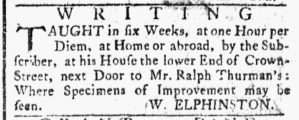
“WRITING TAUGHT in six Weeks … Specimens of Improvement may be seen.”
Among the various advertisements that appeared in the January 8, 1776, edition of the New-York Gazette and Weekly Mercury, W. Elphinston offered his services as a writing tutor. Although writing and reading are skills often taught simultaneously today, that was not always the case in eighteenth-century America. For instance, at “Mrs. TAYLOR’s BOARDING SCHOOL” for “young LADIES” in Philadelphia, all students learned “Reading and the Grammar” along with sewing and embroidery, but they had to pay extra for instruction from a “Writing Master,” a “Drawing Master,” a “Dancing Master,” a “Musick Master,” and other tutors. Some colonizers learned to read without simultaneously learning writing (or arithmetic). Those who made their mark on documents rather than signing their names did not necessarily lack the skill to read those documents, but they did not benefit from instruction in forming the letters that they knew how to read.
Elphinston offered his assistance. He did not teach reading; he assumed that his prospective students already possessed that skill at some level. He expected them to apply what they already knew about reading to learning to write. Elphinston claimed that his pupils would learn to write in just six weeks, provided that they devoted an hour per day to their lessons. In addition to novices, he also helped those with rudimentary ability to improve their writing, yet he did not merely ask prospective students to take his word for it. Instead, he made “Specimens of Improvement” available at the house where he gave lessons. Anyone who considered engaging his services could examine those specimens themselves to see what kind of progress Elphinston’s former students made because of their lessons with the writing tutor. He was not the only writing master to make specimens available to the public. When a “Person from Boston” relocated to Connecticut and advertised that he “will teach in the most elegant and easy Manner, the several Hands now in Practice, both Useful and Ornamental,” he noted that a “Specimen of [his] Performance, in the several hands abovementioned, is left with the Printer … for the Inspection of any Person” who might hire him. Newspaper advertisements attracted attention, but writing tutors believed that samples could seal the deal.