
What was advertised in a revolutionary American newspaper 250 years ago today?
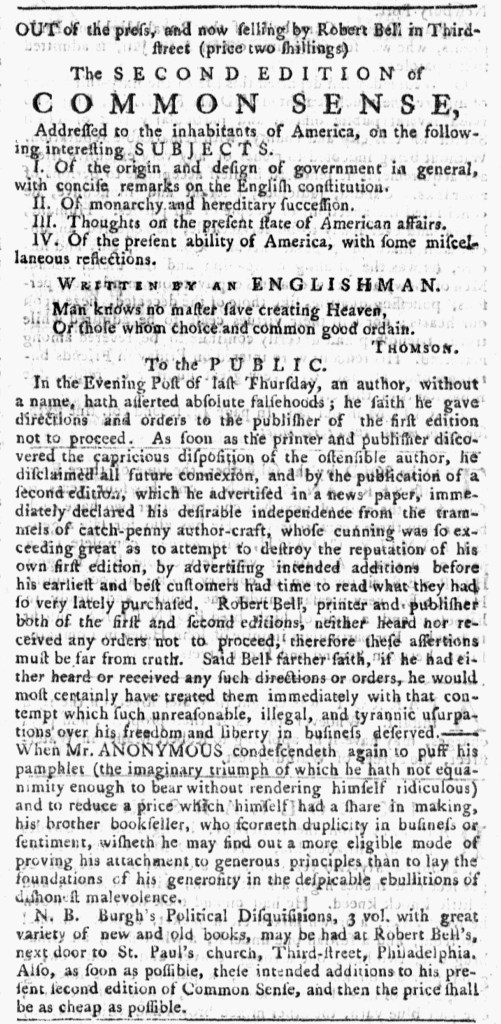
“An author, without a name, hath asserted absolute falsehoods.”
The dispute over publishing the second edition of Thomas Paine’s Common Sense continued in an advertisement in the January 27, 1776, edition of the Pennsylvania Evening Post. Robert Bell, the publisher of the first edition, and William Bradford and Thomas Bradford, the printers designated by Paine to publish a new edition with additional materials, ran competing advertisements on January 25. The Bradfords’ advertisement included a note that informed the public that the author had not authorized Bell to publish a second edition, yet the enterprising printer and bookseller moved forward with the project anyway. That advertisement ran once again on January 27.
In response, Bell submitted a new advertisement to the printing office. An even more prominent headline proclaimed, “The SECOND EDITION of COMMON SENSE,” followed by a list of the four sections that appeared in the first edition. That overview had been part of most of Bell’s advertisements, as well as an epigraph from “Liberty,” a poem by James Thomson. In response to the address “To the PUBLIC” in the Bradfords’ advertisement, Bell added his own address “To the PUBLIC.” In it, he explained that in the previous edition of the Pennsylvania Evening Post, “an author, without a name, hath asserted absolute falsehoods.” At the time, Paine remained anonymous (and, for the first time, this advertisement described his political pamphlet as “WRITTEN BY AN ENGLISHMAN”). Bell objected to the claims that Paine made that “he gave directions and orders to the publisher of the first edition not to proceed.” For his part, Bell declared that “[a]s soon as the printer and publisher discovered the capricious disposition of the ostensible author, he disclaimed all future connexion,” perfectly content to break ties with Paine. Furthermore, “by the publication of a second edition which he advertised in a news paper, [Bell] immediately declared his desirable independence from the trammels of catch-penny author-craft, whose cunning was so exceeding great as to attempt to destroy the reputation of his own first edition, by advertising intended additions before his earliest and best customers had time to read what they had so very lately purchased.” That certainly was not a flattering portrait of Paine. The contents of Common Sense gave colonizers a lot to discuss. The dispute in the newspaper advertisements gave them even more.
Undaunted, Bell testified that he “neither heard nor received any orders not to proceed, there [the author’s] assertions must be far from truth.” In addition, Bell further dismissed Paine’s expectations for the publication of a second edition, stating that “if he had either heard or received any such directions or orders, he most certainly would have treated them immediately with that contempt which such unreasonable, illegal, and tyrannic usurpations over his freedom and liberty in business deserved.” Bell launched one more tirade: “When Mr. ANONYMOUS condescendeth again to puff his pamphlet … and to reduce a price which himself had a share in making, his brother bookseller, who scorneth duplicity in business or sentiment, wisheth he may find out a more eligible mode of proving his attachment to principles than to lay the foundations of his generosity in the despicable ebullitions of dishonest malevolence.” Bell was annoyed that Paine promoted the Bradfords’ edition as “one half of the price of the former edition,” a suggestion that Bell overcharged when, according to Bell, the author and the publisher set the price in consultation with each other. A lower price for the Bradfords’ edition was not truly “generosity,” especially when inspired by “despicable ebullitions of dishonest malevolence” rather than a desire to make the pamphlet more accessible to the public. Clearly, Paine’s address “To the PUBLIC” did not cause Bell to back down but instead to double down on printing and marketing his second edition of Common Sense.