October 9

What was advertised in a revolutionary American newspaper 250 year ago today?

Dunlap’s Pennsylvania Packet (October 9, 1775).

“ON July last, twenty-first day, / My servant, JOHN SMITH, ran away.”

Advertisements about indentured servants who ran away before completing their contracts appeared regularly in Dunlap’s Pennsylvania Packet in the 1770s.  In “Reading the Runaways,” David Waldstreicher demonstrates that similar advertisements ran in newspapers throughout the Middle Atlantic colonies during the era of the American Revolution.[1]  As I have examined newspapers from New England to Georgia for the Adverts 250 Project, I have encountered advertisements describing runaway servants and offering rewards for detaining and returning them in newspapers in every region.  They were so common that many issues featured multiple advertisements, some of them concerning two or more indentured servants that made a getaway together.

Given the ubiquity of those advertisements, John Whitehill wanted to increase the chances that readers noticed, read, and remembered his advertisement.  Rather than write formulaic copy, he composed a poem of more than a dozen rhyming couplets.  “ON July last, twenty-first day,” the first two lines read, “My servant, JOHN SMITH, ran away.”  The poem was easy to spot on the page of the October 9, 1775, edition of Dunlap’s Pennsylvania Packet.  The compositor indented each line, creating white space that distinguished the advertisement from other content.  The irregular lengths of each line of the poem meant even more white space on the right.  On a page of news and advertisements printed in orderly columns, justified on the left and on the right, the significant amount of white space in Whitehill’s advertisement made it easy to spot.

Once readers looked more closely, the opening couplet may have inspired even more curiosity.  “Age twenty-five years, and no more,” Whitehill’s poem continued, “I think his heighth is five feet four; / Black curled hair, and slender made, / And is a weaver by his trade.”  Additional couplets described Smith’s clothing, the items he took with him to set up trade somewhere else, and his arrival from Newry on the Renown the previous fall.  One couplet warned others not to aid Smith: “Should any persons him conceal, / No doubt with them I think to deal.”  The final couplets offered a reward and named the aggrieved master: “SIX LAWFUL DOLLARS I will pay; / I live in Salsbury, Pequea, / And further to oblige you still, / My name is junior JOHN WHITEHILL.”  The reward and the names of the servant and the advertiser were the only part of the poem in all capitals, likely intended to draw attention to the incentive for reading the advertisement and assisting Whitehill.

The poem certainly was not Milton nor Shakespeare, but the format of Whitehill’s runaway advertisement made it different (and more entertaining) than any of the other five notices placed for the same purposes in that issue of Dunlap’s Pennsylvania Packet.  The attention it garnered may very well have been worth the time and effort that Whitehill invested in writing the poem.  For other examples of masters adopting this strategy, see James Gibbons’s advertisement about Catherine Waterson in the December 21, 1769, issue of the Pennsylvania Gazette and John McGoun’s advertisement about John Hunter in the October 26, 1774, issue of the Pennsylvania Gazette.

**********

[1] David Waldstreicher, “Reading the Runaways: Self-Fashioning, Print Culture, and Confidence in Slavery in the Eighteenth-Century Mid-Atlantic,” William and Mary Quarterly, 3rd ser., 56, no. 2 (April 1999): 243-272.
October 26

What was advertised in a colonial American newspaper 250 years ago today?

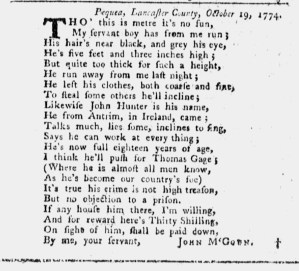
Pennsylvania Gazette (October 26, 1774).

“THO’ this is metre it’s no fun, / My servant boy has from me run.”

It was a novel means of drawing attention to the description of an indentured servant who ran away from his master.  Rather than the usual sort of advertisement that crowded the pages of newspapers from New England to South Carolina, John McGoun rejected writing a paragraph of dense text in favor of composing a series of rhyming couplets that gave readers all sorts of information about John Hunter and offered a reward for imprisoning or returning him.  On occasion, aggrieved masters composed and published such poems, yet they were rare enough to merit a closer look when McGoun inserted his advertisement.  In the first couplet, he played with the form, asserting that his situation was a serious matter even as he sought to entertain readers so they would take note of the details he presented: “THO’ this is metre it’s no fun, / My servant boy has from me run.”

Five other advertisements for the same purpose appeared on the final page of the October 26, 1774, edition of the Pennsylvania Gazette, yet readers may have been more likely to linger over McGoun’s notice.  The others filled the space purchased by the advertisers, running from one side of the column to the other, while McGoun’s poem had white space on each side, making his advertisement visually unique among those on the page.  That aspect initially drew the eyes of readers, with the couplets offering enough “fun” for a subject that was “no fun” for them to peruse the entire poem.  In addition to relaying details about the runaway’s age, height, hair, and eyes, that “fun” included an interesting way of stating that he would disguise himself with new garments: “He left his clothes, both coarse and fine, / To steal some others he’ll incline.”  Likewise, McGoun described Hunter’s habits and comportment: “Talks much, lies some, inclines to sing, / Says he can work at every thing.”  The master apparently did not find the servant as skilled at a variety of tasks as the servant claimed.  McGoun even managed to reference politics and current events in expressing his suspicion that Hunter headed to Boston: “He’s now full eighteen years of age, / I think he’ll push for Thomas Gage.”  He did not need to name the city: “(Where he is almost all men know, / As he’s become our country’s foe).”  The Pennsylvania Gazette and other newspapers certainly provided plenty of coverage of Gage and his role in enforcing the Coercive Acts as governor of Massachusetts.

Readers constantly encountered advertisements about runaway indentured servants, apprentices, and convict servants during the era of the American Revolution.  They usually followed a standard format, yet occasionally masters resorted to verse to distinguish their notices from others that competed for attention in the public prints.

December 21

What was advertised in a colonial American newspaper 250 years ago today?

Dec 21 - 12:21:1769 Pennsylvania Gazette Supplement
Supplement to the Pennsylvania Gazette (December 21, 1769).

“A servant, that from Ireland came, / Catherine Waterson her name.”

Advertisements concerning runaway indentured servants as well as advertisements concerning runaway apprentices and enslaved people who escaped from those who held them in bondage often comprised a significant portion of the notices that appeared in the Pennsylvania Gazette. The December 21, 1769, edition and its supplement included several such advertisements. A “servant boy, named RICHARD LITTLE, about 19 years of age,” ran away from Thomas Renick. An “English convict servant man, named JONATHAN STICKWOOD” ran away from William Goodwin. An “Apprentice lad, a German, and speaks but broken English, named GEORGE THOMAS GERHARD” ran away from Matthias Folk. Several other aggrieved masters described servants and apprentices who departed without their permission. Each offered rewards for apprehending and returning the rebellious servants and apprentices.

James Gibbons, an innkeeper, was among those who placed an advertisement in hopes of recovering a runaway servant. To attract more attention to his notice, he composed it in verse. A series of rhyming couplets transformed what otherwise would have been a mundane description of Catherine Waterson, an indentured servant from Ireland, into an amusing piece of entertainment for readers of the Pennsylvania Gazette. Its format alone distinguished it from the other advertisements on the page, each comprised of dense blocks of text.

Gibson provided the same information that appeared in other advertisements for runaways, but in a manner intended to make the details more memorable. He offered a physical description of Waterson, “Of a down look; complexion dark, / In her face much pock mark’d,” and described her clothing, including “Two handkerchiefs about her neck, / One a flag, the other check.” Waterson, who was “Very apt to swear and lie,” could not be trusted. Gibbons underscored that she “is very artful to deceive, / And an answer quick will give” (relying on a near rhyme to complete the couplet). He noted an encounter Waterson had with “one / Who stop’t her as away she run,” exclaiming that “by a cunning craft wile / She did him so much beguile.” Waterson had a talent for talking her way out of difficult situations; anyone who interacted with her needed to be wary of trusting anything she said. Gibbons suspected that Waterson would attempt to pawn a pincushion and a “very large silver spoon” that she had stolen, presenting perhaps the best opportunity to identify and apprehend her. In that case, he requested that prospective buyers think of him rather than completing the transaction “And safe secure her in some Goal [Jail] / That I may have her without fail.” In return, Gibbons would pay “reasonable charges” and “SIX DOLLARS Reward.”

In the course of thirty rhyming couplets, Gibbons presented a lively tale of runaway servant Catherine Waterson. Although the general narrative did not much differ from those in any of a half dozen other advertisements concerning runaway servants and apprentices in the same edition of the Pennsylvania Gazette, the innkeeper likely made his tale more memorable, increasing the likelihood that an observant reader would recognize the wayward Waterson. The clever poem was not a great work of literature, but it served its purpose by distinguishing his advertisement from the other notices for runaways.