October 28

What was advertised in a revolutionary American newspaper 250 years ago today?
Virginia Gazette [Dixon and Hunter] (October 28, 1775).

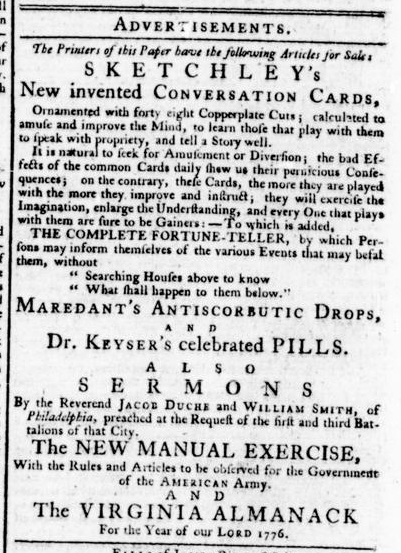
“SKETCHLEY’s New Invented CONVERSATION CARDS.”

Like other newspaper printers, John Dixon and William Hunter provided a variety of goods and services to supplement the revenues from subscriptions and advertisements.  The masthead of the Virginia Gazette solicited customers for “Printing Work done at this Office in the neatest Manner, with Care and Expedition.”  In addition to job printing, they also published books, pamphlets, and almanacs and, according to their advertisement in the October 28, 1775, edition, they even sold patent medicines.  Many colonial printers kept a stock of similar “MAREDANT’S ANTISCORBUTIC DROPS” and “Dr. KEYSER’S celebrated PILLS” on hand, promoting them in their own newspapers.

Hawking yet another product accounted for nearly half of Dixon and Hunter’s advertisement in that issue of the Virginia Gazette: “SKETCHLEY’s New invented CONVERSATION CARDS, Ornamented with forty eight Copperplate Cuts.”  Today, conversation cards serve a variety of purposes.  They can be used for icebreakers at social gatherings, teambuilding exercises for businesses and organizations, or discussion starters among people seeking to explore topics of common interest and forge stronger personal connections.  While consumers may have used Sketchley’s conversation cards in a variety of ways, the advertisement stated that they were “calculated to amuse and improve the Mind, to learn those that play with them to speak with propriety, and tell a Story well.”  In that regard, these cards differed from playing cards for popular games of “Amusement and Diversion” and the “bad Effects of the common Cards” that “daily show us their pernicious Consequences.”  Card games did not have to devolve to the vices of too much luxury and leisure, too much gossip and idle chatter, and too much drinking and gambling.  Sketchley’s conversation cards, “on the contrary, … the more they are played with the more they improve and instruct; they will exercise the Imagination, enlarge the Understanding, and every One that plays with them are sure to be the Gainers.”  In the company of friends, those who used the cards would become more articulate in their speech, more refined in their comportment, and more enlightened in their understanding of the world.

What did consumers acquire when they purchased their own deck of Sketchley’s conversation cards?  Dominic Winter Auctioneers offer this description: “copper engraved playing cards,” measuring 3.75 inches by 2.5 inches, “each with a word [in the] upper margin and [the] associated illustration below.”  The partial set that the auctioneers offered for bids included seventeen cards, such as “Hope,” “Honour,” “Heart,” and “Ruin.”  According to the online auction catalog, those are the only cards from this set known to survive.  “The only other similar, but not identical, set we have been able to trace,” the catalog states, “is that held by the Osborne Collection …, which comprises 52 cards.”  It also features images of sixteen of the cards.  In addition, the catalog notes the advertisement in the Virginia Gazette.  Like most shop signs and many book catalogs, early American newspaper advertisements reveal details that otherwise have been lost because the artifacts do not survive.

By the time that James Sketchley first marketed his “New invented CONVERSATION CARDS” in 1770, he had been producing playing cards for about two decades.  With these cards, he offered an alternative to games of leisure that passed the time with little else to show for it, just as John Ryland had done with a set of “Geographical Cards” that Nichols Brooks advertised in the Pennsylvania Journal in March 1773.  Dixon and Hunter prompted genteel readers and those who aspired to gentility to consider these conversation cards a valuable resource to purchase when their bought they almanac for the coming year or a military manual that included “the Rules and Articles to be observed for the Government of the AMERICAN Army.”
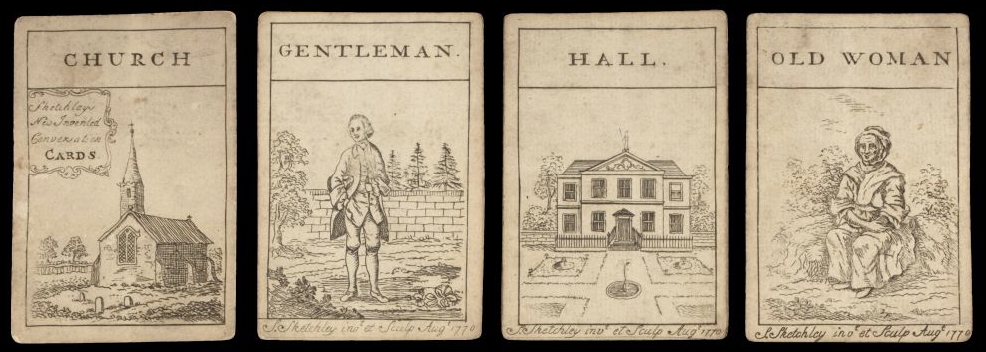
“CHURCH,” “GENTLEMAN,” “HALL,” and “OLD WOMAN,” from Sketchley’s New Invented Conversation Cards (1770).  Courtesy Dominic Winter Auctioneers.

April 9

What was advertised in a colonial American newspaper 250 years ago today?

Providence Gazette (April 9, 1774).

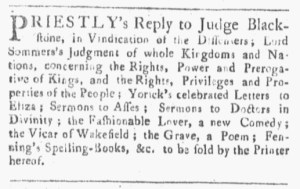
“… to be sold by the Printer hereof.”

Advertisements filled the final column on the third page and the entire last page of the April 9, 1774, edition of the Providence Gazette.  They generated significant revenue for John Carter, the printer, yet not all the advertisements were paid notices.  Like many other printers, Carter used his newspaper to disseminate his own advertisements.  He inserted five of the notices that appeared in that issue.

Those advertisements related to a variety of aspects of operating Carter’s printing office “at Shakespear’s Head, in Meeting-Street, near the Court-House.”  In one, he called on “ALL Persons indebted for this Gazette one Year, or more” and anyone else indebted to him for other services “to make immediate Payment.”  In another, Carter sought a “trusty and well-behaved Lad, about 13 or 14 Years of Age” as “an Apprentice to the Printing Business.”  Candidates needed to be able to “read well, and write tolerably.”  In yet another, a headline in a larger font than anything else in that issue, even the title of the newspaper in the masthead, proclaimed, “RAGS.”  Carter offered the “best Prices … for clean Linen Rags, of any Kind, and old Sail-Cloth, to supply the PAPER MANUFACTORY in Providence.”  The printer intended to recycle rags into paper that he would then use to publish subsequent editions of the Providence Gazette.

Providence Gazette (April 9, 1774).

Other advertisements promoted items for sale at the printing office.  Most printers also sold books.  A few came from their own presses or other colonial presses, but most were imported from England.  Carter listed several titles for readers with diverse interests, from “PRIESTLY’s Reply to Judge Blackstone, in Vindication of the Dissenters” to “the Fashionable Lover, a new Comedy” to “the Grave, a Poem” to “Fenning’s Spelling-Books.”  An “&c.” (an abbreviation for et cetera) indicated that he stocked many more books, pamphlets, and broadsides.  A shorter advertisement stated, “BLANKS of various Kinds to be sold by the Printer hereof.”  Carter printed and sold forms for common legal and commercial transactions.  Even the colophon doubled as an advertisement, informing readers that “all Manner of Printing-Work is performed with Care and Expedition.”

Carter took advantage of his access to the press to tend to the different parts of operating a busy printing office.  While his advertisements did not generate revenue in the same manner as the paid notices placed by merchants, shopkeepers, artisans, estate executors, lottery managers, and others, they supported his business in other ways and some likely resulted in revenue from the sale of books and blanks or the settling of accounts.  Collectively, they gave Carter a very visible presence in the pages of the Providence Gazette.

September 8

What was advertised in a colonial American newspaper 250 years ago this week?

Virginia Gazette [Purdie and Dixon] (September 5, 1771).
“PURDIE and DIXON have imported a fresh Assortment of all Kinds of Paper.”

Like many other colonial printers, Alexander Purdie and John Dixon took advantage of their access to the press to insert advertisements for goods and services they provided in the newspaper they published.  Such was the case in the September 5, 1771, edition of the Virginia Gazette.  Interspersed among the paid notices, the printers included their own advertisement for a vast array of imported goods.

Purdie and Dixon deployed a standard list format, creating a dense block of text.  Within their advertisement, however, they did organize their merchandise according to three main categories:  stationery wares, music, and patent medicines.  Many printers created additional revenue streams by selling books, stationery, and writing equipment.  Purdie and Dixon stocked “a fresh Assortment of all Kinds of Paper, fine large Dutch and Hudson Bay Quills, fine Japan Ink, shining Sand, red and black Dutch Sealing Wax,” and a variety of other items to equip any desk for business or correspondence.  They also carried several pieces of music, including “Midas, the Padlock, and Love in a Village, for the Harpsicord, Voice, German Flute, Violin, or Guitar” and “eight Italian Sonatas for two Violins or Flutes, with a Thorough Bass for the Harpsicord, by several eminent Composers.”  The printers had on hand both popular and genteel selections to suit the tastes of their customers.  Furthermore, most printers and booksellers who included music among their titles did not indicate such an extensive selection.  Purdie and Dixon concluded by enumerating a dozen patent medicines, including many of the most common ones marketed from New England to Georgia.  “Bateman’s Pectoral Drops; Stoughton’s Squire’s, and Daffy’s Elixirs; [and] Turlington’s Balsam” required no further explanation because they were so familiar to consumers.  That may have been one of the reasons that printers frequently supplemented their stock of books and stationery with patent medicines, even if they did not sell other sorts of consumer goods.

Purdie and Dixon’s printing office “at the POST OFFICE” in Williamsburg was a hub for collecting and disseminating information, but it was also a place to go shopping.  They made available a variety of equipment for writing, all kinds of sheet music for entertainment, and an assortment of patent medicines for customers to treat illnesses and chronic conditions.  In addition to the fees they generated for subscriptions, advertising, and job printing, Purdie and Dixon also generated revenues from selling items from select categories of imported goods.

October 6

What was advertised in a colonial American newspaper 250 years ago today?

Oct 6 - 10:6:1769 Connecticut Journal
Connecticut Journal (October 6, 1769).

Just Re-printed, and to be sold by T. & S. GREEN … The Connecticut Colony LAW-BOOK.”

Compared to many other colonial newspapers, the Connecticut Journal and New-Haven Post-Boy carried relatively few advertisements. Thomas Green and Samuel Green founded the publication in 1767. Two years later, advertising remained sparse, comprising less space than in many other newspapers. In that regard, the Connecticut Journal was not much different than other newspapers published in smaller towns in the late colonial era. While newspapers in the busiest urban ports – Boston, Charleston, New York, and Philadelphia – overflowed with advertising and even those in places like Portsmouth, Providence, and Savannah usually filled at least an entire page with advertising, the Connecticut Journal, the Essex Gazette, and the New-London Gazette regularly devoted less space to advertising than their counterparts in larger cities and towns.

Consider the October 6, 1769, edition of the Connecticut Journal. Only ten advertisements appeared in that issue, all of them on the final page. They did not even fill that page. Of the three columns, two consisted of advertising. One short advertisement ran at the bottom of the first column. Revenues from advertising, rather than subscriptions, often made publishing newspapers viable business ventures for colonial printers. The Greens, however, did not cultivate the same culture of advertising in the Connecticut Journal that emerged in other publications. On the other had, they did pursue a strategy that put their business practices in line with those of other printers: they took advantage of their access to the press to promote their own wares. Newspaper printers frequently inserted one or more advertisements for books, pamphlets, blanks, and other merchandise, simultaneously seeking to stimulate demand for other segments of their operations and attempting to convince prospective advertisers of the advantages of advertising. Of the ten advertisements in the October 6 issue, two announced that the Greens sold books at their printing office. Not all of the advertisements in that issue were paid notices that generated revenues for the Connecticut Journal; the Greens used that space to bolster their business in other ways. With relatively few advertisements submitted by others, they resorted to publishing their own.