December 15

What was advertised in a revolutionary American newspaper 250 years ago today?
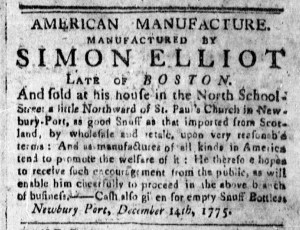
Essex Journal (December 15, 1775).

“Manufactures of all kinds in America tend to promote the welfare of it.”

In December 1775, Simon Elliott took to the pages of the Essex Journal, printed in Newburyport, Massachusetts, to promote the snuff that he made in that town.  He published his advertisement as the siege of Boston continued, much of the copy testifying to the imperial crisis that had become a war with the skirmishes at Lexington and Concord the previous April.

The advertisement featured an elaborate headline.  Indeed, it had a primary headline and a secondary headline, like many other newspaper advertisements.  Elliot’s name, centered and all in capital letters of a larger font than anything else in that issue of the Essex Journal except the name of the newspaper in the masthead, demanded attention.  It was the second line of three, the other two also centered and in capital letters but smaller fonts: “MANUFACTURED BY / SIMON ELLIOT / LATE OF BOSTON.”  A secondary headline, “AMERICAN MANUFACTURE,” appeared above the headline that made Elliot’s name so prominent.

Like so many other artisans when they moved to new towns and introduced themselves to prospective customers, Elliot mentioned his origins.  Usually, “OF BOSTON” sufficed, but in this instance “LATE OF BOSTON” likely indicated that he had been displaced from that city recently.  Many residents chose to leave following the outbreak of hostilities.  In the early days of the siege of Boston, the Sons of Liberty and General Gage negotiated an exchange that allowed Loyalists to enter and others to depart.  In the following months, newspapers throughout New England carried advertisements by entrepreneurs “from Boston,” a diaspora of refugees displaced at the beginning of the Revolutionary War.

In addition to signaling the hardships he recently faced, Elliot also promoted the quality of the snuff that he made in Newburyport, asserting it was “as good Snuff as that imported from Scotland.”  That was no small claim since tobacco processed into snuff in Scotland had a superior reputation at the time.  Yet Elliot had more to say about his “AMERICAN MANUFACTURE” and why consumers should favor it over others.  Echoing the Continental Association, a nonimportation agreement devised by the First Continental Congress, and popular discourses of the last decade, Elliot declared that “as manufactures of all kinds in America tend to promote the welfare of it: He therefore hopes to receive such encouragement from the public” to support his new enterprise.  Supporters of the American cause, he suggested, had a civic duty to purchase the snuff that he made in Newburyport as well as support other entrepreneurs who produced domestic manufactures.
June 29

What was advertised in a revolutionary American newspaper 250 years ago today?

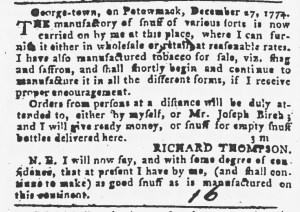
Maryland Gazette (June 29, 1775).

“THE manufactory of snuff of various sorts is now carried on by me at this place.”

On the eve of the American Revolution, Richard Thompson attempted to establish a market for snuff produced in Virginia.  In “The Beginnings of Tobacco Manufacture in Virginia,” Jacob M. Price argues that “there is not even a hint of a local manufacture” of snuff in Virginia from the middle of the 1730s through the late 1760s.  Most of the snuff came from Great Britain with  occasional “bottles, boxes, and kegs of snuff … appear from time to time in notices of arriving cargoes from Antigua, Boston, New York, and Salem.”  According to Price, Thompson “moved his business from Bladensburg [Maryland] to the falls of the Potomac and tried to crash the Virginia market in 1772,” placing a lengthy advertisements in the October 8 edition of William Rind’s Virginia Gazette.  “Little more is known,” Price continues, “of this early Maryland industrial pioneer and of his seemingly premature efforts to introduce a ‘patriotic’ tobacco and snuff manufacture into the Chesapeake.”[1]

An advertisement in the June 29, 1775, edition of the Maryland Gazette, published in Annapolis, reveals that Thompson continued to produce snuff at “George-town, on the Potowmack” at that time.  The “manufactory of snuff of various sorts is now carried on by me at this place,” Thompson proclaimed, “where I can furnish it either in wholesale or retail, at reasonable rates.”  In addition, Thompson had “manufactured tobacco for sale, viz. shag and saffron, and shall shortly begin and continue to manufacture it in all the different forms, if I receive proper encouragement.”  According to the date on the advertisement, Thompson first asked for that encouragement on December 27, 1774, no doubt hoping that the Continental Association, a nonimportation agreement devised by the First Continental Congress in response to the Coercive Acts, created favorable conditions for snuff produced in the colonies.  Patriotic colonizers had an obligation to support his enterprise, to give him that “proper encouragement,” but they did not have to settle for a product inferior to snuff produced elsewhere in the colonies.  In a nota bene, Thompson declared, “I will now say, and with some degree of confidence, that at present I have by me, (and shall continue to make) as good snuff as is manufactured on this continent.”  Even if his business got off to a rocky start, as Price suggests, Thompson asserted that he made improvements over time.  He composed his advertisement less than a month after the Continental Association went into effect (and a notation, “3m,” indicated that it would appear in the Maryland Gazette for three months), yet apparently decided that the time was right to revive it more than six months later after learning of the battles at Lexington and Concord.  Those battles and the events that followed meant that friends of the American cause, after all, had even more reason to support his endeavor.

**********

[1] Jacob M. Price, “The Beginnings of Tobacco Manufacture in Virginia,” Virginia Magazine of History and Biography 64, no. 1 (January 1956): 9, 12, 14.

June 13

What was advertised in a colonial American newspaper 250 years ago today?

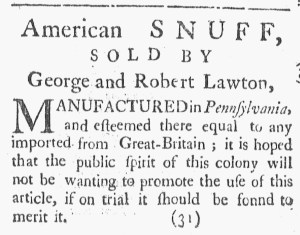
Supplement to the Newport Mercury (June 13, 1774).

“American SNUFF … MANUFACTURED in Pennsylvania.”

George Lawton and Robert Lawton advertised “American SNUFF” in the Newport Mercury as colonizers from New England to Georgia discussed how to respond to the Boston Port Act, legislation that closed the harbor as punishment for the destruction of tea in December 1773.  Simultaneously, newspapers covered other abuses perpetrated by Parliament.  The June 13, 1774, edition of the Newport Mercury, for instance, featured “A BILL for better regulating the Government of the Province of the Massachusetts-Bay, in North-America” and “A BILL for the impartial Administration of Justice in the Cases of Persons questioned for any Acts, done by them in the Execution of the law, or for the Suppression of Riots & Tumults in the Province of the Massachusetts-Bay, in New-England.”  Although neither had yet been passed when the ship that carried them departed from Bristol more than five weeks earlier, the printer, Solomon Southwick, noted “there is no doubt of their having passed before this time.”  In colorful commentary, he added that “the — [devil] himself can suggest nothing too horrid to be expected from the present administration.”  Another note followed the second bill: “God save the PEOPLE from such Laws!

It was in that context that the Lawtons marketed “American SNUFF … MANUFACTURED in Pennsylvania” as an alternative to snuff imported from Great Britain.  They asserted that consumers in Pennsylvania “esteemed” this snuff “equal to any imported,” so customers did not have to sacrifice quality in their support of “domestic manufacturers,” goods produced in the colonies.  The Lawtons presented trying this snuff as the patriotic duty of consumers who had concerns about current events.  “[I]t is hoped,” they implored, “that the public spirit of this colony will not be wanting to promote the use of this article, if on trial it should be fo[u]nd to merit it.”  In other words, the Lawtons encouraged prospective customers to try the snuff, taking into account the endorsements from colonizers in Pennsylvania, and see for themselves if they liked it as much as imported snuff.  If they did, their subsequent purchases could serve two purposes: acquiring a product they enjoyed while putting political principles into practice.  In many places, colonizers already discussed another round of nonimportation agreements, drawing on a strategy deployed in response to the Stamp Act and the Townshend Acts.  Immediately above the Lawtons’ advertisement, the resolutions from “a town meeting held at Providence” called for “an universal stoppage of all trade with Great-Britain, Ireland, Africa, and the West-Indies” until Parliament opened Boston Harbor once again.  Colonizers sought to use commerce for political leverage.  Similarly, decisions about which products to consume had political implications.  Even with no boycott currently in place, the Lawtons encouraged consumers to think about how they could support the colonies in their contest against Parliament.