June 21

What was advertised in a revolutionary American newspaper 250 years ago today?
Massachusetts Spy (June 21, 1776).

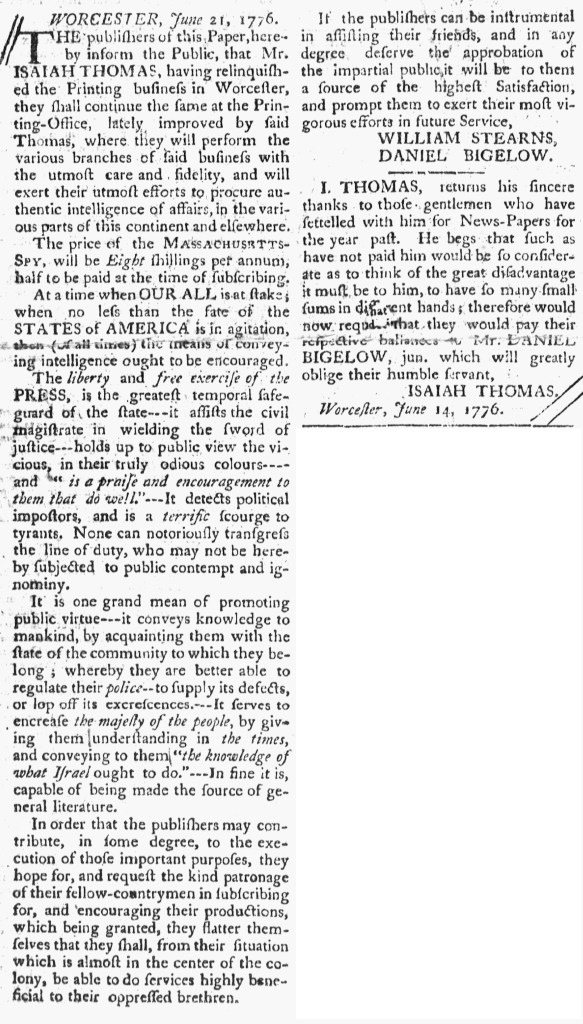
“ISAIAH THOMAS, having relinquished the Printing business in Worcester.”

The title changed from Thomas’s Massachusetts Spy to The Massachusetts Spy with issue “NUMB. 269” on June 21, 1776.  Two months earlier, Isaiah Thomas informed readers that he intended to remain in Worcester “for the present,” but since then he decided to pursue new opportunities in Salem.  He previewed that decision in a notice in the May 31 edition, the last one he published.  In a lengthy address on the first page, William Stearns and Daniel Bigelow, the new “publishers of this Paper,” informed the public that Thomas “relinquished the Printing business in Worcester” to them.  They now occupied the printing office “near the COURT-HOUSE,” where they undertook “the various branches of said business with the utmost care and fidelity, and will exert their utmost efforts to procure authentic intelligence of affairs, in the various parts of this continent and elsewhere.”  They hoped to attract customers for job printing as well and maintain and expand their subscribers.

The title shifted slightly, but the subtitle, American Oracle of Liberty, remained the same.  Stearns and Bigelow made their editorial stance clear in their address.  “At a time when OUR ALL is at stake, when no less than the fate of the STATES of AMERICA is in agitation,” they proclaimed, “then (of all times) the means of conveying intelligence ought to be encouraged.”  That meant that subscribers had a duty to continue to subscribe and others had a responsibility to support Worcester’s only newspaper by becoming subscribers, placing advertisements, and sharing news as they received it in letters and by other means.  In turn, the printers would do their civic duty.  “The liberty and free exercise of the PRESS,” Stearns and Bigelow continued, “is the greatest temporal safeguard of the state—it assists the civil magistrate in wielding the sword of justice—holds up to public view the vicious, and in their odious colours— … —It detects political impostors, and is a terrific scourge to tyrants.”  Readers could expect the same vigilance and advocacy for the American cause from Stearns and Bigelow that Thomas had a reputation for delivering.

Following Stearns and Bigelow’s address, Thomas inserted a brief notice in which he expressed “sincere thanks to those gentlemen who have settelled with him for News-Papers for the year past.”  The spelling error may have been an actual error rather than an eighteenth-century variation.  Despite their pledge to “do services highly beneficial to their oppressed brethren” in central Massachusetts, their skill as printers paled in comparison to Thomas.  For his part, the printer did not offer words of encouragement or general expressions of gratitude as he departed Worcester.  After thanking subscribers who already settled accounts, he called on those who still owed to “pay their respective balances” to Stearns and Bigelow.  After a hiatus of three weeks, a new issue of the Massachusetts Spy carried news (and a couple of advertisements) to readers.  When news of the Declaration of Independence reached Worcester about three weeks later, Thomas may (or may not) have made the first public reading in New England, but he no longer ran his own newspaper.  He published an account of the battles at Lexington and Concord in the first edition of the Massachusetts Spy printed in Worcester, but now others would cover the Declaration of Independence and its reception in the commonwealth of Massachusetts and other states.

June 17

What was advertised in a revolutionary American newspaper 250 years ago today?

Boston-Gazette (June 17, 1776).

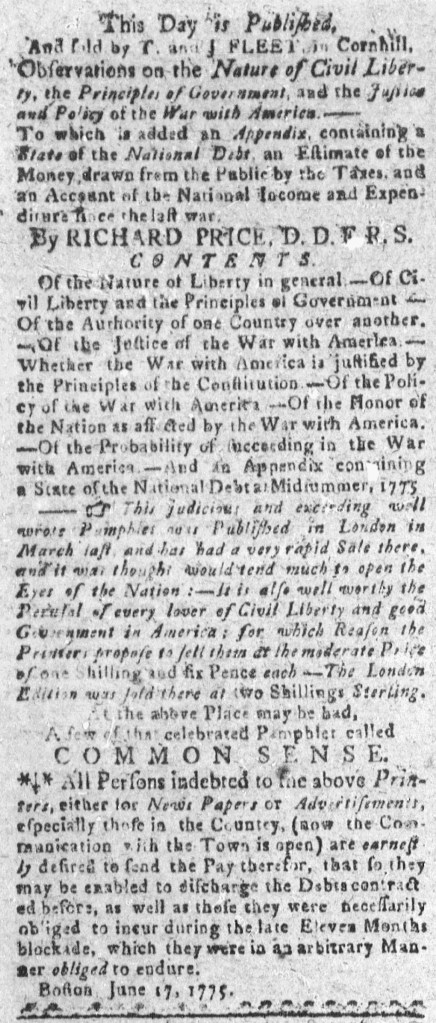
It is also well worthy the Perusal of every lover of Civil Liberty and good Government in America.”

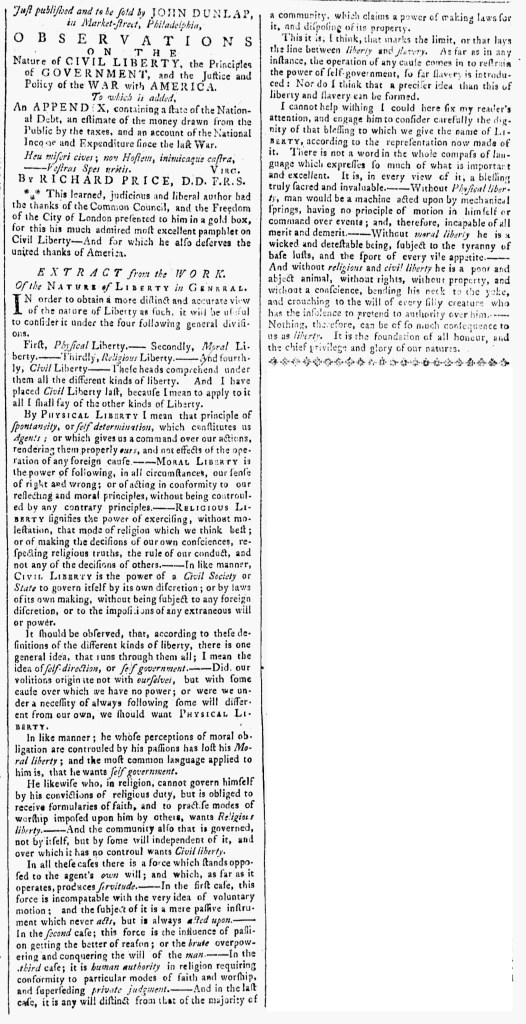
In June 1776, Thomas Fleet and John Fleet announced that they published a Boston edition of Richard Price’s Observations on the Nature of Civil Liberty, the Principle of Government, and the Justice and Policy of the War with America.  Like many other advertisements for books and pamphlets, their notice included an overview of the contents to entice prospective customers with a preview of what they would encounter when they purchased and read the work.  Section headings included “Of the Nature of Liberty in general,” “Whether the War with America is justified by the Principles of the Constitution,” and “Of the Honor of the Nation as affected by the War with America.”

Yet the Fleets did not leave it at that.  They also composed their own address to the public, drawing attention to it with a manicule.  “This judicious and exceeding well wrote Pamphlet,” they reported, “was Published in London in March last and has had a very rapid Sale there.”  The arguments presented combined with the popularity of the pamphlet, the Fleets explained, “was thought would tend much to open the Eyes of the Nation.”  The pamphlet demonstrated that the American cause had supporters on the other side of the Atlantic, though its publication did not have as much impact on policy as the Fleets suggested that it deserved.  Despite that disappointment, the Fleets considered the pamphlet “well worthy the Perusal of every lover of Civil Liberty and good Government in America.”  That being the case, the Fleets sold copies of their Boston edition “at the moderate Price of one Shilling and six Pence each” instead of the “two Shillings Sterling” that printers in London charged for copied printed there.

During the years that they published the Boston Evening-Post before the battles at Lexington and Concord, the Fleets did not gain the same reputation for advocating for the American cause as Benjamin Edes and John Gill, the printers of the Boston-Gazette, and Isaiah Thomas, the printer of the Massachusetts Spy.  The outbreak of the war may have caused them to stake a stronger position, though they may have also aimed to generate revenue in a city that the British had occupied for nearly a year and departed only a few months earlier.  They followed their promotion of Price’s pamphlet with a reminder that they stocked “A few of that celebrated Pamphlet called COMMON SENSE,” another work embraced by the Patriots who remained in Boston after British forces and their Loyalist supporters evacuated from the city.  The Fleets collaborated with the Edes and Gill in publishing and selling Thomas Paine’s influential political pamphlet.  Even though their advertisement did not necessarily reveal their political principles, the Fleets sought to activate the political principles of their prospective customers to sell their Boston edition of Observations on the Nature of Civil Liberty, the Principle of Government, and the Justice and Policy of the War with America.

June 13

What was advertised in a revolutionary American newspaper 250 years ago today?

New-England Chronicle (June 13, 1776).

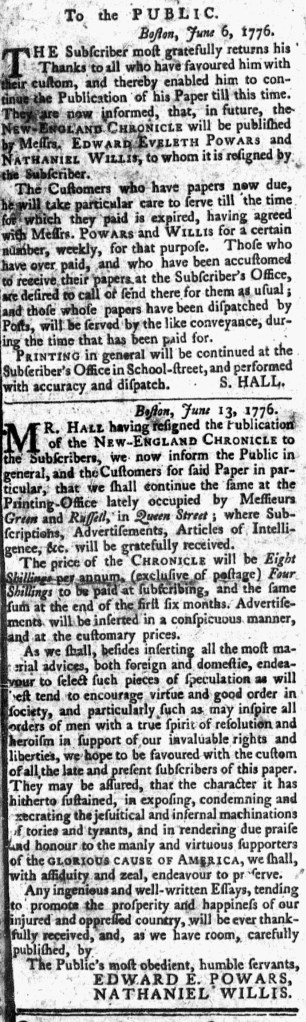
“Rendering due praise and honour to the manly and virtuous supporters of the GLORIOUS CAUSE OF AMERICA.”

It was the first issue of the New-England Chronicle published by Edward E. Powars and Nathaniel Willis after Samuel Hall transferred the newspaper to them.  Their names appeared in the colophon integrated into the masthead at the top of the first page: “BOSTON: Printed by POWARS and WILLIS at their Office opposite the new COURT-HOUSE, Queen-Street.”  For the first order of business in the June 13, 1776, edition, the former printer and the new printers reminded readers about the transition in notices that ran in the first column on the first page.  They previously made the announcement in separate advertisements in the last issue.  Hall’s notice ran again without revisions or additions (except for a salutation, “To the PUBLIC,” and the original date, “Boston, June 6, 1776”) while Powars and Willis took the opportunity to add to their previous advertisement.

In so doing, they vowed to continue the editorial stance practiced by Hall.  The public, Powars and Willis promised, “may be assured, that the character [the New-England Chronicle] has hitherto sustained, in exposing, condemning, and execrating the jesuitical and infernal machinations of tories and tyrants, and in rendering due praise and honour to the manly and virtuous supporters of the GLORIOUS CAUSE OF AMERICA, we shall, with assiduity and zeal, endeavour to preserve.”  The New-England Chronicle catered to Patriots in Boston less than two months after the siege of that city ended when British troops departed on March 17.  Powars and Willis took their responsibilities seriously, stating that they would “select such pieces … as will best tend to encourage virtue and good order in society, and particularly such as may inspire all orders of men with a true spirit of resolution and heroism in support of our invaluable rights and liberties.”  With such promises made, they hoped “to be favoured with the custom of all the late and present subscribers of this paper.”  In other words, they encouraged readers who previously subscribed to renew their subscriptions and current subscribers to continue receiving the New-England Chronicle.  Their previous notice solicited subscribers and advertisers.  That portion appeared again, but this time the printers also requested “ingenious and well-written Essays, tending to promote the posterity and happiness of our injured and oppressed country.”  Through an eighteenth-century version of crowdsourcing, the public could play a role in maintaining the editorial voice that readers expected from the New-England Chronicle.  The publication had new printers, but those new proprietors pledged that the newspaper would remain the same.

June 12

What was advertised in a revolutionary American newspaper 250 years ago today?

Pennsylvania Journal (June 12, 1776).

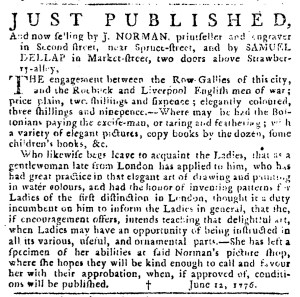
“THE engagement between the Row-Gallies of this city, and the Roebuck and Liverpool English men of war.”

John Norman, an engraver from London, sold prints at his shop on Second Street in Philadelphia.  He also gained acclaim as the publisher of American editions of architectural manuals for which he engraved the images, but it was the prints available at his shop that he advertised in the June 12, 1776, edition of the Pennsylvania Journal.

One print showed the “engagement between the Row-Gallies of this city, and the Roebuck and Liverpool English men of war.”  It depicted a recent battle familiar to residents of Philadelphia and its hinterland.  In March, the Roebuck and the Liverpool blockaded the mouth of the Delaware Bay, eliminating access to the Delaware River and Philadelphia.  The American Revolution’s first battle on the Delaware River occurred on May 8 and 9 when the British frigates sailed up the river.  Thirteen row galleys built by the Pennsylvania Committee of Safety in 1775 repulsed the Roebuck and the Liverpool, demonstrating that the smaller yet agile boats could hold their own against the warships in shallow waters.  The outcome boosted the morale of Patriots in Philadelphia and beyond.  Norman proclaimed that the print was “JUST PUBLISHED” and available for sale (for two shillings and six pence plain or for three shillings and nine pence “elegantly coloured”) less than five weeks after the battle.  He likely did the engraving himself.

He did not, however, engrave “the Bostonians paying the excise-man, or taring and feathering” and many others from the “variety of elegant pictures” he sold.  Instead, he imported most of thoseThe Bostonians Paying the Excise-Man, or Tarring & Feathering was one of five satirical prints engraved by Philip Dawe, printed by Robert Sayer and John Bennett, and sold in both England and the colonies.  The series included The Alternative of Williams-Burg, The Bostonians in Distress, The Patriotick Barber of New York, of the Captain in the Suds, and A Society of Patriotic Ladies, at Edenton in North Carolina.  Although some supporters of the American cause may have embraced these images, Dawe included details that critiqued or mocked their acts of resistance.  The depictions of the women signing a nonimportation agreement in A Society of Patriotic Ladies, for instance, demeaned them as silly, stupid, or disturbingly masculine.  An unattended child dumps a platter of food on the floor as a dog licks its face and urinates on a tea canister, suggesting that the women abandoned their appropriately feminine roles to participate in politics they did not understand.  In Bostonians Paying the Excise-Man, five men dumping tea into the harbor can be seen in the background as Patriots force tea down the throat of John Malcom, a Loyalist tax collector, beneath the city’s Liberty Tree.  A noose hangs from one branch, commenting on the brutality of the Patriots and their methods.  Yet not all viewers necessarily agreed that the Patriots had gone too far.  Some of Norman’s customers in Philadelphia may have appreciated that image of the Boston Tea Party and subsequent events, just as they celebrated the row galleys forcing the Roebuck and the Liverpool to retreat.

May 23

What was advertised in a revolutionary American newspaper 250 years ago today?

New-York Journal (May 23, 1776).

“AN ORATION, Delivered … on the Re-Interment of the Remains of … JOSEPH WARREN.”

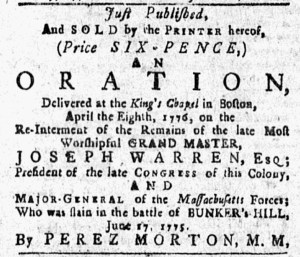
Joseph Warren was an American hero, not just a hero in Massachusetts.  That was part of the point of the proliferation of local editions of the oration that Perez Morton delivered “on the Re-Interment of the Remains of the late Most Worshipful GRAND MASTER, … President of the late CONGRESS of this Colony, AND MAJOR-GENERAL of the Massachusetts Forces; Who was slain in the battle of BUNKER’s HILL, [on] June 17, 1775.”  When the siege of Boston ended with the departure of British forces on March 17, 1776, Warren’s brothers searched for his body.  After identifying it by an artificial tooth, they arranged for a Masonic funeral and burial in the Granary Burial Ground.  A few weeks later, John Gill advertised Morton’s oration from the occasion.  It met with such demand that he issued a second edition.

Yet Gill was not the only printer to publish, advertise, and distribute the oration in memory of Warren.  John Dunlap, the printer of Dunlap’s Pennsylvania Packet, produced an edition in Philadelphia.  Simultaneously, John Holt, the printer of the New-York Journal, published yet another edition.  Advertisements for the various local editions featured nearly identical copy drawn from the extensive title of the oration.  Not only did that relieve the printers of composing their own advertisements, but it also provided readers in New England, New York, and Pennsylvania with a succinct overview of Warren’s most significant achievements, his commitment as a Patriot, and the sacrifice he made for the American cause.  As the war entered its second year and more colonizers advocating for declaring independence rather than seeking redress of grievances within the imperial system, newspapers throughout the colonies regularly carried letters, resolutions, and other items that made John Hancock, the president of the Second Continental Congress, and George Washington, the commander of the Continental Army, known far and wide.  Yet the movement benefited from having even more heroes for Patriots to venerate.  The local editions of Morton’s oration in memory of Warren and the advertisements for in newspapers that circulated far beyond Boston, New York, and Philadelphia played a part in constructing a pantheon of American heroes.

March 25

What was advertised in a revolutionary American newspaper 250 years ago today?

New-York Gazette and Weekly Mercury (March 25, 1776).

“Work in the jewellery way … all sorts of silver-smiths work.”

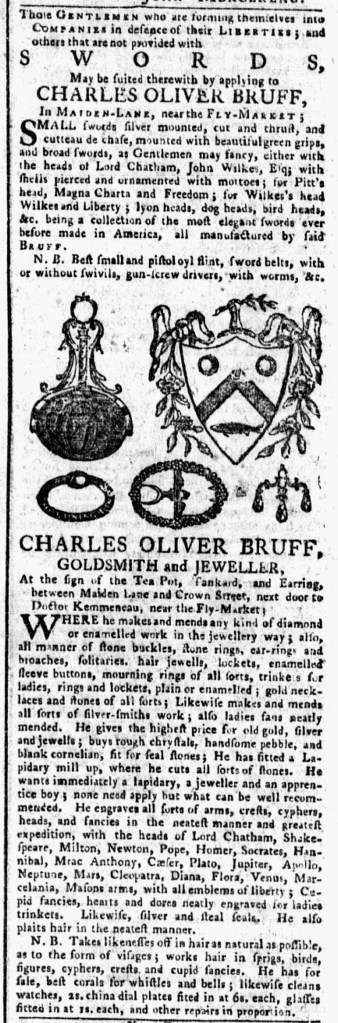
By the time that Charles Oliver Bruff, a goldsmith and jeweler, placed his advertisement in the March 25, 1776, edition of the New-York Gazette and Weekly Mercury he was a veteran advertiser with at least a decade of experience running notices in the public prints in New York.  While little direct evidence about the effectiveness of advertising in early America exists, the fact that Bruff repeatedly invested in marketing suggests that he believed that it worked and considered it worth the investment.  Indeed, his latest advertisement consisted of two advertisements.  The copy for the first one ran as its own notice in the Constitutional Gazette more than six months earlier.  As the first anniversary of the battles at Lexington and Concord approached, Bruff once again offered swords to “Those GENTLEMEN who are forming themselves into COMPANIES in defence of their LIBERTIES.”

Bruff may have considered advertising effective because he did more than merely announce that he had goods for sale.  Instead, he carefully crafted appeals to consumers, encouraging them to purchase his wares.  As he targeted prospective customers “forming themselves into COMPANIES,” for instance, he adorned them with likenesses of British politicians who advocated for the American colonies and corresponding mottoes, including “[William] Pitt’s head, Magna Charta and Freedom” and “[John]Wilkes’s head[,] Wilkes and Liberty.”  He also underscored that the words he stocked were “made in America, all manufactured by said BRUFF.”  When nonimportation agreements became one of the primary strategies for practicing politics, Bruff and other entrepreneurs marketed goods produced in the colonies.

The goldsmith and jeweler also deployed visual images to promote his business.  He advised readers that he kept shop “At the sign of the Tea Pot, Tankard, and Earring,” but they likely noticed the woodcut that adorned his advertisement before anything else.  It featured several of the items available at his shop, including a handheld looking glass with an ornate handle and frame, a ring, a buckle, and an earring.  The image also included an elaborate coat of arms.  A shield decorated with two silver balls, a chevron, and a fish was in the center.  A hand grasping a sheaf of wheat appeared above the shield.  Ribbons cascaded over the side, giving way to leaves and flowers.  The ornate woodcut corresponded to an appeal that Bruff made in the second of those advertisements combined into a single lengthy advertisement: “He engraves all sorts of arms, crests, cyphers, heads, and fancies in the neatest manner.”  For good measure, he reminded prospective customers that he also engraved “all emblems of liberty” on jewelry and other items.

In addition to his “work in the jewellery way” and “silver-smiths work,” Bruff provided other services to entice customers into his shop.  He cleaned watches, installed new glass, and made other repairs at reasonable prices and even “works hair in springs, birds, figures, cyphers, crests and cupid fancies” and “plaits hair in the neatest manner.”  Bruff made his advertisements worth the investment by developing a variety of appeals to consumers and promising an array of goods and services to encourage them to visit his shop.

December 13

What was advertised in a revolutionary American newspaper 250 years ago today?

Connecticut Journal (December 13, 1775).

“FOUR different Views of the BATTLES of LEXINGTON, [and] CONCORD.”

The marketing of memorabilia that commemorated events associated with the American Revolution began before the Second Continental Congress declared independence.  Shortly after the Boston Massacre, for instance, Paul Revere, Henry Pelham, and others produced and advertised images depicting the “BLOODY MASSACRE perpetrated in King-Street.”  Revere also marketed a “Copper-Plate PRINT, containing a View of Part of the Town of Boston in New-England, and British Ships of War landing their Troops in the Year 1768.”  As the imperial crisis intensified, Charles Reak and Samuel Okey advertised a print depicting “that truly staunch Patriot, the Hon. SAMUEL ADAMS, of Boston.”  The production of commemorative items accelerated following the battles at Lexington and Concord in April 1775 and the Battle of Bunker Hill in June 1775.

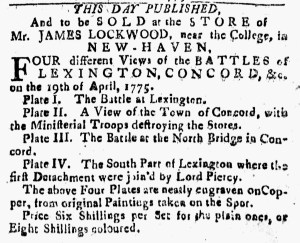
In December 1775, James Lockwood advertised “FOUR different Views of the BATTLES of LEXINGTON, CONCORD, &c. on the 19th of April, 1775.”  He provided a short description of each: “The Battle at Lexington,” “A View of the Town of Concord with the Ministerial Troops destroying the Stores,” “The Battle at the North Bridge in Concord,” and “The South Part of Lexington where the first Detachment were join’d by Lord Percy.”  Lockwood promoted both the quality and accuracy of the prints, noting that the “Four Plates are neatly engraved on Copper, from original Paintings taken on the Spot.”  He almost certainly stocked and sold a series of prints engraved by Amos Doolittle based on paintings by Ralph Earl.  Although Lockwood may have sold the prints separately on request, he promoted them as a package, charging six shillings for as set of “the plain ones” or eight shillings for “coloured” prints.  This collection of prints supplemented news coverage of the battles, helping educate colonizers about recent events, yet many consumers may have desired them as symbols of their patriotism and support of the American cause to display in their homes and offices.  During the first year of the Revolutionary War, the marketing of images that celebrated Americans who defended their towns and their liberties likely encouraged some colonizers to imagine declaring independence rather than merely seeking a redress of grievances.

December 12

What was advertised in a revolutionary American newspaper 250 years ago today?

Pennsylvania Evening Post (December 12, 1775).

“HARE’s and Co. best DRAUGHT and BOTTLED AMERICAN PORTER.”

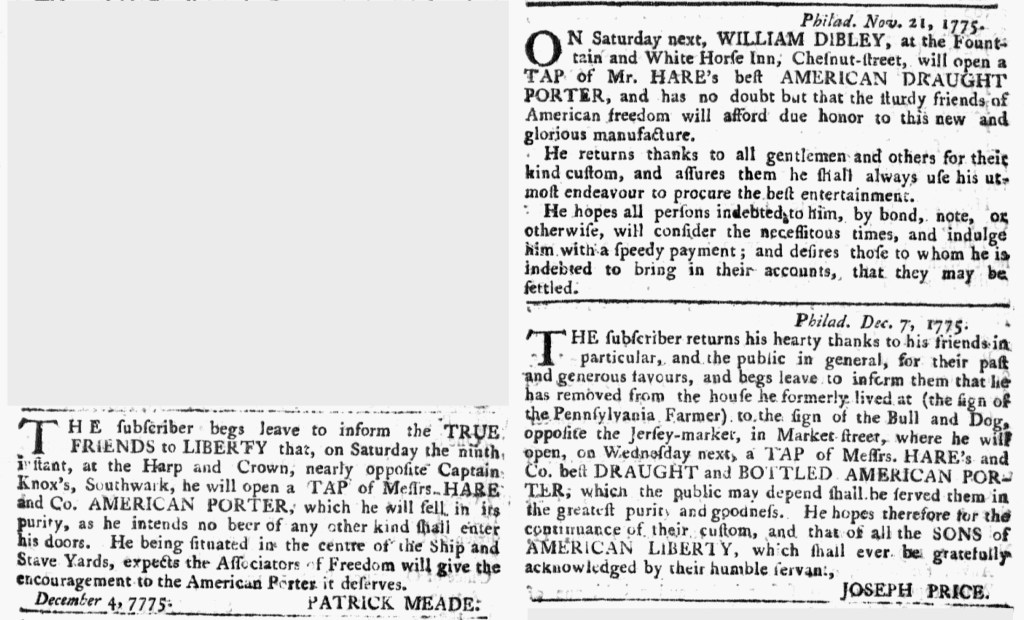
In December 1775, Philadelphia tavernkeeper Joseph Price ran an advertisement to express his gratitude to “his friends in particular, and the public in general,” while simultaneously alerting them that he had moved to a new location.  They could now find him at “the sign of the Bull and Dog” on Market Street rather than at “the sign of the Pennsylvania Farmer.”  To entice readers to visit his new location, he announced that “he will open … a TAP of Messrs. HARE’s and Co. best DRAUGHT and BOTTLED AMERICAN PORTER, which the public may depend shall be served them in the greatest purity and goodness.”

Price was not the only tavernkeeper promoting Hare and Company’s American porter, nor was he the only one associating that beer with support for the American cause.  He proclaimed that he “hopes … all the SONS of AMERICAN LIBERTY” would affirm their commitment by choosing Hare and Company’s American porter.  Price joined two other tavernkeepers who already promoted that brew.  All three of them placed advertisements in the December 12, 1775, edition of the Pennsylvania Evening Post.  William Dibley’s advertisement ran immediately above Price’s notice.  He confidently declared that he “has no doubt but that the sturdy friends of American freedom will afford due honor to this new and glorious manufacture.”  Immediately to the left of Price’s advertisement, Patrick Meade stated that he “expects the Associators of Freedom will give the encouragement to the American Porter it deserves.”  Readers who did not know much about Hare and Company’s American porter encountered endorsement after endorsement, encouraging them to take note of a beer that local tavernkeepers promoted over any others.  Tavernkeepers usually did not mention which brewers supplied their beer, making these advertisements even more noteworthy.  For their part, Hare and Company did not need to do any advertising of their own when they had such eager advocates for their American porter encouraging the public to demonstrate their political principles through the choices they made when they placed their orders at taverns in Philadelphia and nearby Southwark.

December 9

What was advertised in a revolutionary American newspaper 250 years ago today?

Pennsylvania Evening Post (December 9, 1775).

“He will open a TAP of Messrs. HARE’s and Co. AMERICAN PORTER.”

Patrick Meade aimed to create some anticipation among prospective patrons who might visit his tavern, the Harp and Crown, in Southwark on the outskirts of Philadelphia.  In an advertisement that first appeared in the Pennsylvania Evening Post on December 5, 1775, he announced that “on Saturday the ninth … he will open a TAP of Messrs. HARE and Co. AMERICAN PORTER.”  Hare and Company had been building a reputation for their brew.  Two weeks earlier, William Dibley, the proprietor of the Fountain and White Horse Inn in Philadelphia, advertised that he “will open a TAP of Mr. HARE’s best AMERICAN DRAUGHT PORTER.”  Meade’s advertisement ran again on December 9, the day he tapped the celebrated porter.

Meade and Dibley deployed similar marketing strategies to entice “gentlemen and others” to visit their establishments and drink Hare and Company’s porter.  Dibley proclaimed that he “has no doubt but that the sturdy friends of American freedom will afford due honor to this new and glorious manufacture.”  Meade addressed “the TRUE FRIENDS to LIBERTY” and emphasized his location, “situated in the center of the Ship and Stave Yards,” and declared that he “expects the Associators of Freedom will give the encouragement to the American Porter it deserves.”  Meade went all in on promoting Hare and Company’s porter, asserting that “he intends no beer of any other kind shall enter his doors,” especially not porters and other beers imported from England.  The tavernkeeper made a porter brewed in America the exclusive choice for his patron, likely expecting that the lack of other options mattered less to prospective patrons when they gather to drink, socialize, and discuss politics and current events than demonstrating their patriotism by consuming a porter brewed in America.  Meade stated that he would sell Hare and Company’s “AMERICAN PORTER … in its purity,” signaling the quality of the beverage.  Meade issued both an invitation and a challenge: who could desire any beer other than one brewed in America in support of the American cause?

November 30

What was advertised in a revolutionary American newspaper 250 years ago today?

New-York Journal (November 30, 1775).

“A neat Mezzotinto Print of the Hon. JOHN HANCOCK, Esq.”

Richard Sause, a cutler in New York, became a purveyor of patriotic memorabilia during the Revolutionary War.  In October 1775, he advertised “ROMAN’s MAP OF BOSTON,” billing it as “one of the most correct that has ever been published.”  He described the cartographer, Bernard Romans, as “the most skilful Draughtsman in all America,” noting that he earned credibility because he “was on the spot at the engagements of Lexington and Bunker’s-Hill.”  Nicholas Brooks, a shopkeeper who specialized in prints, and Romans collaborated on the project in Philadelphia.  Sause acted as a local agent for marketing and distributing the map in New York.

That was not the only item commemorating current events that Sause advertised and sold.  At the end of November 1775, he took to the pages of the New-York Journal once again, informing the public that he sold a “neat Mezzotinto Print of the Hon. JOHN HANCOCK, Esq.”  The print depicting the merchant from Boston who served as president of the Second Continental Congress was another one of Brooks’s projects.  In addition, Sause also stocked “a view of the BATTLE at Charlestown” and “an accurate Map of the Present Seat of Civil War, taken by an able Draftsman.”  Sause seemingly worked closely with Brooks in acquiring the various prints and marketing them to patriots in New York, perhaps even providing him with advertising copy to adapt for his own notices.  The prints that Sause offered for sale appeared in the same order in his advertisement in the New-York Journal that they did in Brooks’s advertisement in Pennsylvania Journal.  Brooks may have sent a clipping along with the prints that he dispatched to the cutler in New York.

Although Sause had established himself as a cutler who also sold hardware and jewelry in a series of advertisements in New York’s newspapers, his activities in the marketplace in 1775 emphasized his commitment to the American cause.  Before he began selling prints, he promoted “SMALL SWORDS” to gentlemen who anticipated participating in the defense of their liberties and their city.  Even though he continued to advertise an “assortment of Jewellery, Cutlery, Hardware, and Haberdashery,” he made items related to the conflict with Parliament and British troops quartered in the colonies the focal point of his advertisements.